
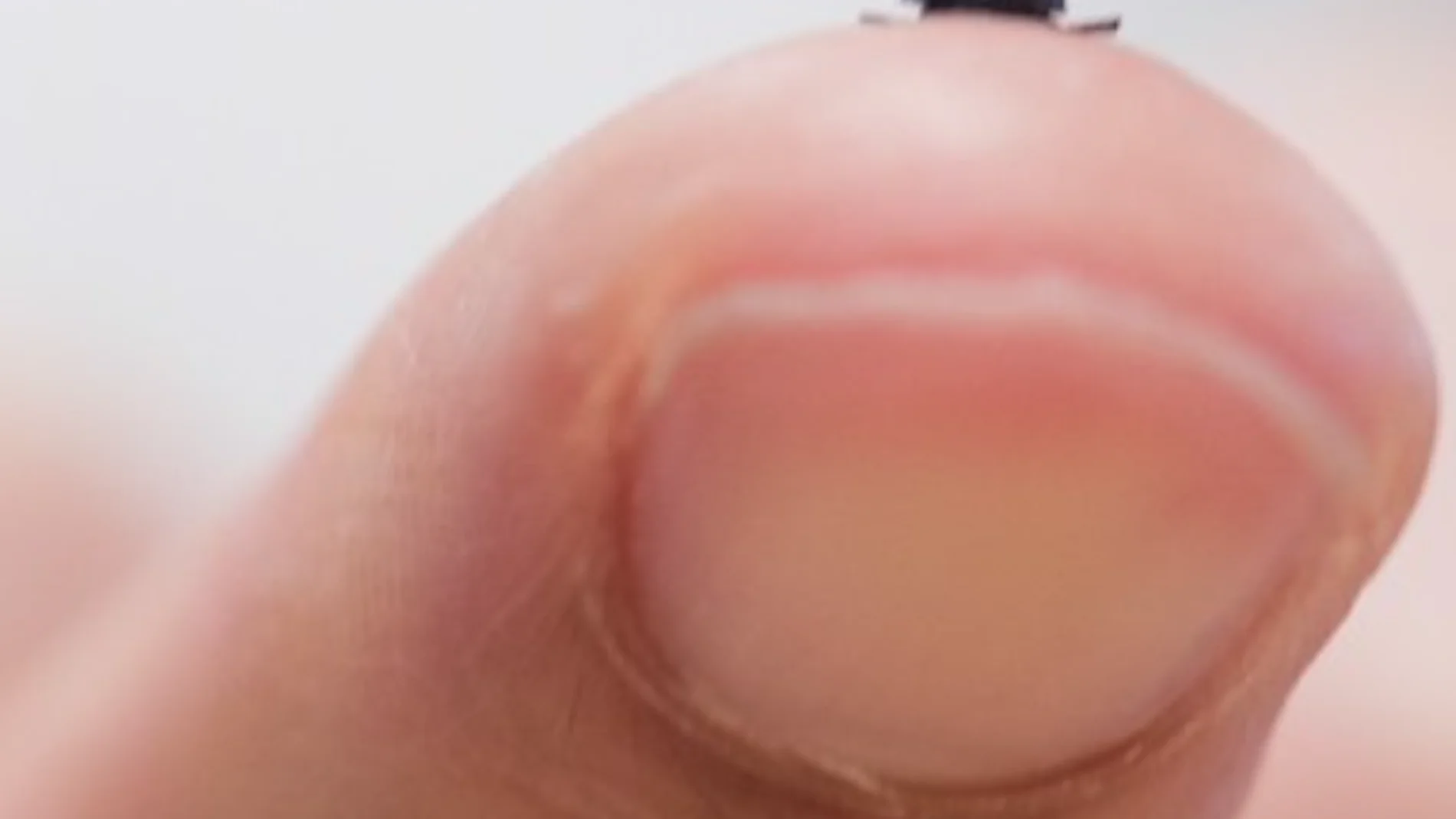
Science and technology usually amaze us by their size: rockets capable of leaving the Earth, telescopes larger than buildings, kilometer-long particle accelerators or industrial robots that lift tons of weight. But sometimes the most disconcerting technology is just the opposite: that which becomes so small that it is almost invisible. And that is precisely what a team of scientists from the University of Singapore has achieved: A surgical robot about the size of a seed that could change the way some operations are performed inside the human body.
The trailer, published in Advanced Materialspresents a microrobot capable not only of moving through extremely small spaces, but also of changing surgical tools in the middle of the procedure. In other words: a microscopic machine that can cut, select, pierce, or deliver substances as needed by the surgeonall within anatomical structures where conventional instruments can barely enter.
The idea belongs to an emerging field known as biomedical microrobotics, a discipline that attempts build robots so small that they can navigate blood vessels, internal cavities or delicate tissues without the need for large incisions. The goal is obvious: to make surgery less invasive, more precise and potentially much safer.
The problem is that reducing the size of a robot also reduces its capabilities. In traditional surgery, a doctor can quickly switch between different instruments: scalpels, forceps, needles or cautery systems. But in microscopic robots that is extraordinarily difficult. The available space is minimal and every millimeter counts. The result is more reminiscent of a microscopic Swiss army knife than a traditional robot. And a very fast one since it takes just a second to switch between the five tools.
That’s where the new design by the authors of the study, led by Guo Zhan Lum, comes in. The system incorporates a mechanism capable of alternating between five different tools using external magnetic fields. Instead of carrying motors, cables or batteries (something practically impossible at that scale), the robot responds to magnets controlled from outside the body. These magnetic fields not only move it, but activate the different instruments integrated into its structure.
According to the Zhan Lum team, The device measures just a few millimeters and can move across moist and complex surfaces, similar to those you would find inside the body. During laboratory tests he was able to perform different simulated surgical tasks, from manipulating small objects to piercing tissues or releasing materials at specific points.
In this sense, extreme miniaturization is not just an aesthetic or engineering issue. Currently, many interventions require opening healthy tissue simply to access a deep area of the body. Even minimally invasive surgery still relies on relatively large instruments introduced through small incisions. A robot of this size could further reduce that collateral damage.
The idea of Zhan Lum’s team is to create procedures in which swarms of microrobots enter the body through very fine catheters or even through injections. Once inside, they could move to hard-to-reach areas, act with precision and leave without leaving a trace. That would have potential applications in neurosurgery, cardiovascular treatments or localized tumor removal, where a few millimeters can make the difference between preserving or damaging critical tissue.
Furthermore, the use of magnetic fields offers another important advantage: it avoids the need for internal power sources. One of the great challenges of medical microrobotics has always been how to power these devices. Batteries take up space, generate heat and limit autonomy. By being controlled from the outside, this robot eliminates much of that problem.
Of course, between an experimental prototype and a real operating room there is still an enormous distance. The robot must still go through multiple development phases before being tested on humans. It is also the question of navigation. The human body is not an empty, orderly space: it is full of currents, soft tissues, involuntary movements and microscopic obstacles.. Guiding such a small robot with millimeter accuracy continues to be one of the discipline’s greatest challenges.
Even so, the study reflects something that is beginning to be repeated more and more in medicine: The surgery of the future will probably not rely on larger or more powerful tools, but on smaller, smarter and more precise systems.