
Nature seems to be supported by invisible forces. Electromagnetism keeps electrons bound to the nucleus and shapes the structure of atoms; gravity organizes matter on a large scale, from planets to galaxies; the weak interaction allows certain radioactive decays. And then there is the strong interaction, perhaps the most extreme of all: the force capable of keeping protons together within the atomic nucleus even though, electrically, they should violently repel each other.
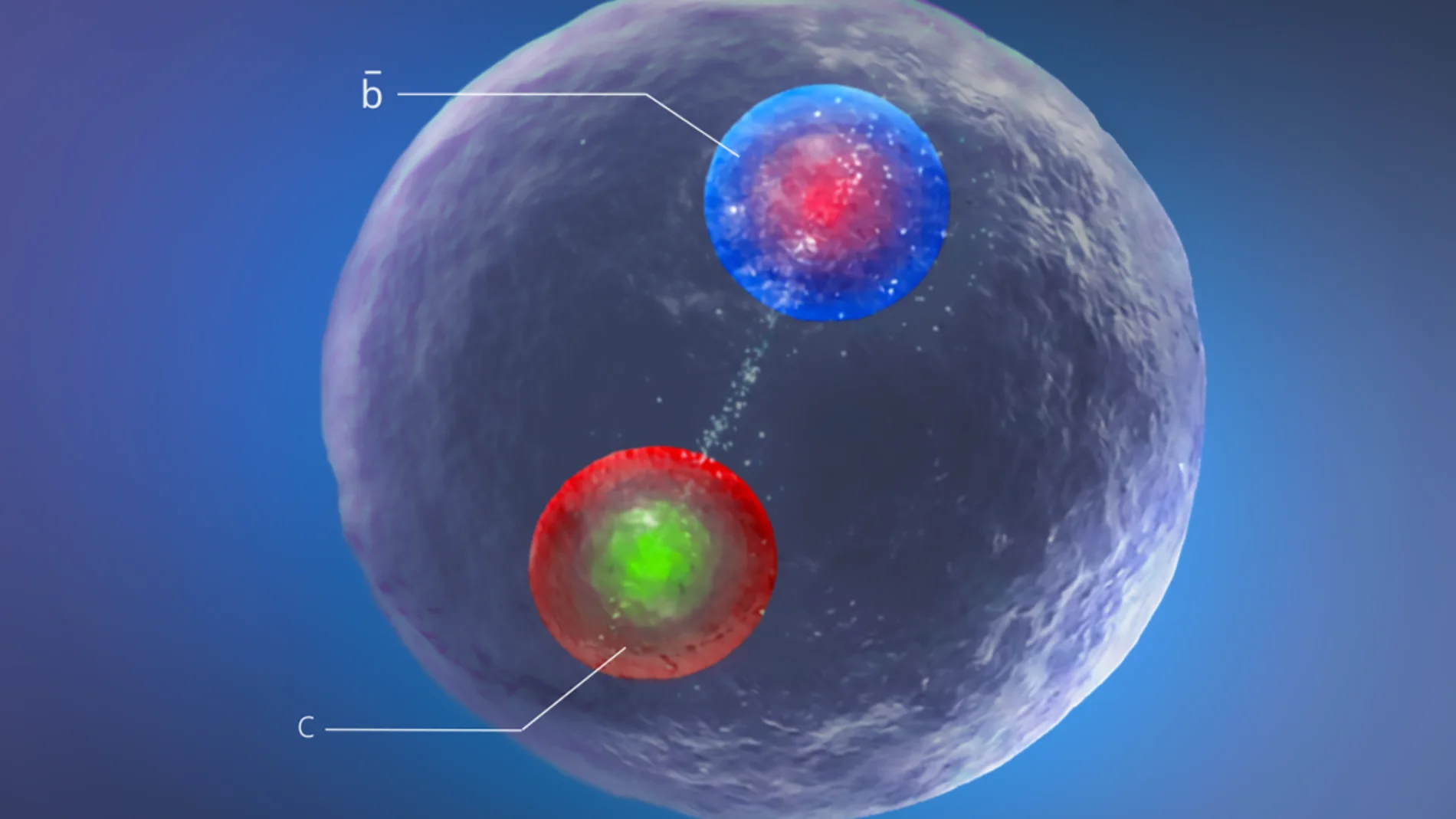
We understand its effects precisely, but its internal mechanism remains one of the great mysteries of physics. According to a study published on arXiv, CERN’s ATLAS experiment announced the first observation of the Bc*+ meson, a new composite particle made up of a charm quark and a bottom antiquark. It is not the piece that closes the puzzle (physics rarely works like that) but it is a new window into the processes that hold matter together.
The problem is that we still don’t fully understand how that force emerges at the most complex levels of matter. The experiment has observed a new excited version of a fully heavy tetraquark, a structure made up of four charm quarks that exists for a tiny fraction of a second, but offers physicists a rare opportunity to study how the strong interaction works.
At first glance, it may seem like a technical detail within the zoo of subatomic particles. But for physicists it means something much more important: an exceptional opportunity to study how the force that holds the nucleus of atoms together behaves. Because the visible universe exists thanks to a paradox. The Protons within an atomic nucleus have a positive charge and should violently repel each other. However, they stay together because of the strong interaction, a fundamental force carried by particles called gluons. It is literally the force that holds matter together.
The problem is that That interaction becomes extraordinarily difficult to describe mathematically when the particles begin to group together in complex ways. For decades, physicists thought that hadrons (particles made of quarks) could only organize in two ways: in quark-antiquark pairs, forming mesons, or in trios of quarks, forming protons and neutrons. But in recent years, “exotic” configurations have begun to appear: tetraquarks and pentaquarks, structures that defy traditional classification.
The new discovery belongs precisely to that family. The particle detected by ATLAS is a more energetic version of an already known tetraquark, something similar to finding an atom in an excited state. Just as electrons can occupy different energy levels around a nucleus, these composite particles can also exist in different internal configurations.
And that is what makes this discovery especially interesting. Tetraquarks of this type are relatively “clean” from a theoretical point of view. Being formed only by heavy quarks, quantum effects are somewhat more controllable than in particles composed of light quarks. For physicists, they are almost an ideal laboratory to test the equations of quantum chromodynamics, the theory that describes the strong interaction.In other words: these particles could help understand why matter remains stable. The finding also has deeper implications for the nature of the quantum vacuum itself.
In the subatomic world, the vacuum is not empty. It is full of constant fluctuations, virtual particles and energy fields that continually appear and disappear. Exotic particles like this emerge precisely from the turbulent behavior of gluons and quarks. Understanding how they form, how long they last, and how they decay could help answer questions that remain open in fundamental physics: How matter was organized in the first moments after the Big Banghow certain collective properties of quarks emerge or even how matter behaves under extreme conditions, such as those inside neutron stars.
Although the discovery does not immediately change our daily lives, it belongs to that kind of science that ends up transforming our understanding of the world in unpredictable ways. Quantum mechanics, developed a century ago to explain apparently abstract phenomena, ended up making transistors, lasers, magnetic resonance imaging and the Internet possible.