
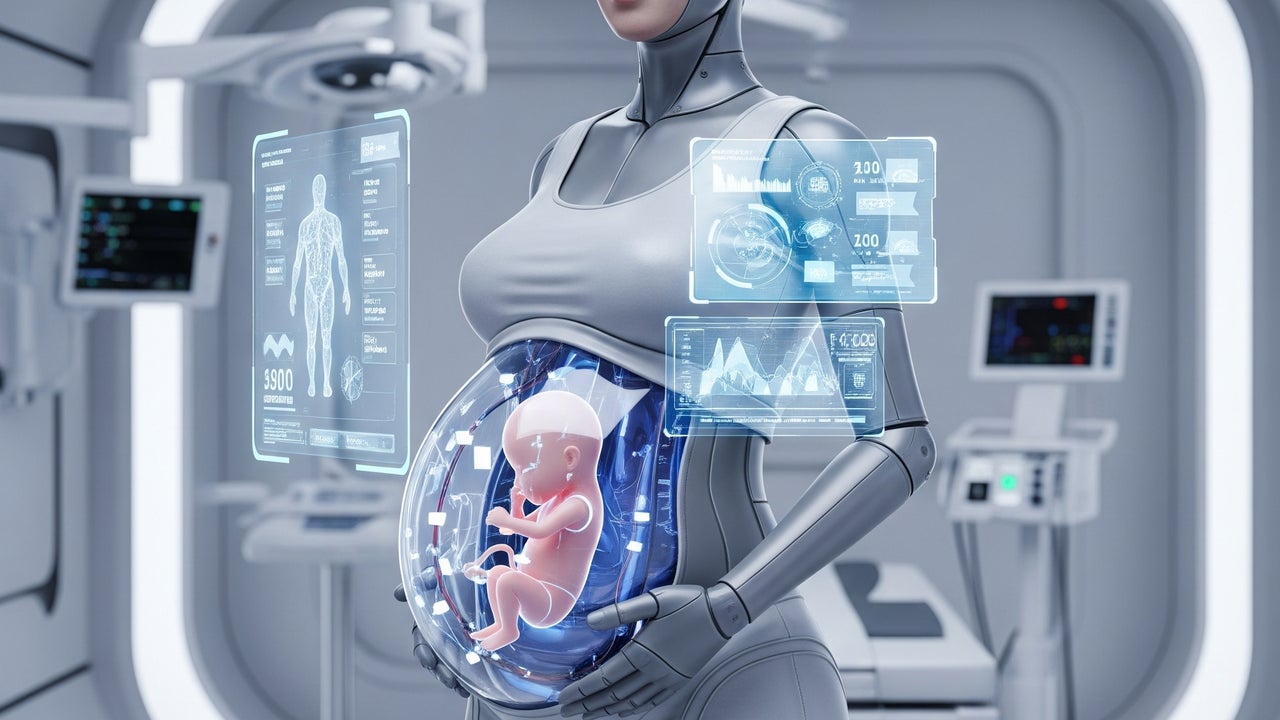
In recent days, numerous media have echoed news about a pregnancy robot developed in China. The images showed hugged human babies inside the robot bellsfloating in a liquid similar to the amniotic that would allow its development.
Media, such as Newsweek, The Economic Times and Chosunbiz, They cited a Chinese media, Kuai Ke Zhi, as the source of the news. According to the “original” news Zhang Qifeng, the head of the robot design, he told that medium that a prototype would be ready in 2026 at a price of less than 100,000 yuan (about 13,000 euros).
“Some people do not want to marry, but they do want a ‘wife’; others do not want to get pregnant, but they do want a child -Zhang would have pointed out -. Artificial uterus technology It only needs to be implemented in the robot abdomen so that a real person and the robot can interact and achieve pregnancy ”, although obviously the nature of that interaction between humans and robots is not detailed.
According to the different media, Zhang was the executive director or the founder of Kaiwa Technology, a company based in Guangzhou. It was also mentioned as a PhD from the Technological University of Nanyang (NTU) of Singapore. But the reality is that the Chinese medium Kuai Ke Zhi does not exist, neither does Kaiwa Technology and there is no one called Zhang qifeng linked to the NTU.
So that The news of the pregnancy robot, although viral, is not real. However, history makes us ask ourselves how much reality there can be in a robot like this.
The closest, to date, which has been proven is the development of artificial uters. In the Children’s Hospital of Philadelphia (Chop), scientists are developing a device similar to a uterus called “extrauterine environment for the development of the newborn” or Extend. Hope is to support babies born extremely premature, between 23 and 28 weeks gestation.
Until now, Extend has been tested with lambs. In a 2017 study, the team showed that Lamb fetuses could remain on the device for a month and that their development continued similarly to how it would have done in the uterus.
In another more recent study, also published in Nature, the authors They describe how Extend influenced cerebral genetic activity. The device helped preserve the genetic activity in the brain of premature lambs, so that it resembled that of the lambs that remained in the uterus for much longer.
Although the Extende team intends to initiate the essays in humans, There are still doubts about when and how would it be ethical to test the devicesince many premature babies have the possibility of surviving with existing technologies.
The news indicates two facts very typical of our era. The first is that the viralization of an affirmation seems to make it a reality and we disregard the facts, as if its single appearance on the Internet gave it a certain quality. That many spread it or that we are interested to be true, it does not make it a truth.
And the second important fact is How could our relationship with robots change in the coming decades. In the same way that an ethical framework for artificial intelligence is needed, it is also necessary to have one that covers the possible intersections of humans and robots, mainly when biology is involved.