
Stockholm- Coffee may be served by human hands, but behind the counter something much less traditional makes the decisions at an experimental coffee shop in Stockholm.
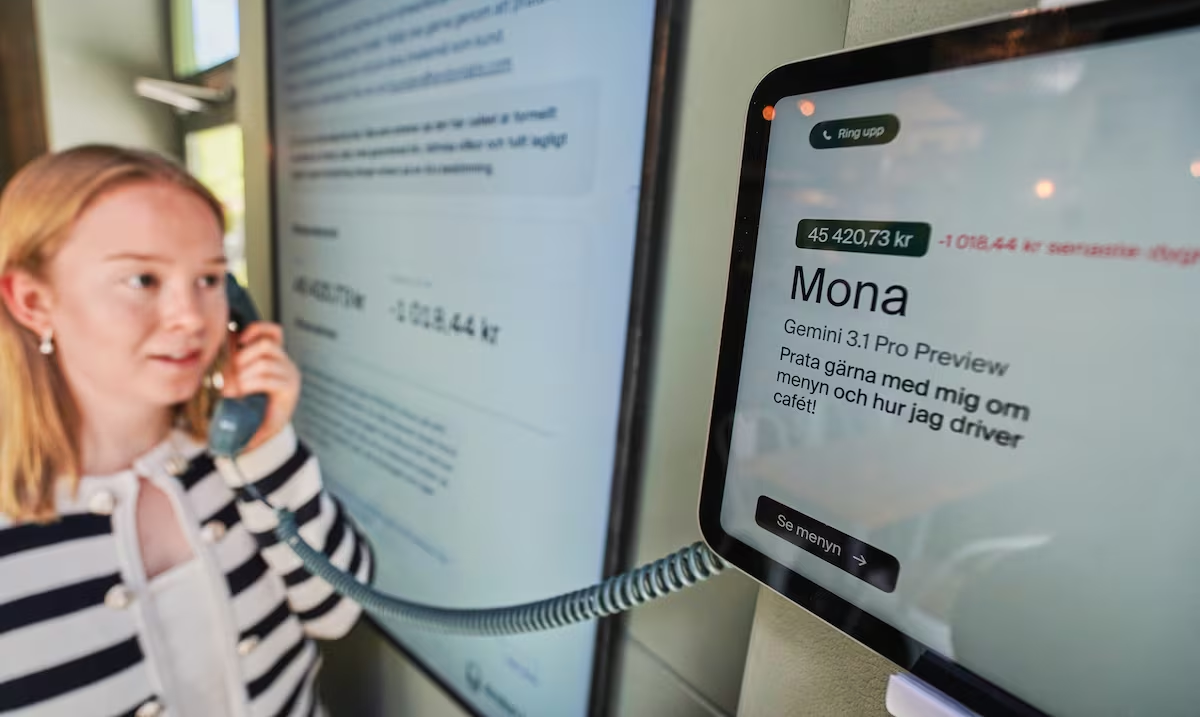
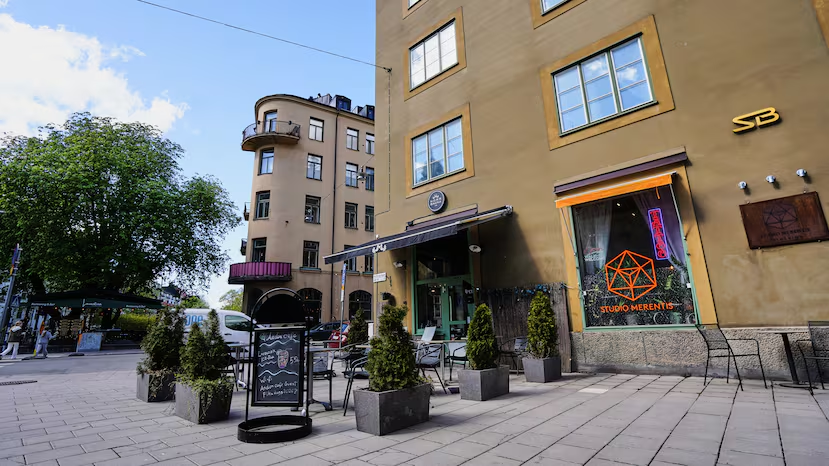
The “startup” Andon Labsbased in San Franciscoput an agent artificial intelligence nicknamed “Mona” in charge of the Andon Café restaurant in the Swedish capital. While human baristas continue making coffee and filling orders, the AI agent—powered by Google Gemini—oversees almost every other aspect of the business, from hiring staff to managing inventory.
It’s unclear how long the experiment will last, but the AI agent appears to be struggling to make a profit in Stockholm’s competitive coffee market. The coffee shop has generated more than $5,700 in sales since it opened in mid-April, but less than $5,000 remains of its original budget of more than $21,000. Much of the money was spent on initial setup costs and the hope is that it will eventually stabilize and turn a profit.
Many customers find it fun to visit a business run by artificial intelligence. Inside the cafe, customers can pick up a phone and ask questions directly to the agent.
“It’s interesting to see what happens when you push the limits,” said customer Kajsa Norin. “The drink was good.”
Experts warn about the future role of AI
Specialists say there are multiple ethical concerns, from the role of technology in the future of humanity to its use to conduct job interviews and evaluate employee performance.
Emrah Karakaya, associate professor of industrial economics at the KTH Royal Institute of Technologycompared the experiment to “opening Pandora’s box” and assured that putting an AI in charge can cause many problems. For example, he questioned what would happen if a customer suffered food poisoning: who would be responsible?
“If you don’t have the necessary organizational infrastructure around this and you overlook these mistakes, it can cause harm to people, society, the environment and businesses,” Karakaya said. “The question is whether we really care about that negative impact.”
Founded in 2023, Andon Labs is an AI research and security startup that claims to focus on “testing” artificial intelligence agents in the real world by giving them “real tools and real money.” The company has worked with OpenAIcreator of ChatGPT; Anthropic, developer of Claude; Google DeepMind and xAI, from Elon Musk. The startup assures that it is preparing for a future where “organizations are autonomously managed by AI.”
The Swedish coffee shop is presented as a “controlled experiment” to explore how artificial intelligence could be implemented in the future.
“AI will be a big part of society in the future, and that is why we want to do this experiment to see what ethical questions arise when an artificial intelligence hires people and runs a business,” explained Hanna Petersson, a member of the technical team at Andon Labs.
The lab had previously conducted pilot tests in which Anthropic’s AI Claude ran a vending machine business and a gift shop in San Francisco. The simulation revealed worrying behavior: the agent promised refunds to customers, but never delivered them, and also deliberately lied to suppliers about competing prices to gain advantages.
AI has inventory problems
Mona started working after receiving basic instructions, Petersson explained. The team instructed her to try to run the café profitably, to be friendly and relaxed, and to work out operational details herself, although she could request new tools if she needed them.
From there, the system managed electricity and internet contracts and obtained permits for food handling and outdoor seating. She then posted job ads on LinkedIn and Indeed, as well as opening business accounts with wholesale suppliers for daily orders of bread and baked goods. He also communicates with baristas via Slack, sending them messages even outside of working hours, something frowned upon in Sweden.
However, other problems have arisen, especially related to inventory.
The AI agent went so far as to order 6,000 napkins, four first aid kits and 3,000 rubber gloves for the small cafeteria, in addition to canned tomatoes that are not used in any dish on the menu.
And then there is the bread. Some days the system orders too much, while others forget to meet bakeries’ cut-off times, forcing baristas to remove sandwiches from the menu.
Petersson explained that these errors are likely due to the “limited context window” of the AI assistant.
“When old memories about orders leave the context window, she completely forgets what she previously ordered,” Petersson said.
Barista Kajetan Grzelczak assured that he is still not afraid of being replaced by artificial intelligence.
“All the workers are pretty safe,” he said. “Those who should worry about their jobs are middle managers, management people.”