
There was a time when it seemed that the American veto, the loss of Google services and the impossibility of competing on equal terms in smartphones seemed too much weight even for one of the largest companies on the planet. But something curious happened: Instead of trying to get back to exactly the same place, Huawei evolved.
Without a doubt, there lies one of the keys to the success of the Chinese manufacturer in wearables and audio: adaptation. While other brands tried to turn each watch into a “mini mobile”, Huawei opted for something more pragmatic: real autonomy, good sensors, premium design and a stable experience. I didn’t need to win the app war; I needed to make watches that people would want to wear every day.
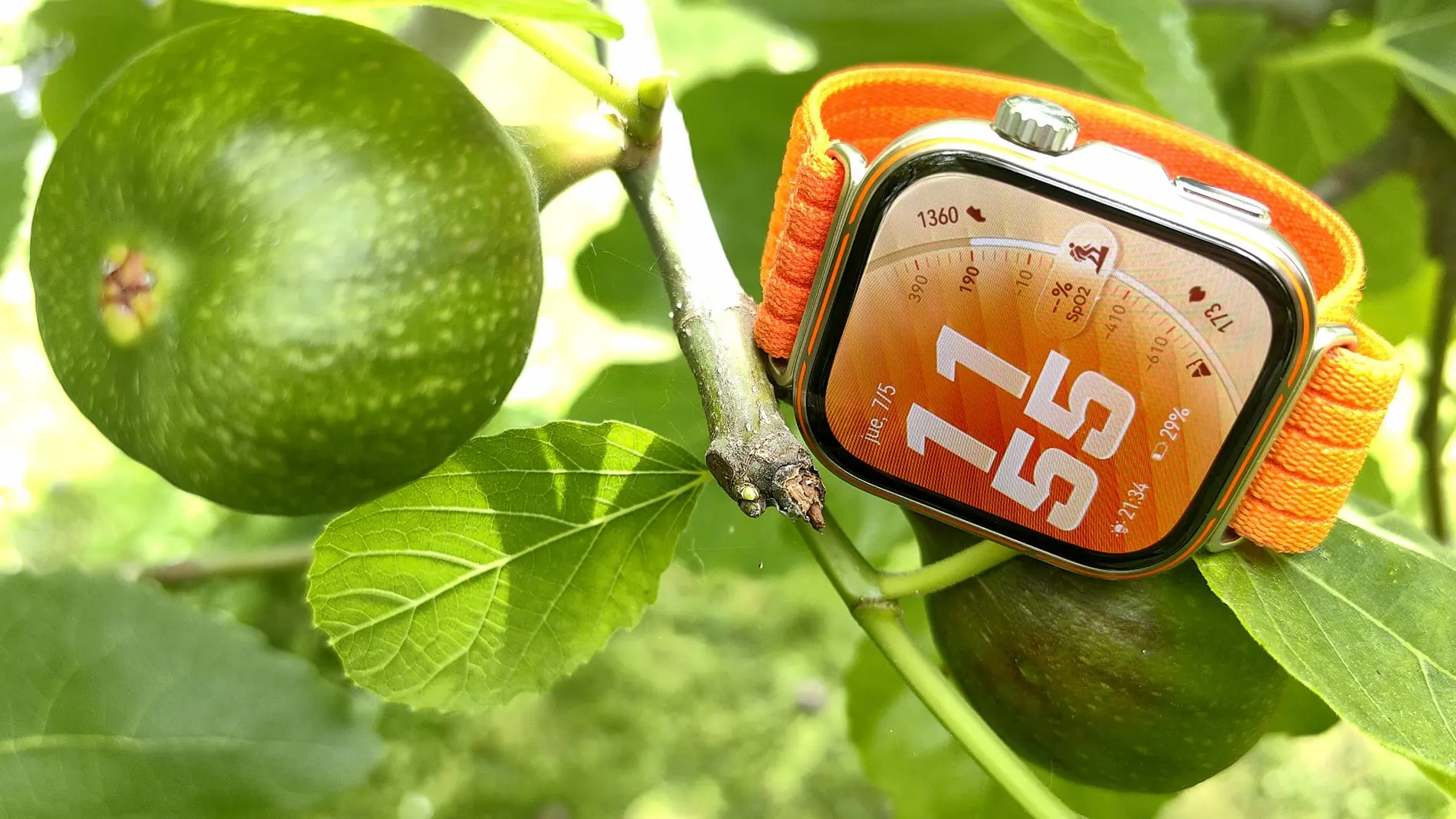
He new Huawei Watch Fit 5 Pro is probably the best example of that strategy. More than a smartwatch, the sensation is that of being faced with a strange evolution between sports bracelet, premium watch and health gadget, with the best of each world. The Watch Fit 5 Pro abandons the “sport” aesthetic of its predecessors to join a more elegant sophistication.
For the first time in this series, we see a bezel of titanium alloy and a screen protected by sapphire crystal. It’s no longer just a watch for the gym; It is a piece that fits perfectly into a business meeting or a formal dinner, maintaining the lightness that defines the Fit family. Of course, if the straps could be exchanged, the jump would be even greater. 20mm couplings do not fit all hitches.
Visually there are two opposite sections. The first glance is that not much has changed from the previous generation: rectangular design, visible and useful crown and tactile ease of use. But the next look speaks of a slightly larger screen (1.92 inches), brighter (LTPO AMOLED up to 3000 nits) and the almost absence of bezelscloser to the infinite screen of some mobile phones than to the more Lilliputian vision of many watches.
The interesting thing is that Huawei seems to have understood something that many manufacturers still ignore: a smart watch is not used the same as a phone. Most users do not want to respond to complex emails from their wrist or install dozens of apps. You want something fast, convenient, reliable and that doesn’t require you to search for the charger every night. And there Huawei continues to play with an advantage.
Autonomy continues to be one of its strongest points. While many advanced watches barely survive a day or two, The Watch Fit series continues to move in figures close to ten days of battery life. That difference seems minor on paper, but it completely changes the daily experience. The watch stops feeling like another device to maintain and begins to behave like a permanent accessory.
Huawei’s growing and healthy obsession with biometric sensors is also noticeable, despite the health redundancy. The new model incorporates ECG, more advanced sports metrics and functions even aimed at diving and outdoor activity tracking, in total up to 100 different sports modes. The company has been trying to position itself for some time in that hybrid space between health and serious sports, getting closer to Garmin than to purely “smart” watches. And with success. TruSense, the self-designed system, obtains not only precise information thanks to its sensors (the obvious heart rate, the usual blood oxygen level, but also stress, skin temperature and sleep), He also knows what to do with that information. And that’s what’s important.
Although it does not replace a doctor (nor does it intend to) His experiences with the D series, even more focused on medicine, have paved the way for him to gain unique experience in the sector: it is reliable.
And one of those reliabilities is the long-awaited arrival of the payment system. It’s not just about carrying a card on the watch, but creating a random number for each purchase so that it is secure. If we must be honest, we must also mention that It does not have the compatibility of others with some applications and its voice assistant still lacks. Is it worth it? It depends on the user, but if we search a little and take some time, the reality is that most applications are available through other means.
On one side of the scale we have the difficulty accessing certain applications, but in the other an envied battery, enormous reliability of sensors and GPS positioning (already from the previous generation) and a distinctive and elegant design. In my personal opinion, it pays off.