
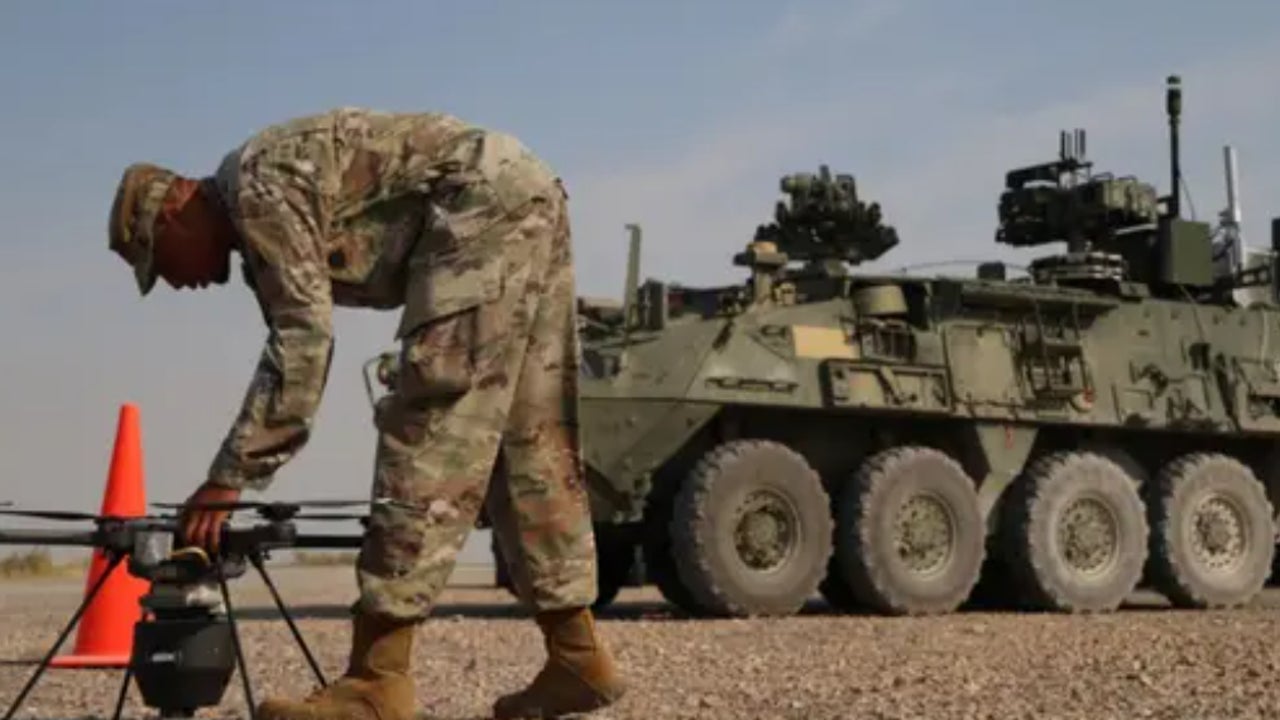
Without a doubt, the Stryker vehicle has become known for being one of the most effective weapons to combat the use of drones in different scenarios. Well now he has given it a twist and added a drone to his own arsenal. U.S. Army soldiers from the 7th Infantry Division have tested a Stryker vehicle equipped with a drone to detect and neutralize nuclear, biological and chemical (NBC) threats.
The Stryker Nuclear, Biological and Chemical Reconnaissance Vehicle (NBCRV) is equipped with the Army’s new Sensor Suite Upgrade (SSU), making it a state-of-the-art NBC detector.
The new SSU upgrade allows the US military to equip a drone on its Stryker vehicles. When an NBC threat is identified, a surveyor within the NBCRV launches an unmanned aerial vehicle (UAV) docked on the rear of the NBCRV and gives you signals through semi-autonomous navigation and by waypoints.
The drone flies over the threat several times to collect a sample, allowing the biological detection payload Quickly identify if an NBC agent is present.
This information is essential so that soldiers can anticipate and react to threats before anyone on your unit needs treatment for exposure to an unknown agent. To this we must add that the vehicle carries out reconnaissance autonomously.
The sensor package incorporated six specialized chemical agent sensors in one uniform packageupdating the NBCRV’s sensor capabilities with current technologies and ultimately preparing it for modern Army maneuver support.
The SSU NBCRV uses unmanned systems that are combined with a manned platform, taking advantage ground and aerial robotic devices and sensor technologies to detect and identify hazards and communicate with commanders when making decisions.
In this way, the update makes it possible to anticipate numerous threats not only from a distance, but also autonomously. The sensors They identify whether it is chemical, biological or nuclear and what type of measure is the most appropriate to counteract it.
Beyond that, improvements to increase maneuvering speed, increase adaptability to different environments, remote sensing capability and create a more advanced system, technology can be adapted to respond to new threats in a military environment that evolves rapidly.