
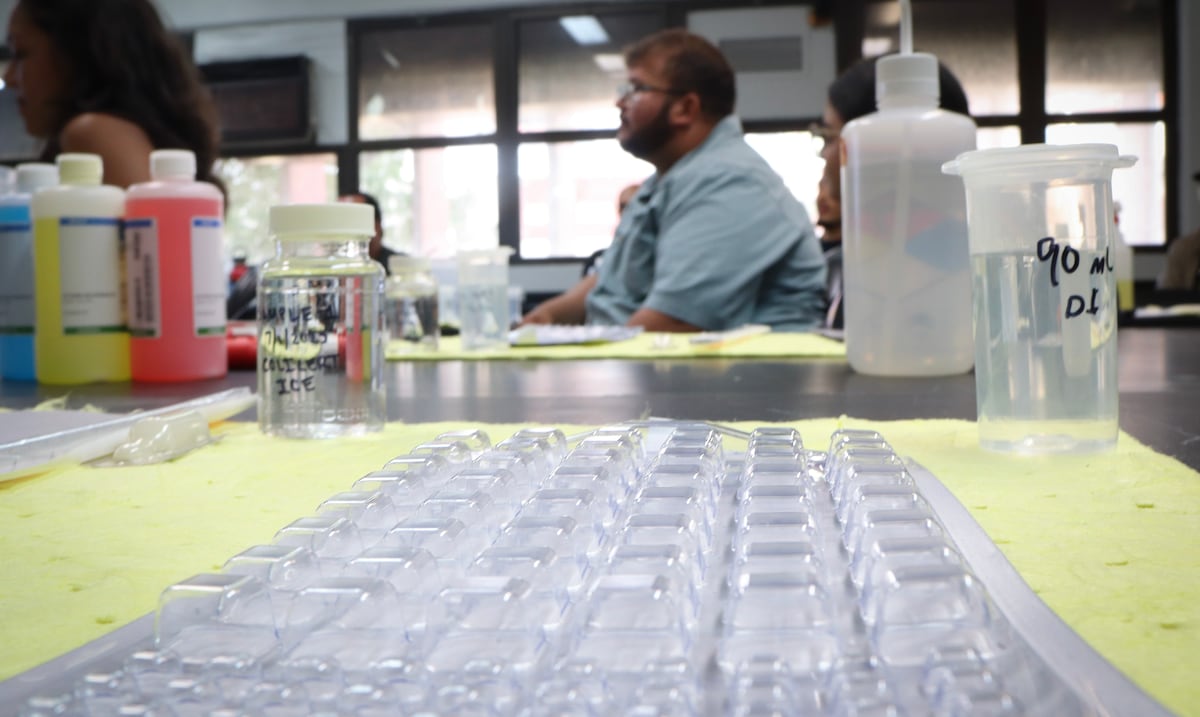
Humacao – The Federal Environmental Protection Agency (EPA, in English) on Tuesday inaugurated a loan center for equipment for monitoring of the Water qualityin it Humacao enclosure of the Puerto Rico University (UPR), where citizens can obtain the necessary tools to make sampling on their own and deliver it to the institution for later analysis.
“You cannot simply monitor each river route on the island,” said the researcher and coordinator of the participatory science program for region 2 of the EPA, Rachael Leta-Graham. “Giving these tools to community groups, universities or municipalities with interest in monitoring small river channels provides more data to determine how healthy they are”he added.
With the center -the room on the island-, the process of monitoring water using scientific resources is simple, said Leta-Graham. First, the UPR-Humacao is contacted to obtain the equipment, which will include a “YSI” (quality meter) that will collect diverse information, such as acidity or alkalinity (pH) of water, temperature and even dissolved oxygen.
When the sample is ready, then, in the center, where UPR employees will make a quality analysis from the data. As part of the analysis, it is possible to determine if there is a presence of bacteria such as E.Coli and Enterococcuswhich can cause intestinal problems in humans. Also, using a “idexx quanti-tray system”-a tool for pollution analysis-, it will be determined if there is more bacteria after 24 hours.
According to EPA data, only the identification of bacteria, for each sample, costs $ 14. Leta-Graham urged citizens to join environmental organizations or universities that would possibly have funds to reduce that cost. Even so, for many of the participants of the training workshop that the EPA carried out to announce the opening of the center, monitoring water is a personal mission.
For Paco López-MujicaPresident of Pro-city reefs And voluntary monitor, poor water quality is the main threat to marine systems, especially in the county area, in San Juan, where – wastewater enters the beaches.
“They are difficult means to understand why they are under the street. So, the only way to find out the problem would be to put a robotcito to see what is under earth,” he said, laughing. But now, having this additional center will help you have more resources to identify if there are bacteria and what kind. Your monitoring occur weekly.
The establishment of the center in Humacao It will help residents of nearby peoples with their samples. According to Jimmy Piña Martínezpresident of the Barrio Cubuy Development Committee, in Naguabowill support with the maintenance of aqueducts in its region managed independently, known as non-prasa. Due to the original design of these systems, many families living on the level of the tank do not receive monitored water, which the community leader expects it to change now.
“We have a social responsibility with communities”said the doctor Joel Meléndez DíazProfessor of the UPR-Humacao Marine Biology Department. “Not only are we educating new generations in marine science, but also helping the communities of our area to improve water quality in our area.”
The other three centers are at the Inter -American University, in San Germán; Hacienda La Esperanza, in Manatí; and the Ana G. Méndez University in Gurabo.
For more information about the centers, resources or data of the monitoring, contact the EPA office in Puerto Rico at (787) 977-5865, or write directly to the Last-Graham Raz letraham.rachael@epa.gov.