
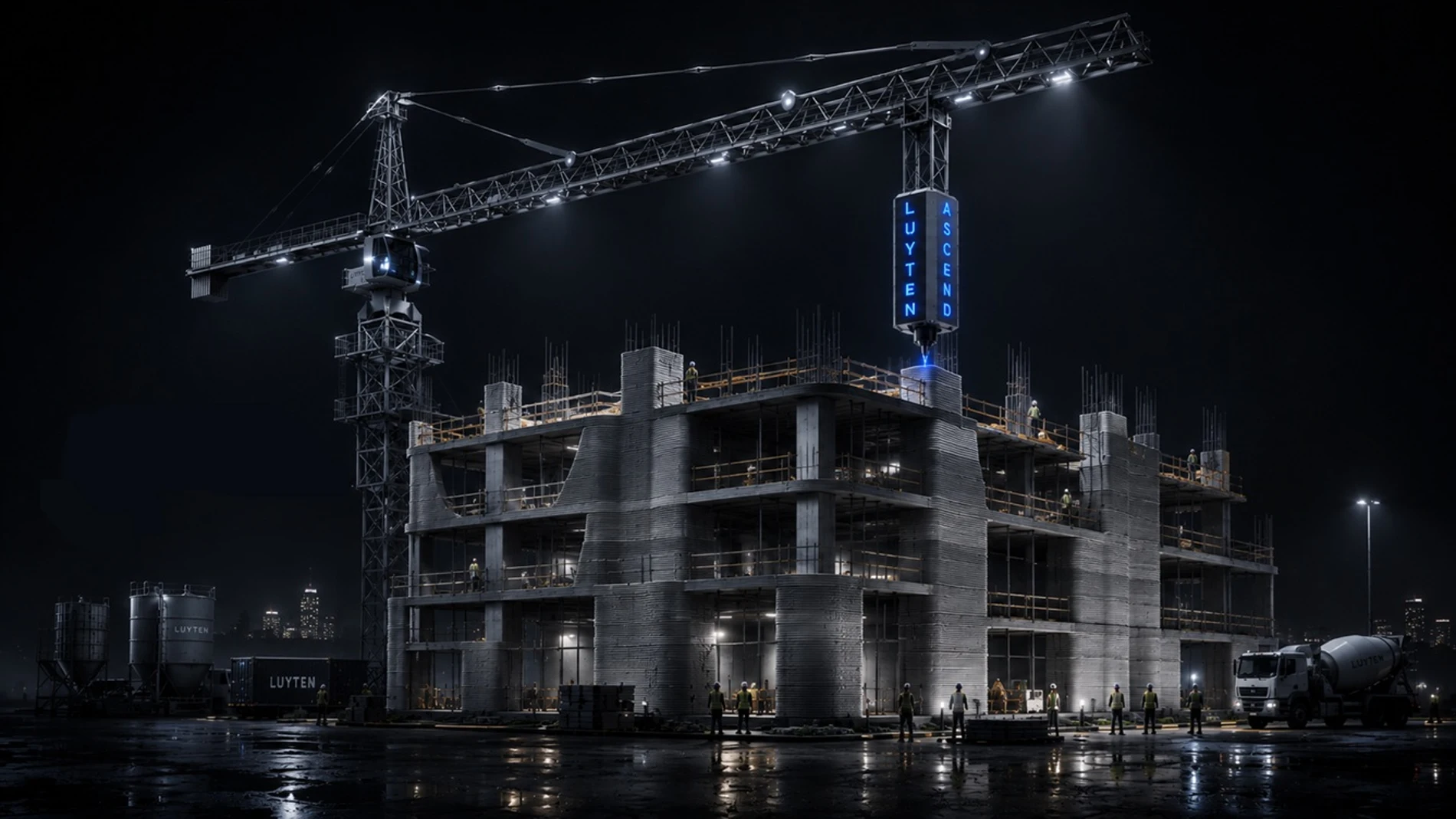
For centuries, constructing a building has meant transporting materials, erecting scaffolding, installing formwork, and coordinating dozens or hundreds of workers. The industrial revolution changed the tools, reinforced concrete allowed new heights to be reached and cranes added the element of speed.
Now an Australian company proposes to go one step further: convert the cranes into a giant 3D printer capable of “manufacturing” buildings layer by layer. The company Luyten has presented ASCENDa system that describes how the first 3D printing platform for construction based on a tower crane. According to its developers, the technology could be used to raise buildings up to 100 meters high.
Yes ok 3D printing in construction is not new and complete homes are already printed using robots that deposit successive layers of concrete Following a digital plane, these systems usually face an obvious limitation: their size. Most operate as huge gantry printers. They are great for building one- or two-story houses, but as the height of the building increases, the structure needed to support the printer becomes increasingly complex.
In other words, printers can build buildings, but building the printer itself becomes part of the problem. Luyten engineers decided to ask a different question. What would happen if, instead of designing a new structure, they took advantage of one that already exists in practically all high-rise projects? The answer is the crane.
For more than a century, these machines have dominated urban horizons. Its function has always been the same: move materials from one point to another. ASCEND changes that logic. Instead of transporting concrete, the crane deposits the material directly where it needs to gofollowing digital instructions and acting like a gigantic three-dimensional printer.
The printing principle is similar to that of a home printer, although on a huge scale. Instead of ink, the system uses a special concrete mixture. The machine deposits successive layers following a previously designed digital model. Each layer hardens as the next is placed on top, creating walls, columns and other structural elements.
It is an additive process: The building is manufactured by adding material exactly where it is needed. Traditional methods, on the other hand, often require temporary molds, cuts, and a considerable amount of waste.
Proponents of this technology highlight three main advantages. The first is speed. By automating part of the construction process, some tasks can be executed continuously and with fewer interruptions. The second is waste reduction. Because the material is deposited only where the digital design indicates, less waste is generated than with many conventional methods.And the third is the shortage of specialized labor. Many countries face difficulties in finding qualified construction workers. Automation could help make up for some of that shortfall.
What sets ASCEND apart from other similar projects is scale. Until now, most 3D printed homes were low houses, small offices, or single-story structures. Luyten assures that his system can work on projects up to 100 meters high (about 30 floors) and operating radii close to 45 meters. That would open the door to residential buildings, commercial complexes and even large infrastructure.
If the technology proves viable in real-world conditions, it could represent for construction what assembly lines represented for the automobile industry. Despite this, the reality is that We still won’t see 3D printed skyscrapers right away. Construction is subject to strict safety regulations, structural certifications and regulatory processes that tend to move more slowly than other technology industries.
Plus, printing a wall is only part of the job. A building also needs electrical installations, plumbing, insulation, elevators, windows and numerous systems that still require human intervention.But the direction seems clear. For decades, cranes have been the symbol of growing cities. If projects like ASCEND prosper, they could become more than just symbols and “deliverers” of materials: they could be the construction companies themselves.