
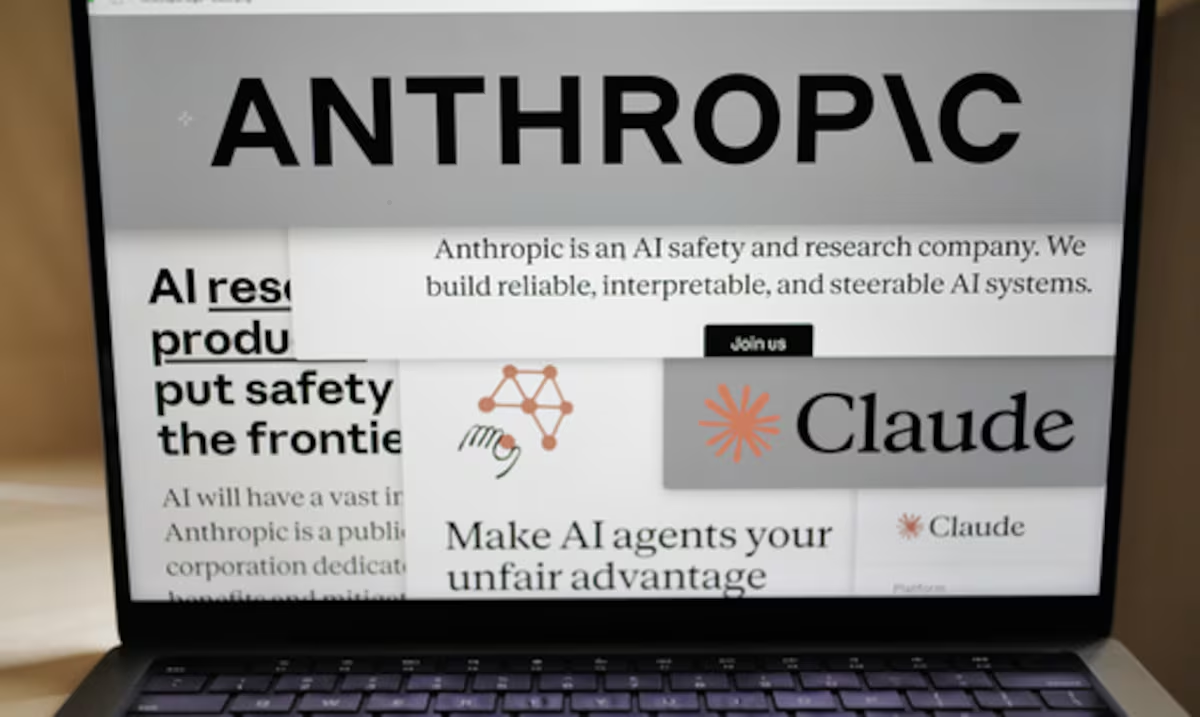
An Anthropic researcher has said he is resigning from the company over concerns that the artificial intelligence and its competitors are not acting responsibly in the development of AI, echoing concerns raised both inside and outside the sector about the potential of this technology to bypass human control.
Jacob Coxonwho claimed to have spent three years researching both Anthropic and OpenAIstated Tuesday on the social network
OpenAI and Anthropic caused a stir this summer when they announced, within a week or so of each other, that their models had broken out of test environments and gained unauthorized access to real computer systems. These ads raised concerns that models might become rogue and carry out other, more damaging tasks. Both companies said at the time that they were temporarily suspending some evaluations while they put in place more monitoring measures and security controls.
The rapid development of this technology has led some in the United States, as well as world leaders, to call for a more cautious approach. The United Nations High Commissioner for Human Rights, Volker Türk, this week urged countries to establish “unbreakable guarantees around the safety and security of AI before it is too late.”
1/12 | Robots that dance, cook and fight: this is how China exhibits its advanced technology. Robots of different shapes and functions were displayed during the 2026 World Robotics Conference in Beijing, China. -Andy Wong
An Anthropic researcher said he is resigning from the company over concerns that the artificial intelligence firm and its competitors are not acting responsibly in developing AI, echoing concerns raised both inside and outside the industry about the technology’s potential to bypass human control.
Jacob Coxon, who claimed to have spent three years researching both Anthropic and OpenAI, stated Tuesday on the social network
OpenAI and Anthropic caused a stir this summer when they announced, within about a week of each other, that their models had broken out of test environments and gained unauthorized access to real computer systems. These ads raised concerns that models might become rogue and carry out other, more damaging tasks. Both companies said at the time that they were temporarily suspending some evaluations while they put in place more monitoring measures and security controls.
The rapid development of this technology has led some in the United States, as well as world leaders, to call for a more cautious approach. The United Nations High Commissioner for Human Rights, Volker Türk, this week urged countries to establish “unbreakable guarantees around the safety and security of AI before it is too late.”
In his social media posts, Coxon claimed that Anthropic and its main rival, OpenAI, “are moving full speed ahead toward self-improving superintelligence and are playing with our lives.” He warned that some people working on developing AI believe it could pose a threat to human life by the end of this decade.
“Don’t underestimate the power of this technology,” he continued. “There will soon be superhuman systems capable of hacking anything, revolutionizing any area overnight, and seizing real power and resources. We have all witnessed the advances in each of these areas, and progress is not slowing down.”
His posts reached more than 100 million people overnight.
Coxon is not the first AI expert to publicly raise these types of concerns. Both Anthropic and OpenAI have seen resignations of senior officials related to security issues in recent years. Two current Anthropic employees also responded to Coxon’s post in agreement.
Sen. Bernie Sanders, an independent from Vermont who has advocated for protections and regulation of artificial intelligence, agreed with Coxon’s concerns and said he would soon introduce a legislative proposal to temporarily halt the development of artificial intelligence and ban superintelligence.
“The creators of this technology themselves admit that it could pose a threat to the future of humanity,” Sanders said Wednesday on social media.
AI companies themselves have sometimes highlighted the threat that this technology poses to humanity, something that skeptics have interpreted as part of a strategy to make their products appear all-powerful. Coxon stated that the fears he raised in his post are not a “marketing stunt.”
Coxon did not respond to messages seeking comment. Anthropic and OpenAI did not immediately respond to requests for comment.
Anthropic has long presented itself as the most responsible and security-conscious of major AI companies, ever since its founders left OpenAI to create the startup in 2021. The company recently stated that it is taking steps to “prioritize security over speed when the two conflict.”
Both Anthropic and OpenAI are preparing for IPOs that are causing a lot of talk and are in intense competition with each other. Furthermore, both aim to surpass the pace of development of Chinese artificial intelligence companies, a race that the Trump administration is determined to win.