
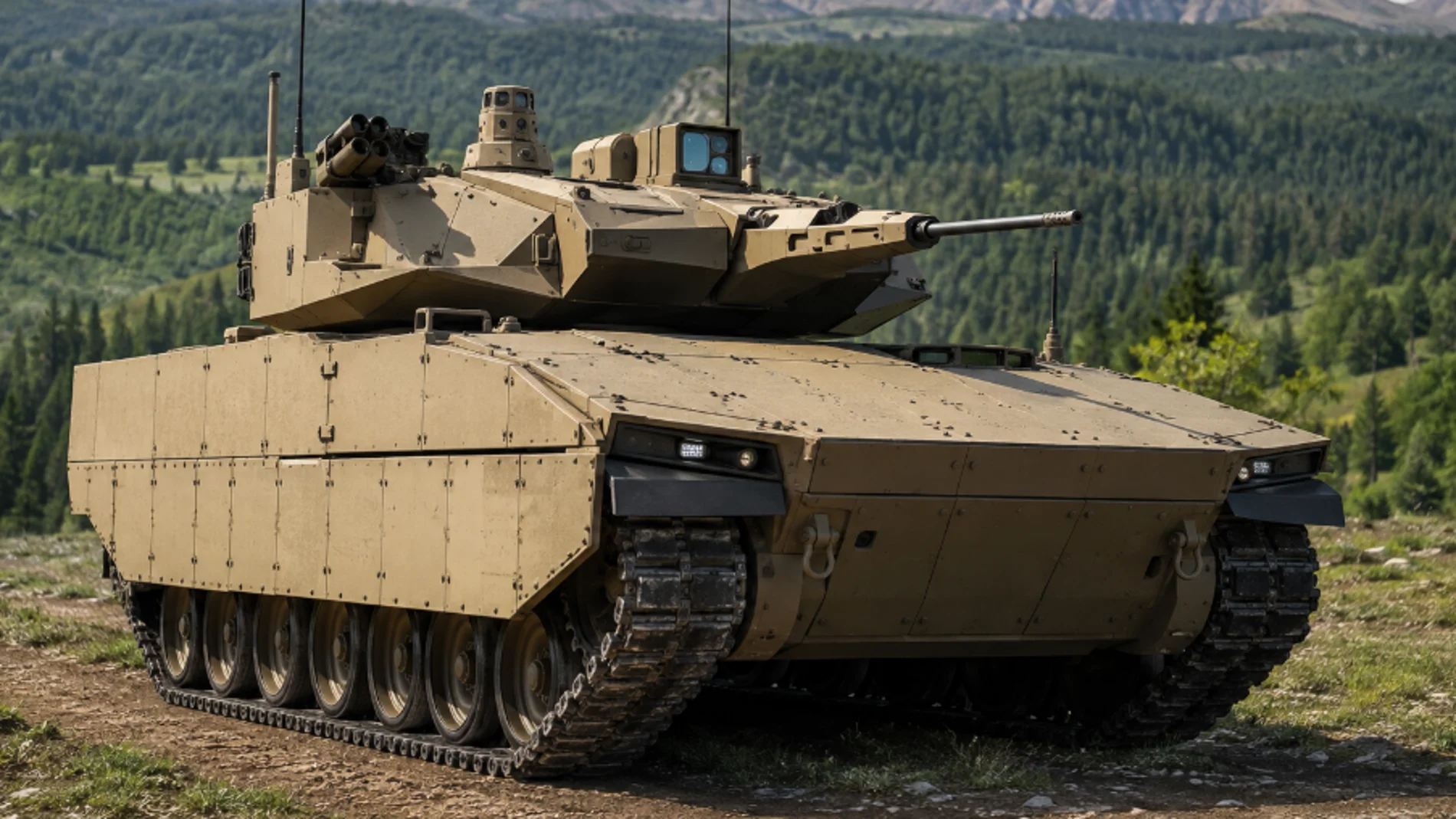
The United States Army has just received a combat vehicle that could become one of the fundamental elements of its future ground forces. Is called XM30 Wolf and it is not enough to simply replace an old vehicle with a more modern one. Its goal is to change the way an infantry fighting vehicle integrates with sensors, software, robots and autonomous systems.
General Dynamics Land Systems (GDLS) has delivered the first of its XM30 Wolf prototypes to the US Army at Aberdeen Proving Ground in Maryland. It is an important step within the program aimed at finding a replacement for the M2 Bradley, which has been in service for more than four decades. But there is still a long way to go: The Wolf is one of two designs vying to become the Army’s next infantry fighting vehicle. The other is the Lynx, developed by American Rheinmetall Vehicles.
The difference with respect to a simple generational replacement is in the philosophy with which it has been conceived. The US Army wants the XM30 to be able to transport soldiers into combat, provide them with protection and firepower and, at the same time, act as a node capable of interacting with robotic and semi-autonomous systems. This capacity expressly appears among the official objectives of the program. In other words, the future infantry vehicle will not necessarily have to fight alone.
The concept is especially important in a battlefield where drones, sensors and unmanned vehicles are increasingly available. Instead of imagining an isolated armored vehicle that detects the enemy with its own systems and responds with its weapons, The Army is designing a machine that can be part of a much larger network.
The XM30 could thus become a kind of mobile front-line operations center, capable of receiving information from different sources and working together with other systems. But to achieve this it is not enough to install many computers. One of the fundamental features of the Wolf is its Modular Open Systems Architecture (MOSA), an open architecture for both hardware and software. The idea is that New systems can be incorporated in the future without having to completely redesign the vehicle. It is a philosophy very similar to that of a modern computer: it is not designed thinking only about the software it will run today, but also about the possibility of updating it tomorrow.
General Dynamics describes the XM30 as a vehicle born digitalconceived digitally from the beginning. The company uses digital engineering tools to maintain a thread of information that connects vehicle design, testing, manufacturing and maintenance throughout its life cycle. This characteristic may be even more important than a certain power or speed figure.
A traditional armored vehicle can remain in service for decades. That means that any technology that is considered advanced on the day it enters service may become obsolete long before its useful life ends. Open architecture tries to solve precisely that problem: that the vehicle can evolve at the pace of technology.
An armored vehicle that cannot be upgraded runs the risk of being left behind, even if its physical structure continues to be perfectly useful. The XM30 tries to avoid this by design. Also incorporates an unmanned turretanother important difference compared to the Bradley. By placing the weapons in a turret without soldiers inside, the space for the crew can be organized in a different way and the military is physically separated from part of the weapons systems. The Army too seeks 360-degree situational awareness through sensors that allow occupants to understand what is happening around the vehicle.
As for armament, the two designs competing for the XM30 program use a 50-millimeter cannon, twice the caliber of the Bradley’s 25-millimeter cannon. Also They incorporate the capacity to integrate missiles, loitering munitions and aerial explosion munitions. But it is advisable not to confuse these characteristics with those of an already operational vehicle. The Wolf has just entered a decisive phase of testing.
GDLS plans to deliver more prototypes and some will be sent to Fort Hood, Texas, where they will be evaluated by Soldiers from the 1st Armored Brigade, 1st Cavalry Division. The Army will use these tests to check how the vehicle behaves in conditions much closer to real operations. The competition is still open. The Army could select a winner in 2027, after comparing General Dynamics’ Wolf with Rheinmetall’s Lynx.