
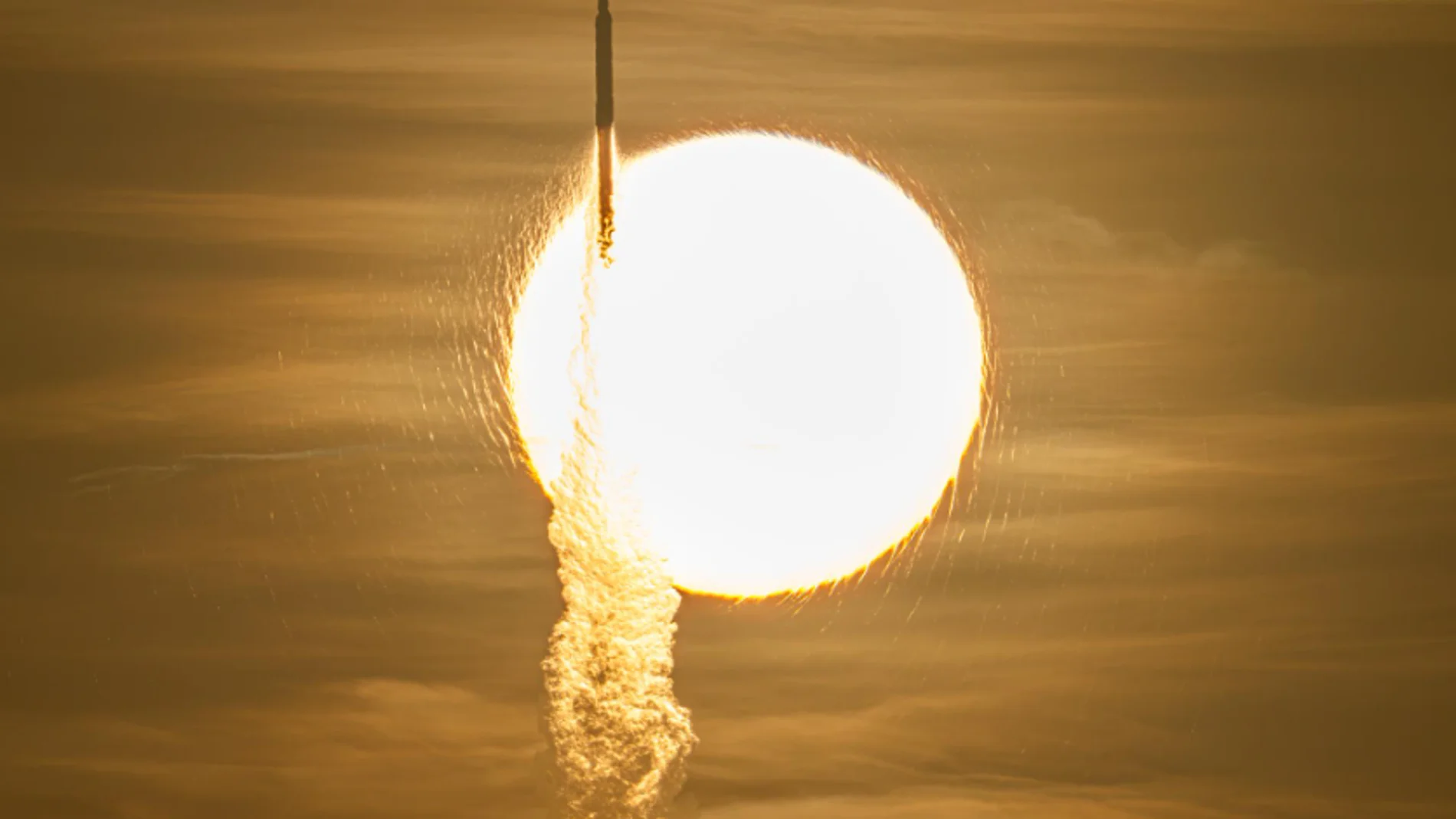
At 7:26 a.m. local Florida time, a SpaceX Falcon Heavy left Kennedy Space Center’s Launch Complex 39A carrying with it a machine designed to look at the universe in a different way. On board was the Nancy Grace Roman Space Telescope, NASA’s new large space observatory, which after more than a decade of development is already on its way to its destination: the second Lagrange point of the Sun-Earth system, L2, located about 1.5 million kilometers from our planet.
Roman will not simply be Hubble’s successor. It is also not intended to replace the James Webb Space Telescope (JWST). In fact, one of the keys to this mission is precisely that the three telescopes do different things. If Hubble has been one of the great “telephoto lenses of astronomy” for decades and Webb allows us to look further and with greater sensitivity in the infrared, Nancy Grace Roman (named after one of the pioneers of NASA, known as “the mother of Hubble”) arrives with a different philosophy: he wants to contemplate a huge expanse of sky at once.
The comparison is especially striking because Roman has a primary mirror of the same diameter as Hubble: 2.4 meters. However, its optical design provides a field of vision at least 100 times larger. Roman’s main camera, the Wide Field Instrument (WFI), can observe in a single image an area of the sky slightly larger than the apparent size of the full Moon.
It’s like comparing a telephoto lens with a wide angle lens. Hubble can focus extraordinarily well on a small region of the universe. Roman will be able to do something that would be extremely slow for Hubble: map huge swathes of the sky while maintaining comparable resolution. NASA estimates that during its first five years Roman will observe more than 50 times the surface of the sky that Hubble has covered in its first three decades and that will be able to carry out these large surveys up to 1,000 times faster.
The reason is its enormous camera of about 300 megapixels, made up of 18 detectors. And here begins the truly important part of the mission. One of its main objectives will be to try to solve one of the biggest enigmas of cosmology: what dark energy is and why the expansion of the universe is accelerating. For this Roman will observe billions of galaxies, supernovae and other cosmic structures, reconstructing how the universe has changed over time. It will also study the distribution of dark matter, that invisible matter that does not emit light, but whose gravity reveals its presence.
Roman will be, in a way, a map-making machine. While Webb may spend a lot of time studying a specific galaxy, star, or planetary atmosphere in enormous detail, Roman will look for patterns on a gigantic scale. YesYour mission is to find the structures and phenomena that appear when we stop looking at a small part of the cosmos and we began to observe it as a whole.
Exoplanets are another of its great objectives. NASA estimates that Roman could discover around 100,000 new exoplanets (just over 6,000 have been discovered so far), many through gravitational microlensing, a technique that allows us to find worlds located even at great distances from us.
But it also incorporates a particularly interesting experimental technology: a coronagraph designed to block the light of a star and allow direct observation of planets orbiting around it. The system uses masks, detectors and deformable mirrors capable of modifying their shape thousands of times to compensate for small optical imperfections. NASA hopes that this technology will allow us to observe planets up to almost a billion times fainter than the star that illuminates them.
And where is the James Webb then? Webb will continue to be essential. Its mirror is much larger, 6.5 meters compared to Roman’s 2.4, and can collect much more light. Besides, It reaches much longer infrared wavelengths, up to 28.5 microns. This makes it possible to study extremely distant objects, primitive galaxies and regions hidden behind cosmic dust with a sensitivity that Roman cannot match.
Roman, on the other hand, will sacrifice some of that depth for something Webb can’t offer on the same scale: breadth. That’s why the two telescopes can work as a team. Roman will be able to locate thousands of interesting objects on his large maps and Webb will then be able to target some of them to study them in much more detail. One finds the forest; the other can approach a tree.