
We spend approximately a third of our lives sleeping. Far from being wasted time, these hours constitute one of the periods of greatest biological activity in the body. While we sleep, the brain consolidates memories, the immune system reorganizes its defenses, the metabolism regulates essential hormones and the cardiovascular system enters a recovery phase. It is not strange that heChronic lack of sleep has been linked to an increased risk of cardiovascular disease, metabolic disorders, cognitive problems and persistent inflammation.
Experts usually summarize good rest in four pillars: sleeping enough hours, doing so regularly, minimizing nighttime interruptions and maintaining adequate environmental conditions. Among the latter, Temperature has become one of the most promising fields of so-called “sleep technology.”
And this is when one of the most interesting technological innovations appears: the ability to bring together artificial intelligence, sensors and mattresses, all in one: that is Eight Sleep, a smart mattress that has conquered entrepreneurs like Elon Musk and Mark Zuckerberg and whose price can exceed 3,000 euros. The question is obvious: What’s so special about a mattress that it appeals to some of the most performance-obsessed people on the planet? And why does it have that price?
A smarter dream
The answer begins with a biological fact known for decades: body temperature plays a fundamental role in the quality of sleep. So much so that one study clearly points this out: “The Earth’s climate is expected to warm significantly in the 21st century, affecting human societies in a variety of ways. Since sleep is a basic human need and part of everyone’s life, the question naturally arises of how temperature affects human sleep. The effect of a hot day (above 25°C) is -13.3 minutes less sleep, but if it is preceded by other hot days, the effect is even greater: 24.7 minutes”.
Every night, shortly before falling asleep, the body begins a cooling process. The body’s core temperature drops slightly and this reduction helps synchronize circadian rhythms and promotes the onset of deep sleep.. The problem is that conventional mattresses usually do just the opposite.
Memory foam, thick fabrics, and your own body heat create a kind of microclimate that can raise the temperature of the bed by several degrees. For many people, especially during the summer or menopause, Excess heat becomes one of the main enemies of rest.
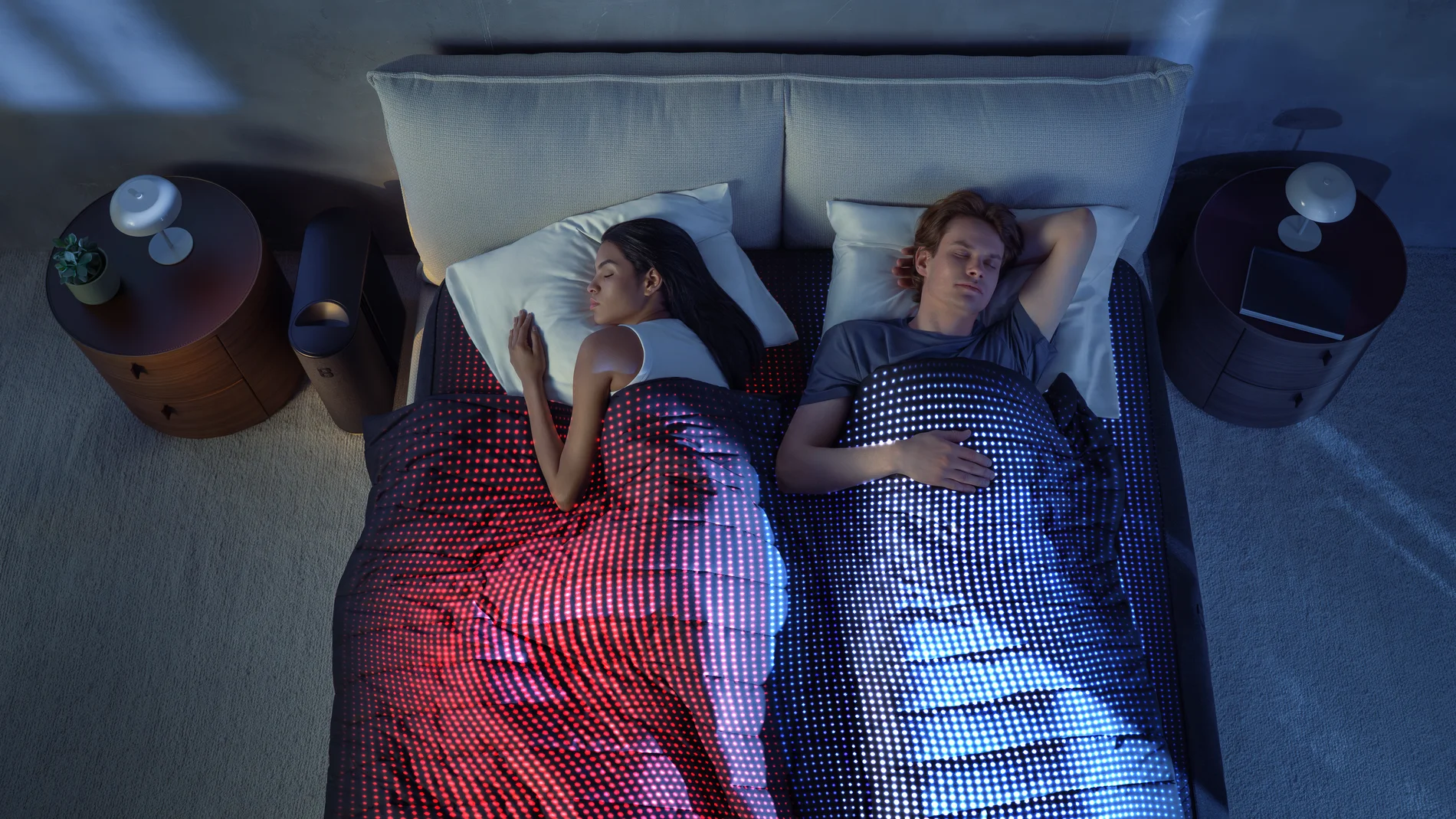
Eight Sleep’s great innovation is to directly attack that problem. Instead of using fans or passive materials, The system incorporates a network of conduits through which heated or cooled water circulates through an external unit. This network covers practically the entire surface of the bed and allows the temperature to be adjusted very precisely. It is, in a way, a personal climate control system for sleeping.
Two people, two different temperatures
One of the most striking features of the system is that each side of the bed can be configured independently. If one person sleeps cold and another sleeps hot, the sensor determines the appropriate temperature for each. Without having to negotiate the thermostat of the entire room. Current technology allows working in a very wide range of temperatures, from approximately 13 °C to more than 40 °C. Although these figures may seem extreme, the user does not come into direct contact with water at these temperatures. What you perceive is a cooler or warmer surface, which gradually changes the thermal environment of sleep.

A laboratory hidden under the sheets
Thermal regulation is only part of the story. The mattress too It incorporates sensors capable of recording numerous physiological parameters while we sleep. These include heart rate, respiratory rate, sleep duration, nighttime awakenings, and different estimates related to the quality of rest.
Every morning the app generates a detailed report that is more reminiscent of a smartwatch than a traditional mattress. The company defines this philosophy as sleep fitnessa type of sleep training in which every night it generates data that can be analyzed and improved.
Artificial intelligence enters the bed
The feature that its most famous users are most excited about is not the mattress itself, but the software. The system uses algorithms that learn from the user’s habits and automatically modify the temperature throughout the night.
The idea is simple: the bed detects when the person falls asleep, when they enter deeper phases of sleep or when awakening is approaching, and adjusts the temperature to favor each of these stages. In theory, the user does not need to intervene. The bed makes decisions on its own. Is the same logic that we find in autonomous cars, smart thermostats or virtual assistants: collect data, detect patterns and automatically optimize the environment.
Does it really work?
Here it is convenient to separate marketing from scientific evidence. We’ve already mentioned the abundant research showing the importance of body temperature for sleep. We also know that Excessive heat promotes nighttime awakenings and reduces the quality of rest. Therefore, the basic premise has a solid physiological basis.
What is more difficult to demonstrate is how much additional benefit each of the smart functions provides. The quality of sleep also depends on factors such as stress, light, exercise, diet, alcohol consumption or irregular schedules. Perhaps the most interesting aspect is the future that the company imagines. Eight Sleep has announced its intention to develop medical applications for its technology, including tools related to sleep apnea, hot flashes associated with menopause and other sleep disorders.
If those plans come to fruition, mattresses could stop being simple sleeping surfaces and become platforms for continuous health monitoring. It’s an idea that would have seemed like science fiction just a few years ago. But perhaps it is not so strange if we remember that we spend approximately a third of our lives in bed. AND If there is a place to collect information about our body for eight hours straight, it is precisely there.