
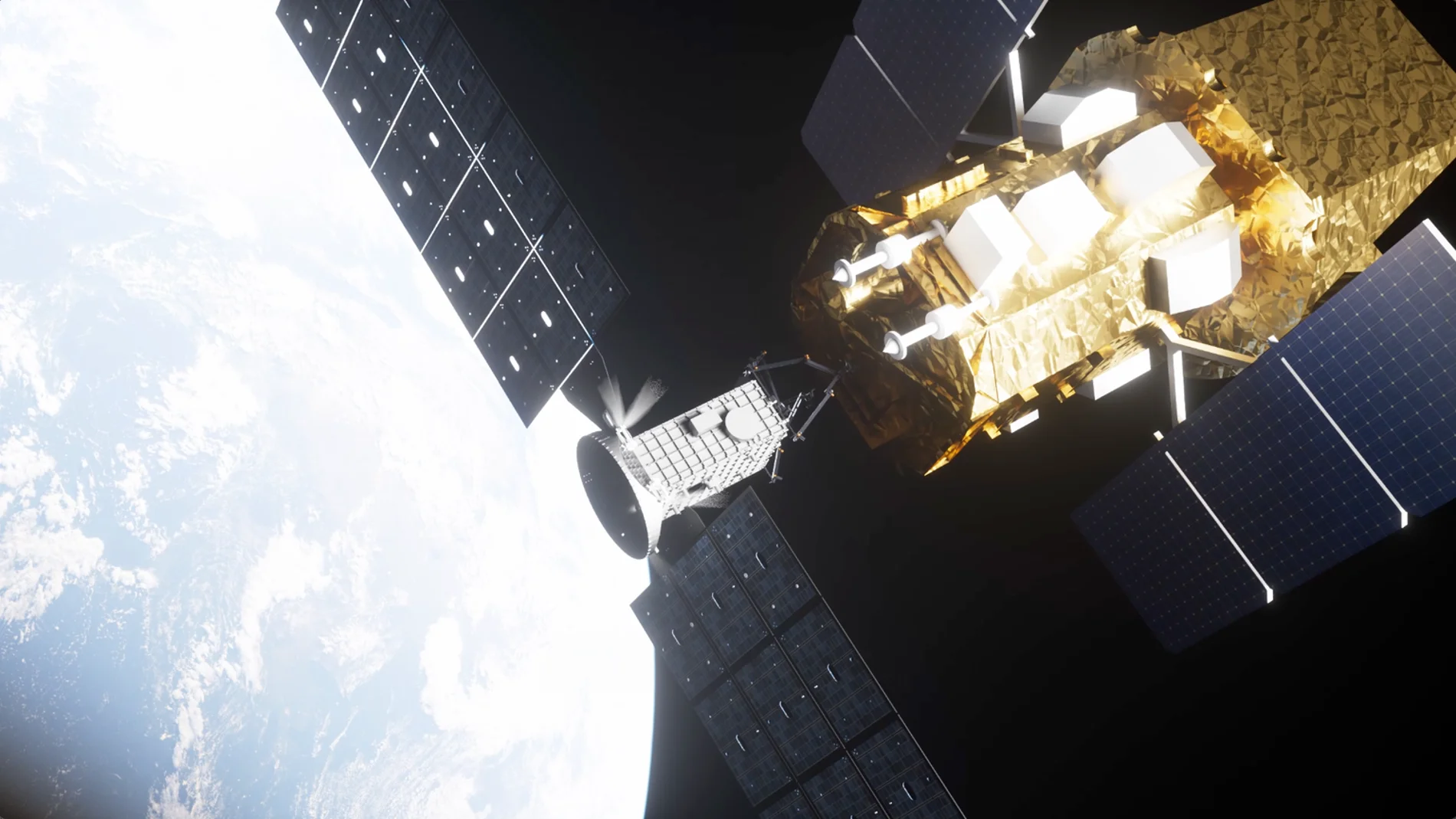
The robotic ship Katalyst Space, LINKlaunched on July 3 to prevent the space observatory SWIFT ends up falling into the atmosphere and is destroyed, it is spinning out of control after suffering a new failure in its orientation system. The POT has confirmed that two of its three reaction wheels do not work and? the cold gas thruster system It has also lost part of its capacity.
The reaction wheels are internal flywheels powered by electric motors. By accelerating or slowing down its rotation, they make the ship rotate in the opposite direction and allow it to orient itself without wasting fuel. LINK needed three to control its movements on the three axes. Cold gas thrusters complement that system expelling small amounts of compressed gas, without combustion, to apply short pulses and quickly correct the orientation.
The problem began over the weekend and caused intermittent communications with the ship. LINK continues to generate sufficient electricity, maintain contact with Katalyst Space, and keep its other main systems operational. The technicians will try to slow the spin over the next few days using their xenon electric thrusters..
LINK measures 1.5 meters tall, weighs 425 kilograms and deploys solar panels with a wingspan of about six meters. It has three robotic arms and three ion thrusters powered by about 60 kilograms of xenon. These engines convert gas into charged particles and accelerate them using electric fields. They produce little thrust, but can operate for long periods much more efficiently than a chemical engine, essential for slowly raising SWIFT’s orbit.the purpose of the mission.
SWIFT has almost 22 years in space since its launch on November 20, 2004. The observatory weighs 1,470 kilogramsmeasure 5.6 meters high and its solar panels reach four meters. Their three telescopes They observe the sky in visible light, ultraviolet, X-rays and gamma rays. Its main mission is to detect explosions of gamma rays and study its evolution, although it has also observed black holes, neutron stars, comets and other phenomena.
The need to rescue it is due to the fact that SWIFT lacks a propulsion system capable of maintaining its altitude. The thin atmosphere that still exists in low Earth orbit slows down the satellites slightly. This continuous loss of speed and energy causes their orbits to progressively descend.. The increase in solar activity has expanded the upper layers of the atmosphere and has accelerated this loss of height to the point where the observatory is at risk of re-entry and destruction.
The original plan called for LINK to complete its checks, travel to SWIFT and perform a visual inspection to confirm where it can hold it without damaging it. Then it has to deploy its three arms, grab the observatory and use the xenon engines to slowly raise it to about 600 kilometers in altitude over several months.. Once the maneuver is completed, LINK will separate and eventually re-enter the atmosphere.
The next steps now depend on Katalyst manages to stop uncontrolled spins. When LINK regains a stable orientation, the equipment will review its status and will modify the guidance, navigation and control software to adapt to the loss of two wheels. Katalyst and NASA will then decide if it can safely approach and capture SWIFT or if the mission needs another plan.