
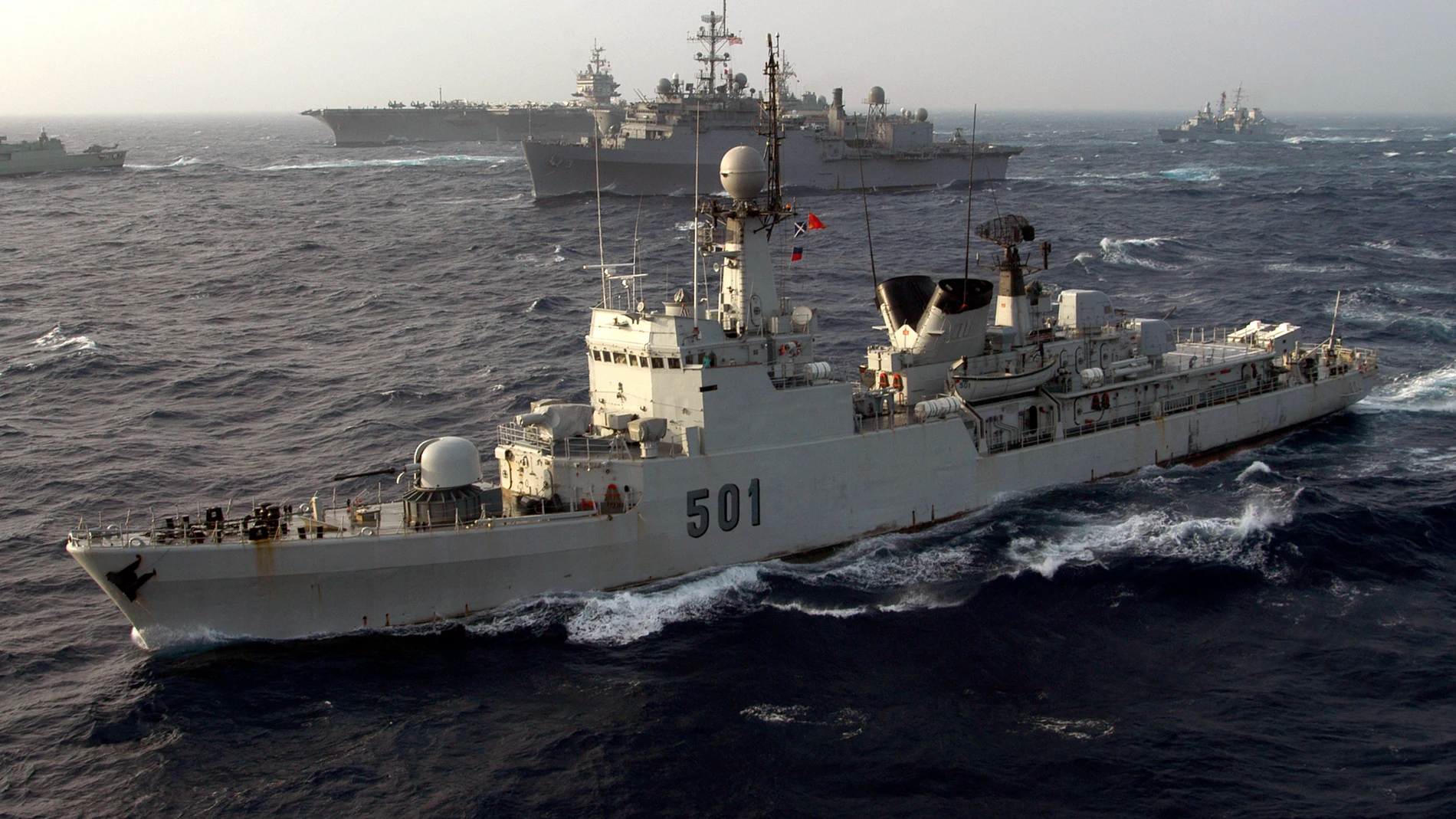
Spain exported to Morocco defense material for 30.1 million euros between January and June 2025according to the latest semi-annual report from the Secretary of State for Commerce. The deliveries included weapons, ammunition and fire direction equipment. In fact, this relationship goes back a long way: a part of the Moroccan military assets have come from Spanish factories and shipyards.
The supply also reaches the workshops. In 2024, when Spanish defense exports to Morocco totaled nearly 25.4 million, devices were sent to assemble and dismantle armor chains, presses and molds to repair their shoes, components and machinery spare parts. They are less attractive equipment than a fighter or a frigate, but they allow the material that already exists to be kept in service.
Buying a vehicle provides initial capacity, maintaining it requires parts and knowledge for years and Spain has participated in both jobs. The military relationship with Rabat combines commercial operations, technical assistance and political decisions, including transfers for symbolic amounts under PP and PSOE governments.
Navantia itself reconstructed its background in a transparency response dated August 1, 2025. In the late 1970s and early 1980s, the then Empresa Nacional Bazán signed contracts with Morocco to build a Descorta-class corvette, six Cormorán patrol boats and four Lazaga. Some time later the maintenance orders arrived.
The corvette Lieutenant Colonel Errahmani summarizes that continuity. Morocco ordered it in 1977 and received it in 1983. In October 2017, 34 years after its delivery, the ship returned to Navantia Cartagena for a thorough inspection, according to the General Navy Magazine.
There were also airplanes. In an interview published by the Spanish Defense Magazine in February 1990, the president of Construcciones Aeronáuticas, Javier Alvarez Varaincluded seven CN-235s for the Moroccan Air Force among the company’s recent sales. Rabat was already a client of the Spanish naval and aeronautical industry long before its current modernization programs.
The cooperation included material that Spain removed from its arsenals. The governments at the beginning of the millennium authorized operations, most at a symbolic price, with cannons or torpedoes as protagonists. The references of the councils of ministers of 2003 and 2008 document this supply route, distinct from the construction of new equipment to order. Things changed starting in 2008, where the scale changed significantly. Commerce recorded exports to Morocco for 113.9 million euros corresponding to 1,015 vehicles: unarmored SUVs, ambulances and tankers, firefighting trucks and cranes. The material covered mobility and support needs of the Moroccan Armed Forces.
The list allows us to appreciate what those Spanish supplies contributed, transporting personnel, caring for the wounded, supplying fuel or removing a damaged vehicle are functions that require their own resources. Logistical support takes up less space in the public display of weapons, although it is part of the ability to use them. Ambulances and tow trucks also count in a military inventory.
Relationships continue
The latest naval order extends that industrial relationship. Navantia announced in January 2021 a contract to build a high-altitude patrol vessel for the Royal Moroccan Navy. The 87-meter vessel was launched on May 27, 2025 in San Fernando, Cádiz. The public company estimated the program’s workload at more than one million hours and about 1,100 direct, indirect and induced jobs over three years.
The agreement includes spare parts, tools, documentation and technical training in Spain for Royal Navy personnel. Logistical support is part of the product sold. Navantia presented a design prepared for a crew of up to 60 people and designed to facilitate maintenance during long periods of deployment at sea. During the launching, the representative of the Royal Navy, Mohammed El Fadili, linked the order to the modernization of the Armed Forces decided by Mohamed VI. The same contract provides work to the Spanish shipyards and new naval means to the buyer. Military cooperation thus has a very specific economic expression in the Bay of Cádiz.
The Spanish contribution has a concrete scope within a market dominated by other suppliers. Between 2021 and 2025, the United States supplied 60% of the volume of Moroccan imports of large weapons; Israel, 24%, and France, 10%, according to data from the Stockholm International Peace Research InstituteSIPRI. Rabat’s main purchases are concentrated in those three countries with which it maintains strong diplomatic and economic ties. The Institute estimates that Moroccan imports increased by 12% compared to the previous five years. Renewal then requires meeting the needs of each team: supplying spare parts, updating instruments or repairing engines. Having several suppliers distributes these relationships between different countries, but leaves pending the development of the technical capabilities necessary to take on these jobs within Morocco.
Texas and Benslimane
On 28 August 2026, L3Harris reported that it had completed inspections of the first Moroccan C-130 included in its modernization program. The plane was in the town of Waco, Texas, undergoing maintenance, repairs and changes to its instruments. The company said it expected to receive a second device in the fall and a third before the end of the year, the latter to install a complete digital booth.
Contracted work includes aircraft modifications, major overhauls, engine repairs and logistical support. According to L3Harris, the goal is to prolong the life of the fleet and reduce time spent on maintenance. The updating of these transports shows how a military purchase can retain its usefulness for decades through subsequent interventions carried out by specialized companies.
Currently, Rabat is trying to transfer some of that work to its territory. The Maintenance Aero Maroc project, in Benslimane, brings together Moroccan public partners with Sabena Engineering and Lockheed Martin. The construction company Spantech explained in January that the hangar was under construction and placed its planned start-up in the second half of 2026, with the capacity to carry out major overhauls of F-16 and C-130.
In addition, the effort now extends to manufacturing. The agreement announced in June 2026 with Harmattan AI includes producing autonomous defense systems in Morocco, creating a research center and collaborating with academic institutions in the country. These are projects with which Rabat aims to acquire knowledge and industrial capacity through associations with companies located abroad.
Spain also maintains its dependence on foreign suppliers. In that five-year period, the United States contributed 49% of its large weapons imports, according to SIPRI, followed by Switzerland, with 25%, and France, with 9.1%. These supplies coexist with the Spanish capacity to build ships, manufacture airplanes and maintain military systems.
On the other hand, preserving one’s own technical capacity requires investment. The Armament and Experimentation Logistics Center, in Torrejón, Madrid, maintains groups dedicated to flight testing, aeronautical software and weapons, and provides support to the Eurofighter and A400M programs. Defense highlighted these functions during the visit of Margarita Robles on July 15. The degree of autonomy depends on what tasks each country can perform with its technicians and facilities.
To evaluate Moroccan military evolution from Spain, we will also have to pay attention to these workshops: what they can repair, what specialists they train and what components must continue to arrive from outside. The new industrial centers seek to reduce that dependence. Meanwhile, L3Harris’ contract to modernize Rabat’s C-130s includes work in Texas until 2029.
Six torpedoes for one euro
One euro was the total price of the six torpedoes that the Government of Spain authorized to transfer to Morocco on June 27, 2008. The amount, obviously symbolic, corresponded to the entire lot. They were MK 46 MOD 2, a version that the Spanish Navy was retiring in favor of a transition to using a much more modern one. The reference from the Council of Ministers held then explains that it was, in reality, an advantage for Spain since it could avoid the expense of demilitarizing these weapons. He also called for the improvement of bilateral relations. The admiral chief of the Navy Staff had reported favorably on the transfer. Five years earlier, the Executive had authorized another symbolic operation. Two 76-millimeter Oto-Melara cannons and two directions of fire would leave for Morocco for one euro each. They came from Lazaga patrol boats retired from service and would be used to equip Floréal frigates acquired from France. Rabat had requested that material. In January 2008, another transfer was approved: eight sets of aviation bomb launchers, valued at 86,848 euros, for one euro each. Defense had already replaced them with more modern equipment. These operations coexisted with contracts of another dimension. In 2008, Spanish exports to Morocco of 1,015 transport and support vehicles reached 113.9 million euros, according to the Secretary of State for Commerce.