
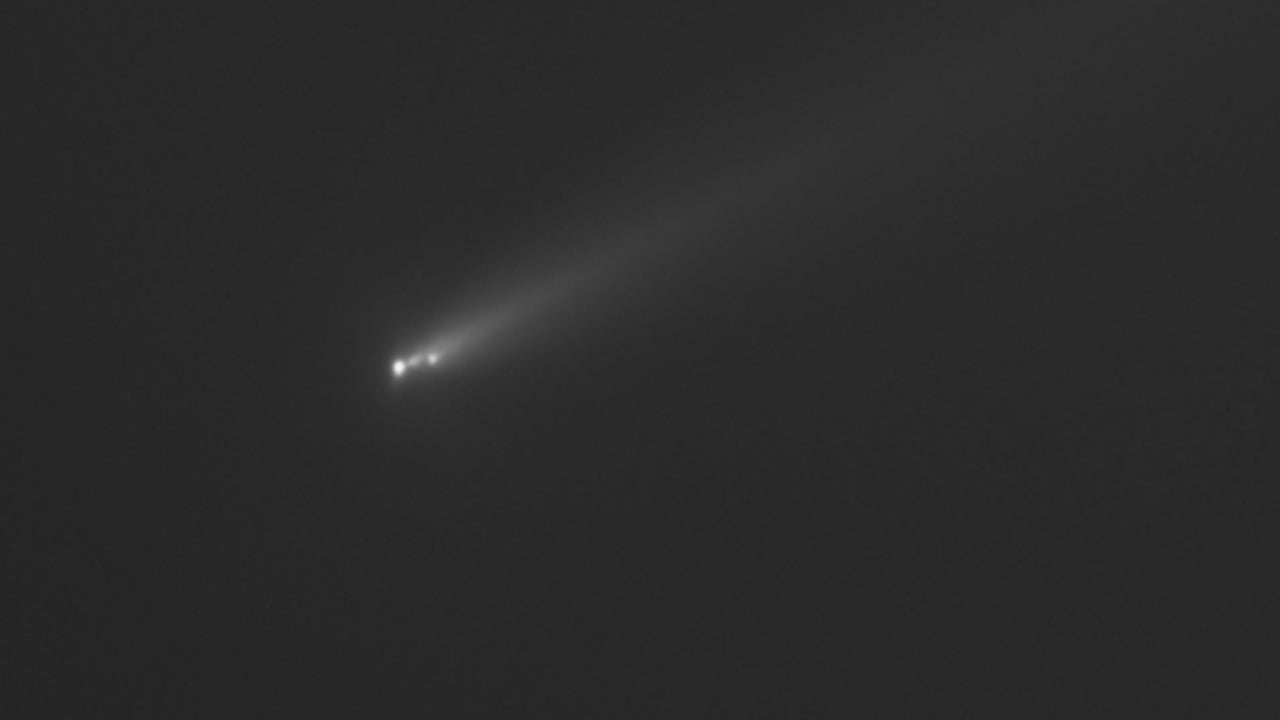
We are no longer just talking about 3I/ATLAS, the famous interstellar object has what we could call a little brother. Comet C/2025 K1 (ATLAS) was discovered in May by astronomers from the Asteroid Terrestrial Impact Final Warning System (ATLAS, hence its “last name”) and passed through its perihelion, or closest point to the Sun, on October 8. It has no relation to the famous interstellar comet 3I/ATLAS, except that both were discovered by the same telescope network at almost the same time.
Initial observations seemed to indicate that Comet K1 survived its passage around the Sun at a minimum distance of 50 million kilometersapproximately four times closer than comet 3I/ATLAS.
However, new observations made by astronomer Gianluca Masi in Manciano, Italy, show that The gravitational strain of its journey around the Sun was too much for the comet, causing it to break up.
“Several parts (subnuclei or debris clouds) are observed, as well as a plume just below the main fragment”said Masi, astronomer at the Campo Catino Astronomical Observatory and founder of the Virtual Telescope Project.
The disintegration of C/2025 K1 was heralded by a sudden increase in brightness near perihelion, during which The comet changed the greenish tone characteristic of many comets that pass near the Sun (due to the presence of diatomic carbon that glows in sunlight) to a golden stripe.
The cause of this transformation is not clear; Some scientists speculate that the color change had to do with a relative shortage of carbon-containing molecules in the comet’s coma. (the cloud of ice, gas, and dust that surrounds your body).
Although The comet is still too faint to see with the naked eye, it can be observed with a good telescope or binoculars for astronomical observation. If you want to see it, look in the constellation Leo, where it shines at magnitude 9.9, according to The Sky Live.
The comet’s remains will pass closer to Earth on November 25. They will come within about 60 million kilometers, or just under half the average distance between Earth and the Sun.. At that time you will be able to learn even more about this object.