
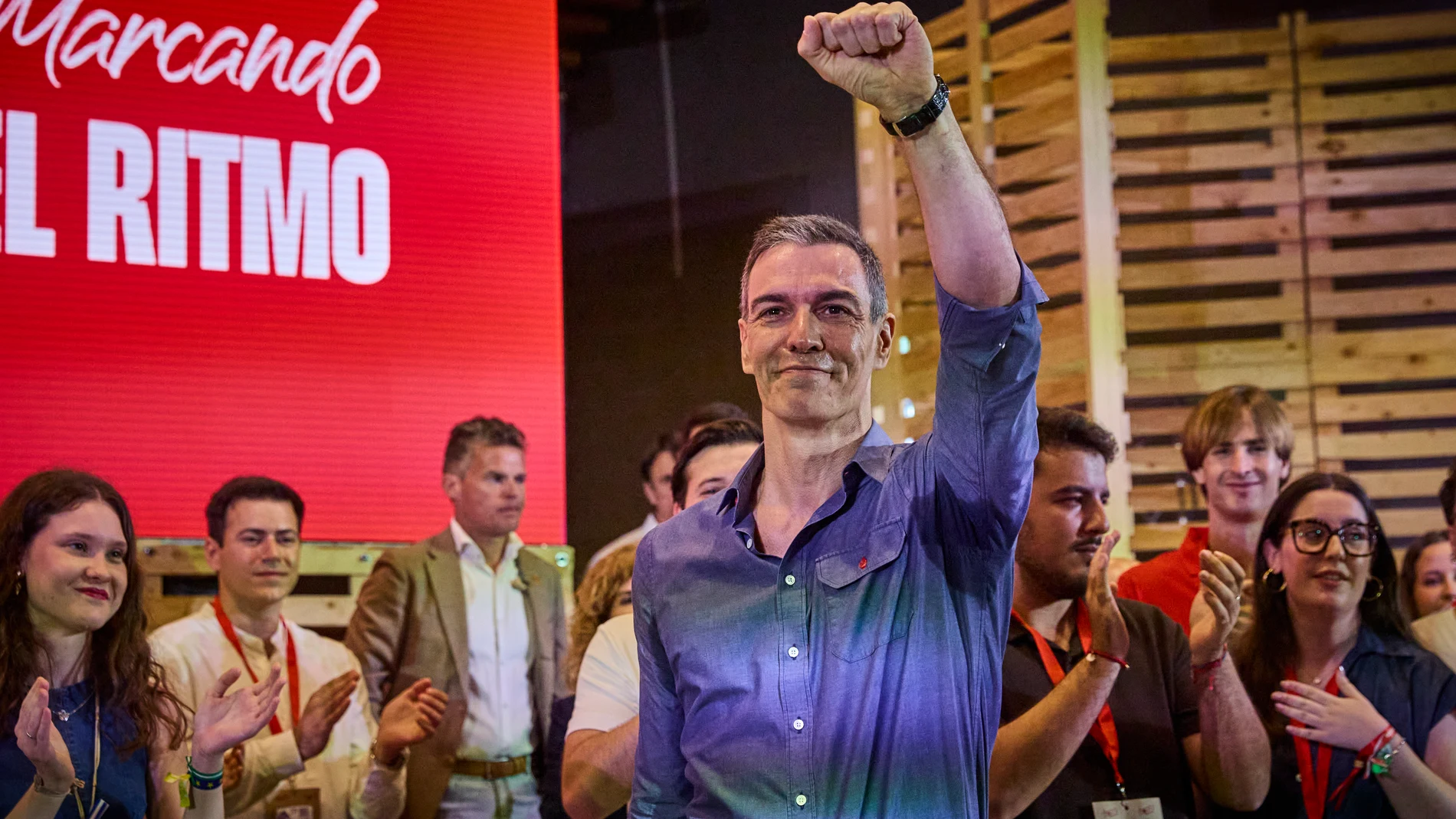
Yesterday, Pedro Sánchez completed his most difficult week since he took charge of the country. The President of the Government insisted that he is faced with a “rogue” opposition that seeks nothing more than his downfall, even through undemocratic methods, as denounced by the Minister of Transport, Oscar Puente.
Although Sánchez limited himself to making them ugly for their “bad arts.” The feeling that runs through Moncloa is that the Executive is being the victim of a hunt. It matters little that the concatenation of scandals left the PSOE this past week without a pulse.
The investigation opened to the former president Shoemaker for being the alleged ringleader of an illicit enrichment plot and the second search of the Ferraz headquarters by the UCO within the framework of the “plumber case” broke the socialists on all four sides. None of them thought they would see everything they saw last week. For this reason, Sánchez tried yesterday to revive the organization in front of the youth.
The president, and his hard core, trust that the summer will melt the offensive against him and reduce the indignation of the citizens. The truth is that the Government plays with the conviction that the party against the PP is “tied».
It matters little that the corruption cases affecting the PSOE are recent, because the popular ones “are the institutionalization of corruption,” in the words of a minister. And, for this reason, Sánchez blames all the popular scandals every time he has the opportunity. The president’s gurus They warn that the next electoral campaign is going to be played “negatively” rather than positively.
Sánchez is determined to resist until the end of the legislature because he considers that he still has a political agenda to complete and because he understands that the Government retains the legitimacy that the polls gave it to govern until 2027. In La Moncloa they maintain that an important part of the European funds still needs to be executed, to which much more importance is given than to the Budgetsand they refuse to call early elections at a time that they consider favorable for the PP.
Furthermore, there are those who, like the president, believe that an early election will irremediably aggravate the situation on the left. The strategy involves enduring the wear and tear of the coming weeks and overcoming the appearance in Congress, to which Sánchez has had no choice but to arrive to please some partners who do not hide their discomfort at the putrefactive smell that comes from the socialist headquarters of Ferraz.
It is true that the Government is also saved by the fact that none of its partners dare to overthrow it with a motion of censure that encourages the arrival of the PP and Vox to Moncloa.
In the Executive they have clung to the idea that, when the dust settles, the scandals will end up having much less impact than they seem today. They argue that the “lobbying” exercised by Zapatero does not constitute any illegal activity and that the former president has the same right as any former high official to develop a professional career outside of politics.
Regarding Leire Díez, the official thesis is even more forceful: “he is nobody” and, in any case, the responsibility for his actions falls on Santos Cerdán. The PSOE insists that it has already acted against those it considers responsible for having betrayed the party’s trust, José Luis Ábalos and Cerdán himself.
For this reason, Sánchez’s closest circle understands that there is no reason to open a major political crisis. Neither resignation, nor question of trust. Precisely, as this newspaper has reported, the storm that the Government is going through has also become a test of loyalties within Sánchez’s hard core.
His closest collaborators take note of who is involved in the president’s defense and who opts for silence, distance or calculated prudence. What those who know how Moncloa works describe is a president increasingly closed in on himself. Sánchez shares less information than before, consults less and has reduced spaces for collective deliberation to a minimum.
The socialist machinery has progressively been left out of major decisions and some leaders observe with concern how the head of the Executive has been isolating himself from the heavyweights of the party. “It is crushing people,” summarizes a veteran socialist. The leaves of the calendar are falling, where there are no months, there is resistance.