
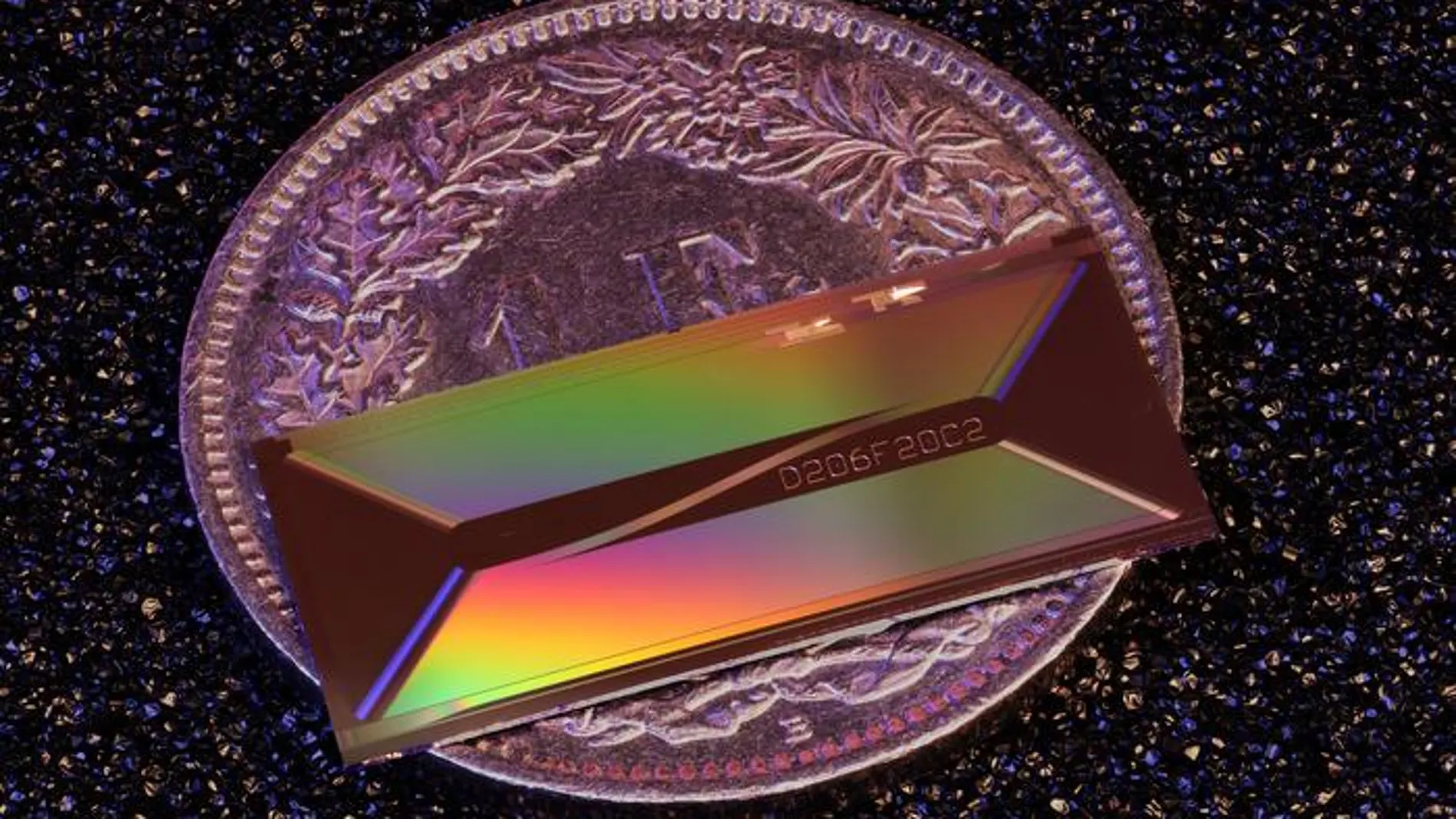
For light, a second is an eternity. In the time it takes us to blink, a light ray could circle the Earth several times. Therefore, when physicists talk about ultrafast lasers, they enter a territory where the scales no longer seem human. The pulses generated by these devices last only a few hundred femtoseconds. A femtosecond is equivalent to one billionth of a second: 0.000000000000001 seconds. Yes, something infinitesimal. The figure is so extreme that it barely has intuitive meaning. And yet, those very brief flashes of light underpin some of the most precise technologies ever developed by humanity.
They are used to manufacture microscopic components, perform high-precision eye surgeries and generate so-called optical frequency combs, a Nobel Prize-winning technology that constitutes the heart of the world’s most accurate atomic clocks. The problem is that these lasers are usually large, complex and expensive.
For decades, systems capable of generating ultrashort pulses have remained confined to specialized laboratories, occupying entire optical tables covered in mirrors, fibers and delicately aligned components. Now, A team of scientists from the Federal Polytechnic School of Lausanne (EPFL), led by Tobias Kippenberg, claims to have achieved something that many experts considered one of the great pending challenges of integrated photonics: transferring this technology to a chip.
The device described in the magazine Nature It generates pulses of just 147 femtoseconds and reaches energies greater than the nanojoule, performance that until now was mainly associated with much larger desktop systems. The most accurate comparison of how long this “quantum flicker” is, 147 femtoseconds is to a second what a second is to about 216,000 years. To get an idea of the magnitude of the advance, it is convenient to imagine an electronic circuit. In a microprocessor, electricity flows through microscopic channels etched into a silicon wafer. Photonic chips work in a similar way, but instead of electrons they transport light.
Thanks to them, numerous optical functions that previously required equipment the size of a room have been progressively reduced to occupying just a few square millimeters. However, ultrafast lasers had proven especially difficult to miniaturize. Kippenberg’s team turned to an architecture known as the Mamyshev oscillator (a ttype of fiber optic laser designed to generate ultrashort light pulses)an idea proposed years ago, but relatively little explored in integrated photonics. And the result was surprising.
The laser cavity has a total length of 42 centimeters. However, Those 42 centimeters are folded and rolled into a surface comparable to the size of a match head. It’s like compressing an athletics track inside a coin.
The duration of each pulse is so small that it is difficult to find satisfactory analogies. Light travels approximately 44 micrometers for 147 femtoseconds. That means that, for the duration of each pulse, the light travels less than the width of a human hair.Another way of looking at it is to think that these flashes are so brief that they allow us to observe phenomena that occur on a molecular scale, where atoms vibrate, chemical bonds are formed and electrical charges move. They are, in a sense, ultra-fast cameras for studying the invisible world.
The most interesting thing about the advance may not be the speed of the laser, but the possibility of manufacturing it as if it were a microchip. The authors note that more than a thousand laser cavities could be produced simultaneously on a single waferusing processes similar to those used by the semiconductor industry. If that promise comes to fruition, the cost of these systems could be dramatically reduced.
And that’s when the applications appear. Ultrafast lasers are used to detect atmospheric pollutants, identify chemical molecules, analyze materials, inspect invisible defects in industrial components, and perform extremely precise measurements. Also could play an important role in future generations of wearable medical devices. But perhaps one of the most ambitious applications is the miniaturization of optical atomic clocks.
These instruments are so precise that they would waste less than a second in billions of years and form the basis of technologies such as satellite navigation systems, advanced telecommunications and much fundamental research in physics. Today they occupy entire laboratories. Tomorrow, some of its functions could fit into a device the size of a mobile phone.