
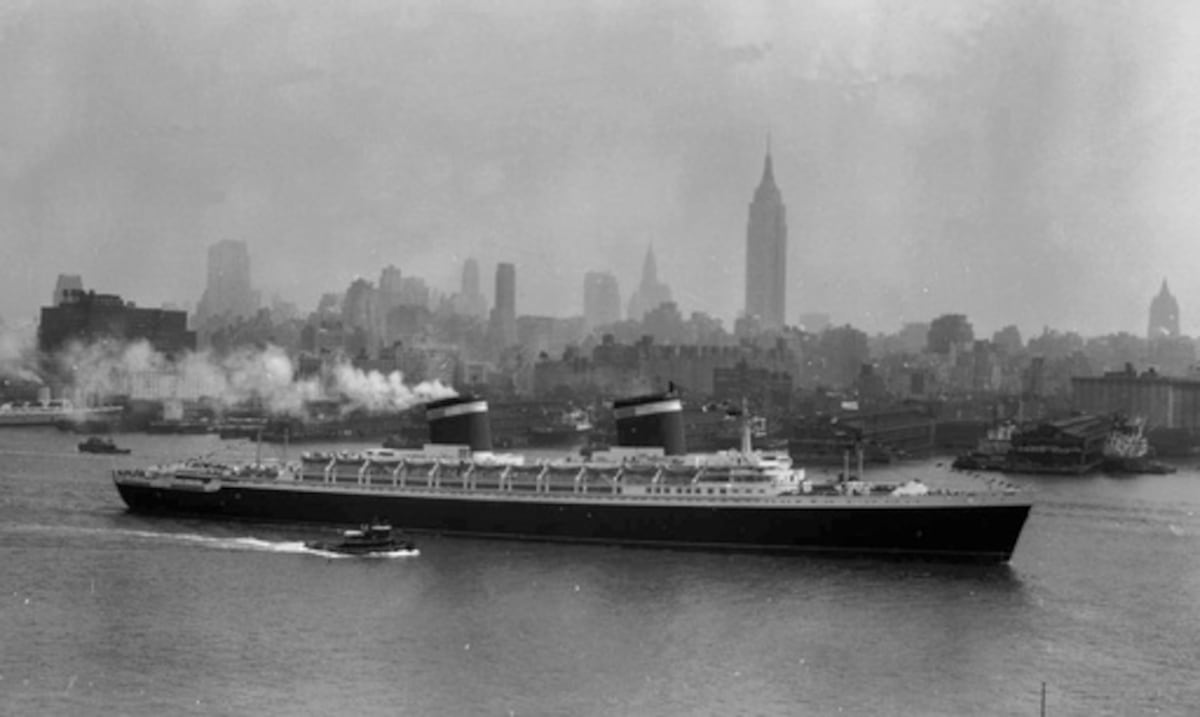
A historic ocean liner will become the world’s largest artificial reef after it sinks off the coast of the Gulf of Mexicoin the state of the Florida early next year.
Okaloosa County officials announced Tuesday that they hope to sink the SS United States in early 2026 about 22 nautical miles southwest of Destin and 32 nautical miles southeast of Pensacola.
The nearly 1,000-foot-long ship, which broke the transatlantic speed record on its maiden voyage in 1952, has spent most of this year in the port of Mobile, Alabama, where it has been cleaned to remove chemicals, cables, plastics and glass.
Regional association
The ship’s final location was chosen within the framework of an agreement with the Pensacola tourism authorities, which is contributing $1.5 million to the project, and the Florida Coastal Conservation Association, which is contributing another $500,000. Authorities had been considering two other locations, including one that would have placed the ship further east and closer to Panama City Beach.
“This collaboration will foster incredible adventures for generations of visitors and create a tourism economy that will benefit the state and the entire Northwest Florida region,” Okaloosa County Board Chairman Paul Mixon said in a statement.
Contributions will be used to transform the SS United States into an artificial reef and fund a multi-year marketing campaign. The deal is part of Okaloosa County’s $10.1 million plan to acquire, relocate, clean up and sink the ship, which includes $1 million for a land-based museum to promote the ship’s history.
Once in place, the SS United States will sit at a depth of about 180 feet, but the vessel is so high that the upper decks will be about 60 feet from the surface, making it attractive to both novice and experienced divers. The artificial reef will also be about 12 nautical miles from the USS Oriskany, another popular diving destination that sank in 2006.
The SS United States will join Okaloosa County’s more than 500 artificial reefs, which include a dozen smaller shipwrecks.
“The transformation of the SS USA on the largest artificial reef in the world provides a unique opportunity to showcase our entire region on the international stage,” said Darien Schaefer, President and CEO of Visit Pensacola.
The new artificial reef will provide essential habitat for marine life, prompting the Coastal Conservation Association Florida to make its largest donation in the organization’s 40-year history.
“It is a unique opportunity to contribute to the creation of the largest artificial reef in the world,” said Brian Gorski, Executive Director of CCA Florida, in a statement.
long trip
The SS United States arrived in Alabama in early March after a 12-day tow from Philadelphia’s Delaware River, where it has spent nearly three decades. Okaloosa County took ownership of it after a rental dispute between the entity that oversees the boat and its owner was resolved last October.
Various groups have attempted to restore the SS United States over the years, but all plans were eventually abandoned due to its high cost. Recently, increasing media attention has led to more calls to preserve the ship, and a group called the New York Coalition filed a lawsuit in federal court in Pensacola asking a judge to stop the sinking of such a historically significant vessel.
But Okaloosa County officials have said that preventing the SS United States from becoming a reef would only serve to send it to the scrapyard.
The ship, which is more than 100 feet longer than the RMS Titanic, was once considered a beacon for thousands of American troops. On its maiden voyage, the ship reached an average speed of 36 knots, or just over 41 mph (66 kph), The Associated Press reported from aboard.
The ship crossed the Atlantic Ocean in three days, 10 hours and 40 minutes, beating the RMS Queen Mary by 10 hours. To this day, the SS United States holds the transatlantic speed record for an ocean liner.