
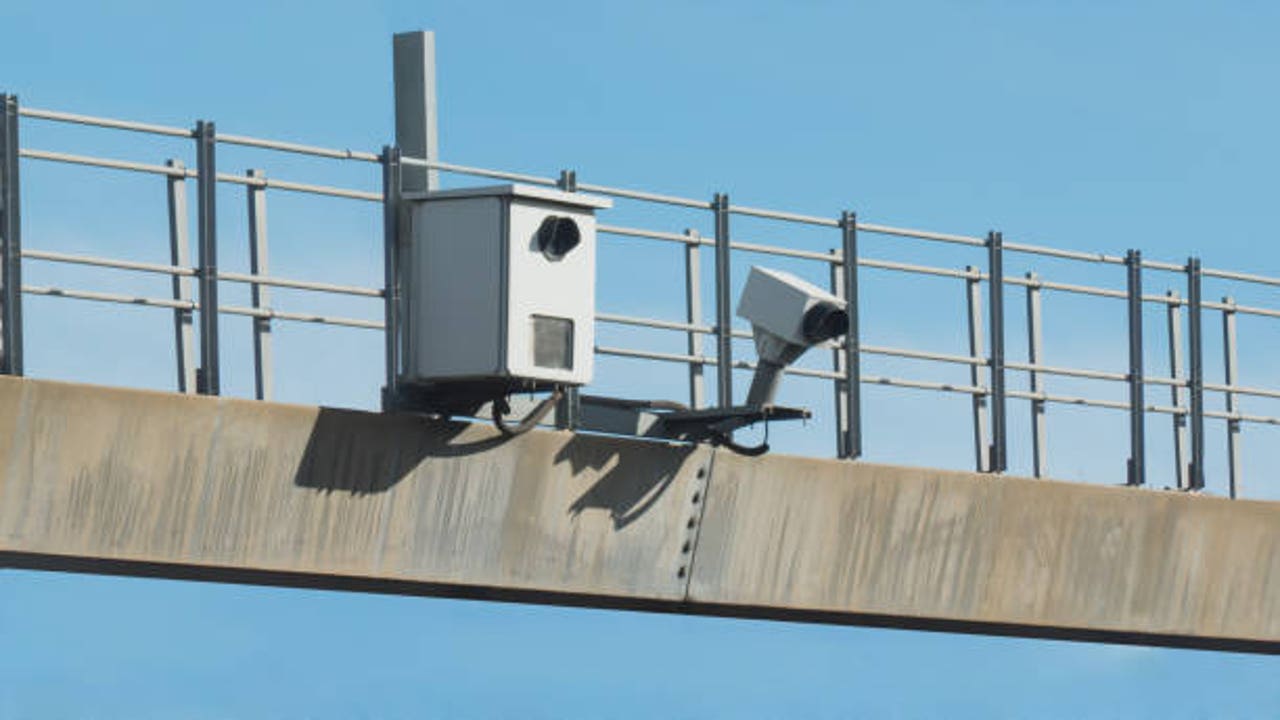
The General Directorate of Traffic It is the maximum body in charge of control of the roads, as well as their regulations of circulation, speed, entry and exit of them. In addition, this entity is responsible for writing and sending the corresponding fines to the offenders within the national territory.
Therefore, the General Directorate of Traffic requires knowing the circulation standards published in the Official State Gazette (BOE). Within these norms, the GENERAL CIRCULATION REGULATION and the Traffic Law.
Within these standards, Speed limits is one of the most controversial issuesand it is a large part of the number of fines that are imposed in the national territory. Therefore, the DGT in collaboration with the Civil Guard of Traffic has increased surveillance in these types of infractions in recent years.
Revenue record thanks to camouflaged radars
In this way, the association Associated European motorists (AEA) has denounced the increase in turnover by traffic fines Due to the ‘camouflaged radars‘of the General Directorate of Traffic (DGT).
Last year DGT fines collection reached the record of 539,985,552 eurosbeing the highest of the last 10 years, according to the ‘radiography of traffic fines in Spain 2024’ carried out by the driver defense organization.
During the past year, the DGT formulated on the Spanish roads of its competition a total of 5,413,507 complaints, which supposed an increase of 5.14% compared to the complaints made in 2023 (5,148,667)and a collection of 539,985,552 euros, according to a recent report that has analyzed the evolution of the infractions committed on Spanish roads during the 2024-2023 period.
However, 10.51% of the complaints are going down for not making use of the helmet (6,139 complaints against 6,860 formulated in 2023) or for conducting overcoming the allowed alcohol rate (-5.83%), as well as those formulated by exceed a red traffic light (-22.52%)
What types of radars does the DGT have?
However, the General Traffic Directorate has A large and extensive qualified equipment for the detection of infractions of all kinds. If we focus on speed radars, these are some of which are usually used:
- Fixed radars: They are the traditional ones. They are located At a fixed point of the road And they work through an antenna that emits a microwave signal to the road, this signal bounces in the vehicles and returns to the antenna calculating the speed of the car at that time. By law they are marked on the road
- Section radars: There are more and more and consists of the placement of two radars that control the average speed of vehicles that circulate between those two points.
- Mobile radars: They are located inside a civil guard car or on a tripod next to the road controlled by an agent. It works both in a moving vehicle and one standing.
- Velolaser radars: It is one of the last types of radar to reach the DGT. It is a radar with laser technology that controls a road through the projection of laser lines. When a vehicle passes, the light beam is projected on it and bounces to the device, which allows calculating the distance and time between which it goes and that light returns.
- Pegasus helicopter: The DGT has 13 of these radars, but only 10 have the camera that is capable of putting speed fines from the air. These helicopters a year perform more than 3,000 hours of surveillance and detect up to about 20,000 infractions.
- Traffic light radar: They are also known as photo-reds. It is a type of radar used by municipalities to control who skip a traffic light. It consists of a camera placed in the vicinity of a traffic light capable of taking a photo that captures the registration and location of the car.
- Radar in waterfall: As we explained before it is a type of radar that consists of placing a mobile radar just after a fixed radar, thus knowing if a driver accelerates once again has gone through the first control.
- Belt radar: They are not really radars, but cameras that detect if the occupants of a vehicle are wearing the seat belt. They can take up to 50 photographs per second and in Spain there are more than 200 camera of this type located in posts and porches.
Finally, we must remember that in this year 2025, the DGT has put into circulation a total of 122 new radars throughout Spain as part of your plan to improve road safety and reduce accidents caused by speeding.
Until August, 41 of these radars have already been activatedof which 28 are fixed and 15 stretch radars. Besides, Recently another 32 new Radars distributed by different autonomous communities, including both fixed and section radars, installed on roads ranging from highways to secondary roads.