
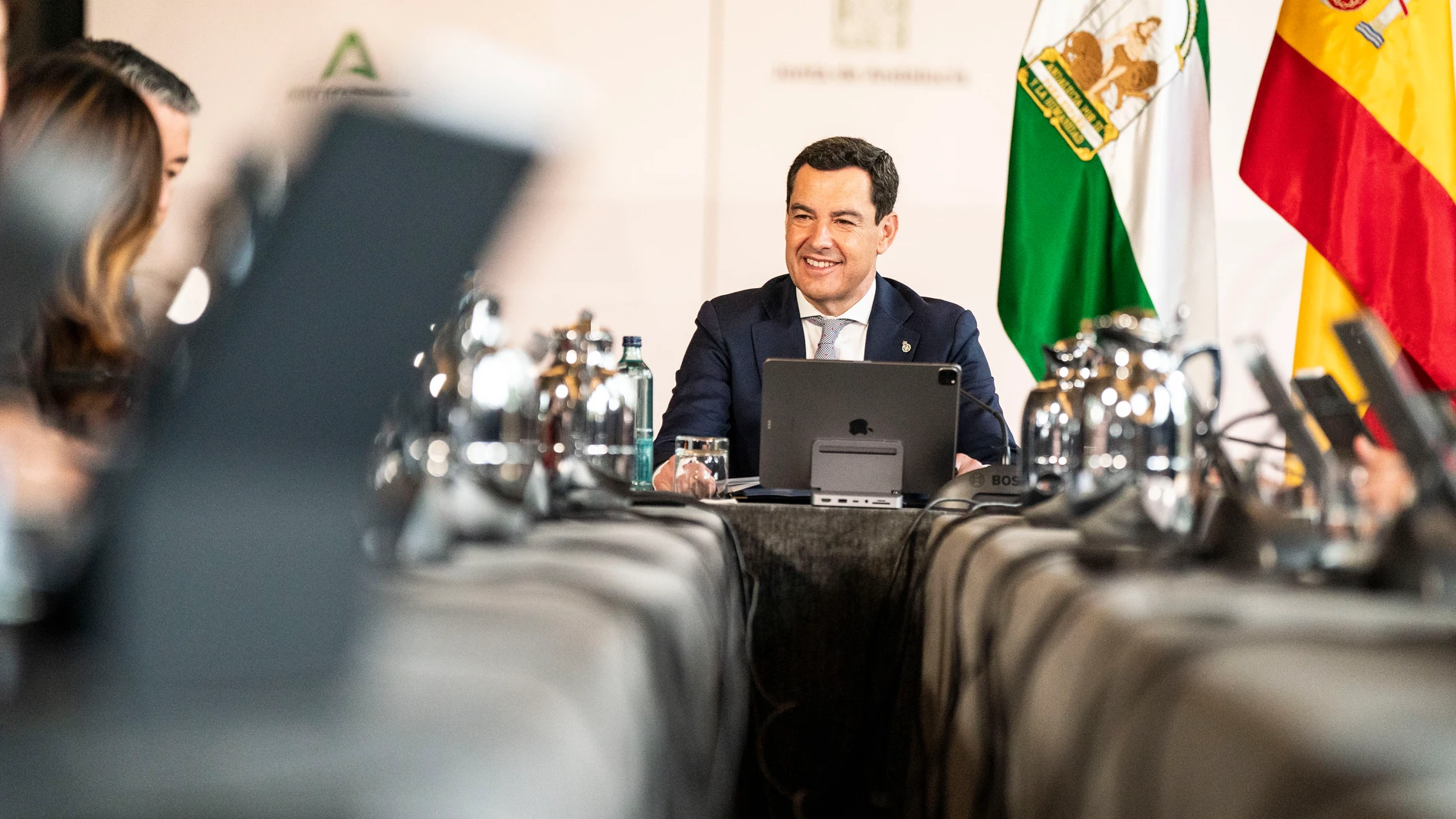
The prediction bordered on the territory of the axiom. The acting Andalusian president had been repeating for weeks, with the insistence of someone who knows the ropes, that the day after the Andalusian elections the Government of Pedro Sánchez would reactivate its commitments to the Catalan independentists. There was no need to wait. In less than 48 hours, Salvador Illa and Oriol Junqueras signed a budget agreement for the Generalitat of 2026 that the Andalusian Executive in office describes as a new “grievance” and “privilege to the independence movement.” A self-fulfilling prophecy. “I warned a few days ago that there would be new concessions to the Catalan independence movement after the Andalusian elections, and this has come true,” the Andalusian president recalled in X.
The agreement has sensitive figures for the south: 5.2 billion euros for an orbital train in Catalonia and another 527 million until 2029 to reinforce the Catalan Tax Agency, which the spokesperson for the Andalusian Government, Carolina España, interpreted as a step that “paves the way to fiscal independence” and “violates the principle of equality and interterritorial solidarity.” All this while Andalusia accumulates, according to Moreno himself, zero new kilometers of Cercanías. The numerical contrast does not need a gloss: billions for the Catalan railway infrastructure, and nothing for the Cercanías network of the most populated community in the country. The spokesperson for the Andalusian Executive described the agreement as a “mockery” to the Andalusian citizens and recalled that the Andalusian Parliament will be formed on June 11, with Moreno’s investiture as the only possible solution, according to the acting Executive. The PP-A’s argument does not exhaust itself in the denunciation of the new pacts but rather points directly to María Jesús Montero: the socialist candidate who fell to 28 seats on March 17 is not only the leader of the budding Andalusian opposition but also the Minister of Finance who designed and presented in January the autonomous financing model that she now says she wants to reform. Montero said after the electoral setback that he would go “game by game” and started with an own goal for the electorate.
The contradiction was exposed with crystal clarity on page 72 of his own electoral program, the so-called “Montero Plan.” The text promised to “claim an active and permanent presence of Andalusia in the design and negotiation of the model.” The problem is that the model was already closed when the program was printed. It was Montero herself who presented it, after agreeing on it with ERC, and it was Junqueras himself who announced it. No autonomous community, except Catalonia, participated in its architecture. The candidate admitted it unequivocally: the proposal “is closed.” She made it herself. She promised in Andalusia what as minister she had already ruled out in Madrid.
The Centra Barometer of October 2025 puts figures on the discomfort: 62% of Andalusians considered it “very negative” that the Government would forgive Catalonia’s debt, and 77.7% agreed that fair financing is more urgent than any forgiveness. These are data that Moreno agitated throughout the campaign and that now, with the Illa-Junqueras agreement on the table, they take on new political life.
The financing proposal also includes what the director of Fedea, Ángel de la Fuente, described as “the imaginative excuse to give Catalonia a juicy financing premium on account of VAT for corporate SMEs.” Translated into euros: 1,441 million for Catalonia for this concept. For Andalusia, again the same number as in Cercanías.
During the campaign, Moreno shed light on Montero’s role after the elections. “On the 18th, Mr. Junqueras will exercise the note he has on the mortgage that Mr. Sánchez has,” he predicted. The PP-A asked if Montero knew about the agreement before the elections “and yet he hid it” while Andalusia also waits for its train.