
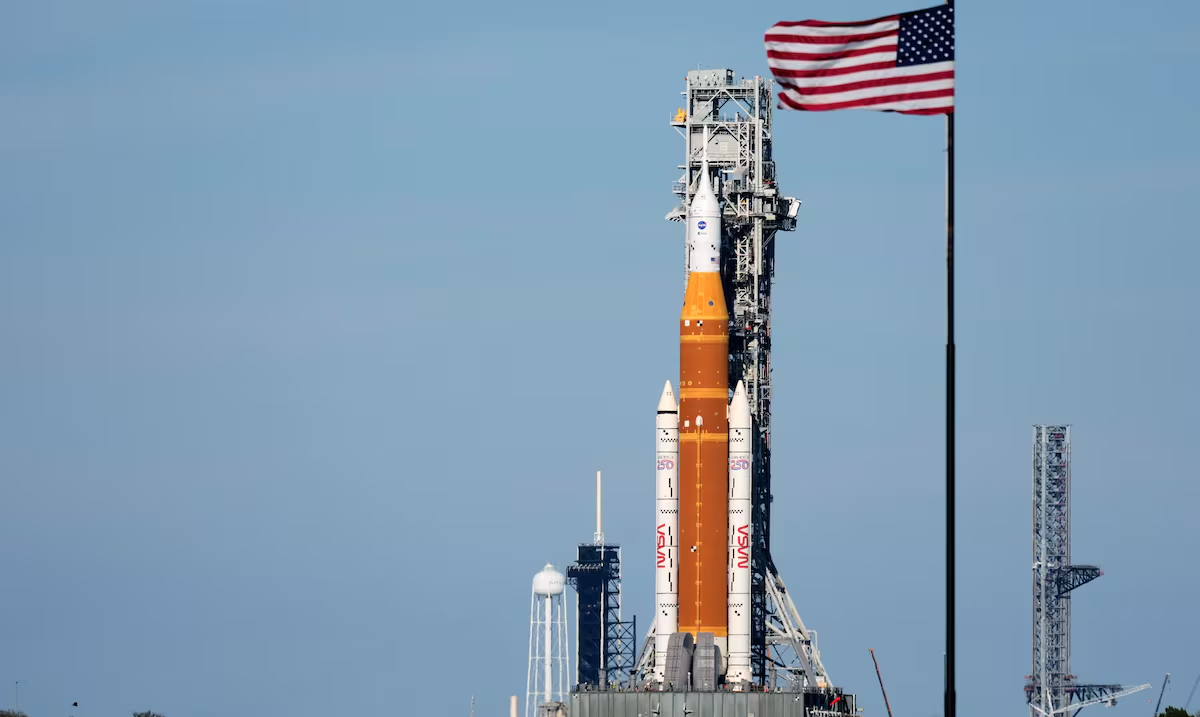
The historic takeoff of the mission Artemis IIwith four crew members heading to lunar orbit, must overcome the initial eight and a half minutes of greatest risk this Wednesdayas explained to EFE by Spanish engineer Carlos García-Galán, director of Moon Base of the POTa program aimed at developing a colony on the lunar surface.
“The truth is that I am not going to applaud until the first 24 hours, if I am honest, but it is a very good sign if we pass the first 8 minutes, if we pass them, much of the risk of takeoff is already behind us”accurate.
The engineer eagerly awaits the mission’s takeoff from Cape Canaveral, scheduled for today at 6:24 p.m. local time (22:24 GMT) from the Kennedy Space Center (Florida).
He pointed out that, approximately two and a half minutes after takeoff, the enormous first stage, which has the two solid fuel engines, falls off into the Atlantic, while other pieces will do so later in the Pacific.
1 / 15 | Meet the crew of NASA’s Artemis II mission. One day (April 1, 2026) before the scheduled launch of the Artemis II mission, the National Aeronautics and Space Administration (NASA) finalized planning for its first manned mission to the Moon since 1972. – EFE Agency
Among other parts being released are the three layers that protect the Orion service module and also the escape tower, which is a safety engine on top of the crew capsule for emergency use. “This is used if the capsule has to be removed in the event that there was a rocket failure or the rocket exploded. But if we don’t need it, in about 5 minutes or so we can remove it”he explained.
In the remaining minutes, as the ship continues to accelerate, the second stage of the rocket, which houses the four main engines, runs out of fuel, separates and falls as well.
“In 8 and a half minutes we will know that the rocket has worked well and has put us in the correct orbit”said García-Galán.
“Launch and reentries are always important,” he said, referring to the biggest risks. “We will be checking that all systems are working well and we will not take off until we are ready.”he added.
24 hours before going to the Moon
Once the critical stage has been passed, the third phase of the rocket (Interim Cryogenic Propulsion Stage – ICPS), which “It looks like a module with a very large motor”will raise the ship to a very high orbit, while Orion remains docked, the NASA manager detailed.
The height, García-Galán explained, is chosen in such a way that it allows “spending 24 hours in Earth orbit, checking all the systems, making sure everything is fine before sending them to the Moon”.
During this process, the ship also separates and the crew performs the first test of the mission: it takes manual control and runs a docking simulation with the third phase as if it were a lunar landing module.
Advances of SLS and Orion
The Space Launch System (SLS), NASA’s largest and most powerful rocket, and the Orion capsule, which already carried out a first test in 2022 during Artemis I, this time with dummies, arrive today for this second flight with some minor adjustments in the first, and with “all crew-related systems” incorporated in the second, which were absent in the initial mission, explained the engineer.
He also indicated that they will test a new Orion laser communication system: an optical terminal that uses infrared laser light instead of radio waves to transmit data to Earth, allowing a much larger amount of information to be sent.
“If it works it will give us great HD images and we will also be able to see the crew live.””he explained.
“Reflect” diversity
The mission is also historic for taking a woman, Christina Koch, an African-American astronaut, Victor Glover, and a non-American, Canadian Jeremy Hansen, to the Moon for the first time, an aspect that, according to the engineer from Malaga, makes diversity in space exploration visible.
The crew is completed by NASA Commander Reid Wiseman.
“I think it is important to reflect, that people can reflect on them and say: these people are doing something that seems impossible, going to the Moon again after more than 50 years. That people, boys and girls, can reflect on them and say ‘I can do that too'”, he stressed.
The Spaniard, in charge of the construction of a lunar base at NASA, highlighted that these new generations will be required in space exploration.
“We are going to need new engineers, new scientists. For example, we are going to build a lunar base, a colony starting this year that will be operational by 2032 or so. And that is the beginning, we are going to use it to learn the things we need to go to Mars. And from there, let’s dream,” he said.