
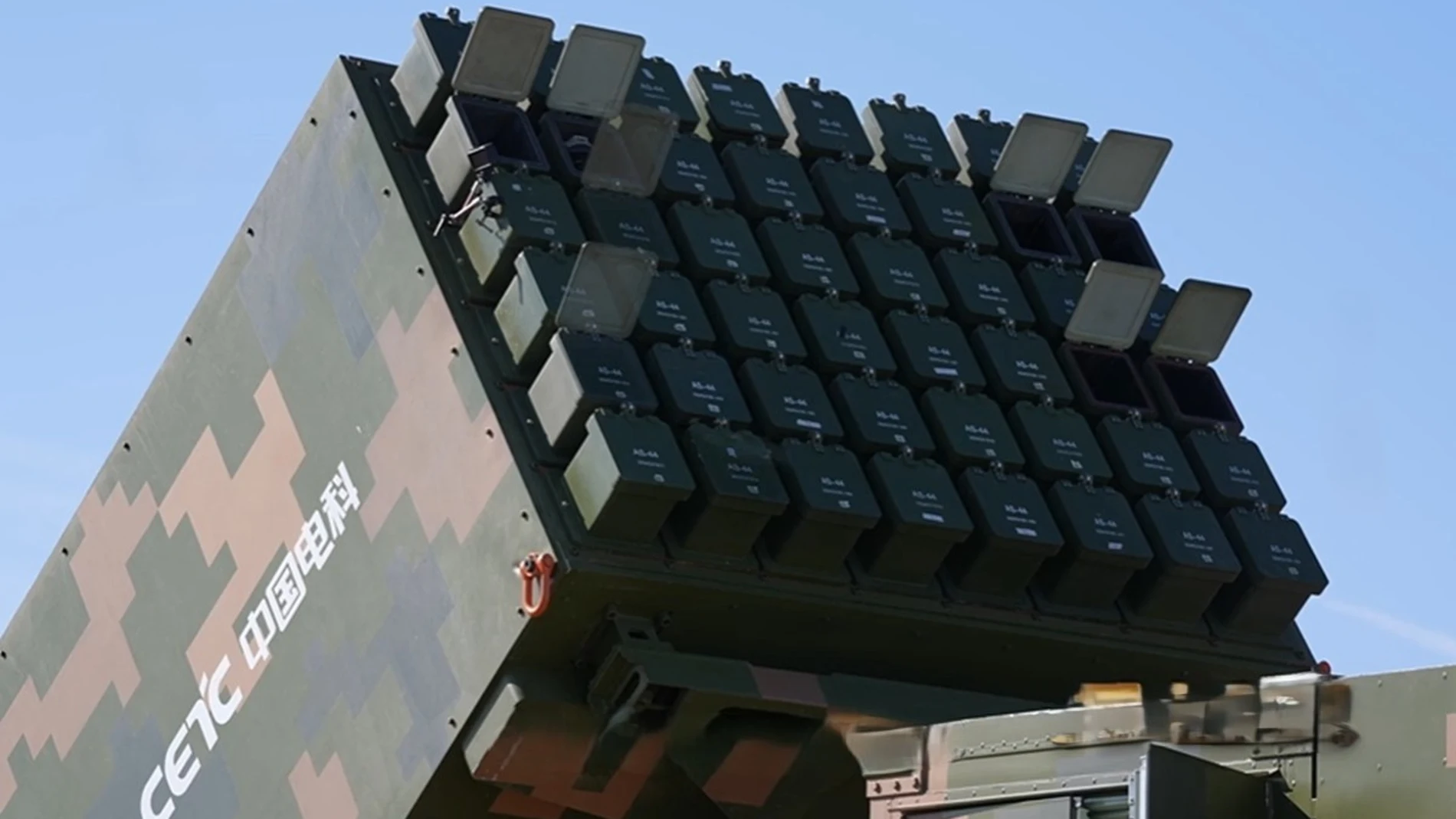
China has presented Atlasyour system drone swarm operationsin a demonstration broadcast on Wednesday by state media. The test offers a rare and fairly detailed picture of how it plans to deploy coordinated drone formations in combat. According to the information released, the system integrates reconnaissance, target selection, launch control and attack execution into the same operational chain.
The demonstration carried out on March 25 showed the entire operational sequence of Atlas. In the testing field, the system moved from detection to attack in a continuous flow after conducting coordinated reconnaissance on several similar targets. He then identified the intended command vehicle and started the launch sequence.
The drones were deployed and completed a precision strike after locking on the target in mid-flight. The test revealed a complete attack chainbeyond a simple launching system.
According to state media, the ground combat vehicle Swarm-2 launched a drone every three seconds and adjusted the departure order based on mission needs. Reconnaissance aircraft could be deployed first, followed by electronic warfare and attack units. The information also adds that drones can be reassigned in full missionallowing us to respond in real time to needs on the battlefield.
At the core of Atlas is Swarm-2, first unveiled in 2024 and capable of transport and launch 48 fixed-wing drones. At his side he operates an independent command vehicle capable of controlling up to 96 devices at the same time.
Each drone can carry different payloadsincluding electro-optical sensors, attack munitions and communications relay systems. The system also supports devices of different sizeswhich expands its flexibility in reconnaissance, attack and support tasks. According to the information released, a single operator can manage large-scale operations thanks to automation and AI-assisted controlwhile a support vehicle is responsible for logistics, maintenance and system continuity on long missions.
Wang Yunfeia Chinese military affairs expert, told the Global Times that the system can significantly expand the applications of drone swarms on the battlefield. In his opinion, Atlas allows the execution saturation attacks, precision strikes and deep strike missions. He also maintains that, thanks to pre-training with artificial intelligence and integrated algorithms, the devices can autonomously assume tasks such as target recognition, mission assignment and route planning while adapting to the circumstances of a changing environment.
Drones can also react to environmental factorscorrect airflow disturbances and quickly form dense and precise configurations.
For American analysts, the demonstration reflects a broader trend in the evolution of modern warfare, increasingly oriented towards autonomous, connected and software-supported systems. Platforms like Atlas suggest that coordination and software can outweigh the purely physical advantages of the hardware being usedwhile reinforcing the need to improve anti-drone defenses and resilience in electronic warfare. More than just a launcher, Atlas aims for a military doctrine in which swarms act as a unified fighting force.