
There are iconic moments in space exploration. They have nothing to do with takeoff, stepping on lunar soil for the first time… There are no engines, no fire, no countdown, but there is one certainty: from here on, there is no longer a possible rehearsal.
One of those moments, half emblematic, half talisman, is the habit of urinating before a space launch, specifically in the wheel of a bus. The tradition originated on April 12, 1961, when Yuri Gagarin, the first man in space, felt the need to urinate while the bus was taking him to the Vostok 1 launch pad. The “first human being in heaven” asked to stop the bus and urinated on the right rear wheel. Since then, every cosmonaut heading to the Soyuz capsule completes this ritual before taking off.
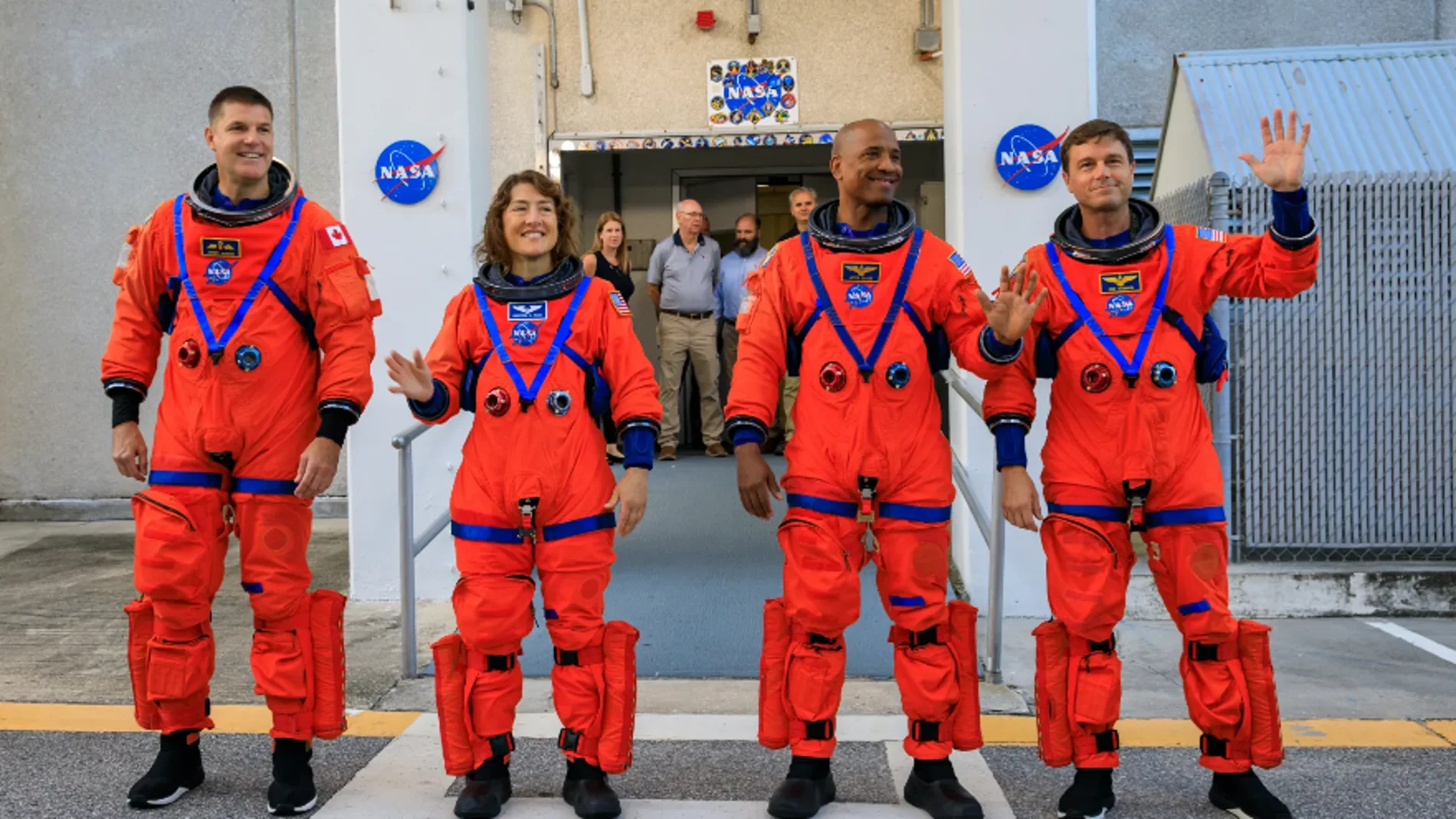
But there is another previous moment that marks a countdown that also does not allow previous rehearsals: when the astronauts finally arrive at the launch base. From that moment on, nothing is improvised and everything follows an unavoidable sequence. That is precisely what happened today, when The astronauts of the Artemis II mission landed in Florida on March 27, from Houston, in NASA’s characteristic training jets.
It is an image that has been repeated for decades, almost ceremonial. But this time it has a different weight. This is not just another mission in Earth orbit. It is the return of human beings to the environment of the Moon more than half a century later.
The crew consists of Reid Wiseman, Victor Glover, Christina Koch and Jeremy Hansen. Four different profiles that come together in a mission that also marks symbolic milestones: It will be the first time that a woman, an African-American person and a non-American astronaut participate in a manned trip around the Moon.
In the previous press conference, the tone oscillated between the technical and the inevitably emotional. Wiseman insisted an idea that runs through the entire Artemis program: “if we want to go far, we have to do it together.” It’s not just a phrase. It is the architecture of the project, which integrates agencies and countries on a scale that is reminiscent, in ambition, of the International Space Station. Christina Koch, for her part, hinted at something more intimate: the awareness of being about to do something that had not happened for decades. It’s not just a mission. It is an interrupted continuity that is resumed.
From now on, the final sequence begins. The Space Launch System waits on pad 39B, fully integrated with the Orion spacecraft. Each system has been tested, reviewed and retested. But in this phase, the checks take on another dimension. It is no longer about validating technology, but rather confirming that everything is ready to work without margin for error.
The next few days will be marked by final simulations, review of procedures and constant monitoring of any variable: from the weather to the smallest telemetry data. It is silent work, almost invisible, but essential. Because In a space launch, the spectacular lasts minutes. The scientific part remains forever.
The launch window opens on April 1. If everything continues on course, the mission will send the crew on a trip of about ten days around the Moon. There will be no moon landing. Artemis II is, above all, a validation mission: testing systems, checking maneuvers, understanding how the human body responds beyond low Earth orbit. It will be the first time since 1972 that humans have traveled so far from Earth.
And yet, the most interesting thing is not the distance, but the direction. Artemis II seeks not only to repeat the past, but to prepare for the future. It is the previous step to missions that will descend to the lunar surface and, later, to a sustained presence on our satellite.