
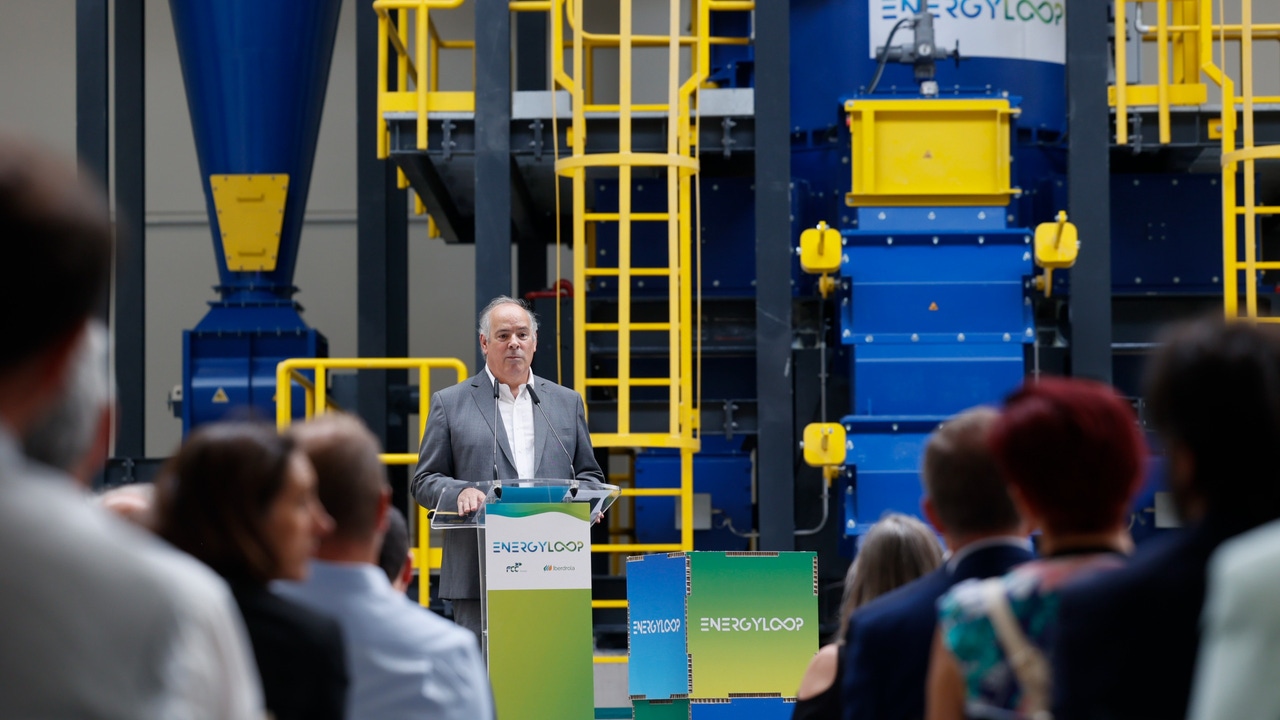
What until now was one of the greats in the medium and long -term renewable sector already has a response in Spain. Iberdrola and FCC have inaugurated Energyloop, the first eólicas blades recycling floor of the Iberian Peninsula, located in the Navarra town of Cortes. The installation is a industrial and environmental milestone that places Spain at the forefront of the circular economy applied to clean energy.
With an investment close to 10 million euros, the plant is designed to process up to 10,000 tons per year. Its objective is to recover the main materials of the blades – mostly, fibers of glass and resins – for reuse in sectors such as energy, automobile, aerospace, textile, chemical or construction. In addition, the plant aspires to generate 100 direct and indirect green jobs throughout the next decade.
María Chivite, president of the Government of Navarra, the Iberdrola Spain CEO, Mario Ruiz-Taglethe CEO of FCC Enviro, Iñigo Sanz, and Mikel Irujo, Minister of Industry and Ecological and Digital Transition of the Government of Navarra, inaugurated this morning the installation.
A unique project for a global challenge
The initiative is the result of the collaboration between Iberdrola, through its PERSEO program, and FCC scope, filial of FCC Enviro. The plant for the recycling of wind turbines has been driven with the support of the Government of Navarra, which already considered it in 2023 as a project of regional interest. It also has a subsidy of the IDAE in the framework of the circular repowering part, and with the accompaniment of Sodena, Navarra Public Society.
During the opening ceremony, the president of the Government of Navarra, María Chivite, stressed that “the green transition, competitiveness, circularity and innovation are pillars of the productive model that we promote from the government. Energyloop is not only a pointer project, but an example of how to combine all this. In addition, this government is doing a effort to decentralize industrial activity And that’s why Cortes, located on the Ribera de Navarra, has been the place chosen for this industry. “
For its part, the CEO of Iberdrola Spain, Mario Ruiz-Tagle, stressed that “today opens Much more than an industrial plant. A new stage is inaugurated in the circular economy, because this factory is the first in the peninsula dedicated to the recycling of wind turbine blades, it is a specific response to a challenge that is already here. “He added that” new technologies allow a sustainable energy transition and Generate employment in the rural worldso the necessary repowering will be a new engine for this circular cycle. “
From FCC Enviro, his CEO Iñigo Sanz pointed out that “this plant marks a milestone on the road to a more responsible and circular future. It is the beginning of a new era, where innovation and respect for the planet go hand in hand.” He also claimed a greater institutional impulse at European scale: “It is necessary to prescribe the use of recycled materials to ensure the development of projects such as Energyloop, keys to the circular economy.”
Circular economy for the wind sector
Spain is a world power in wind energy, with more than 28 GW of installed power. As a pioneer in its implementation, it will also be the first to face the need to manage large amounts of waste from wind turbines that have reached the end of their useful life.
In fact, it is estimated that In Europe about 5,700 wind turbines per year in 2030 will be dismantledeither by repowering or for seniority. In this scenario, Energyloop advances to the challenge and becomes a continental reference. The first lots of blades that will be recycled come from the Isabela and Mollar of Molinar wind farms, the first of Iberdrola to enter into the repowering phase.
The cutting plant will be dedicated to all phases of circularity of blades, from pretreatment and conditioning In situto transport logistics, material recovery technology and the marketing of recycled products. With this, not only is there a second life to valuable materials, but the environmental impact is significantly reduced of the dismantling of renewable infrastructure.
Beyond its direct impact on Navarra, Energyloop is presented as a replicable model that could be extended to other regions of Spain and Europe. Its innovative value chain approach, its ability to create green and quality employment, and its connection with diverse industrial sectors make it a key piece of the renewable ecosystem. At a time when sustainability requires not only to produce clean energy, but also manage its waste in a responsible way, this plant can open a realistic and scalable path.