
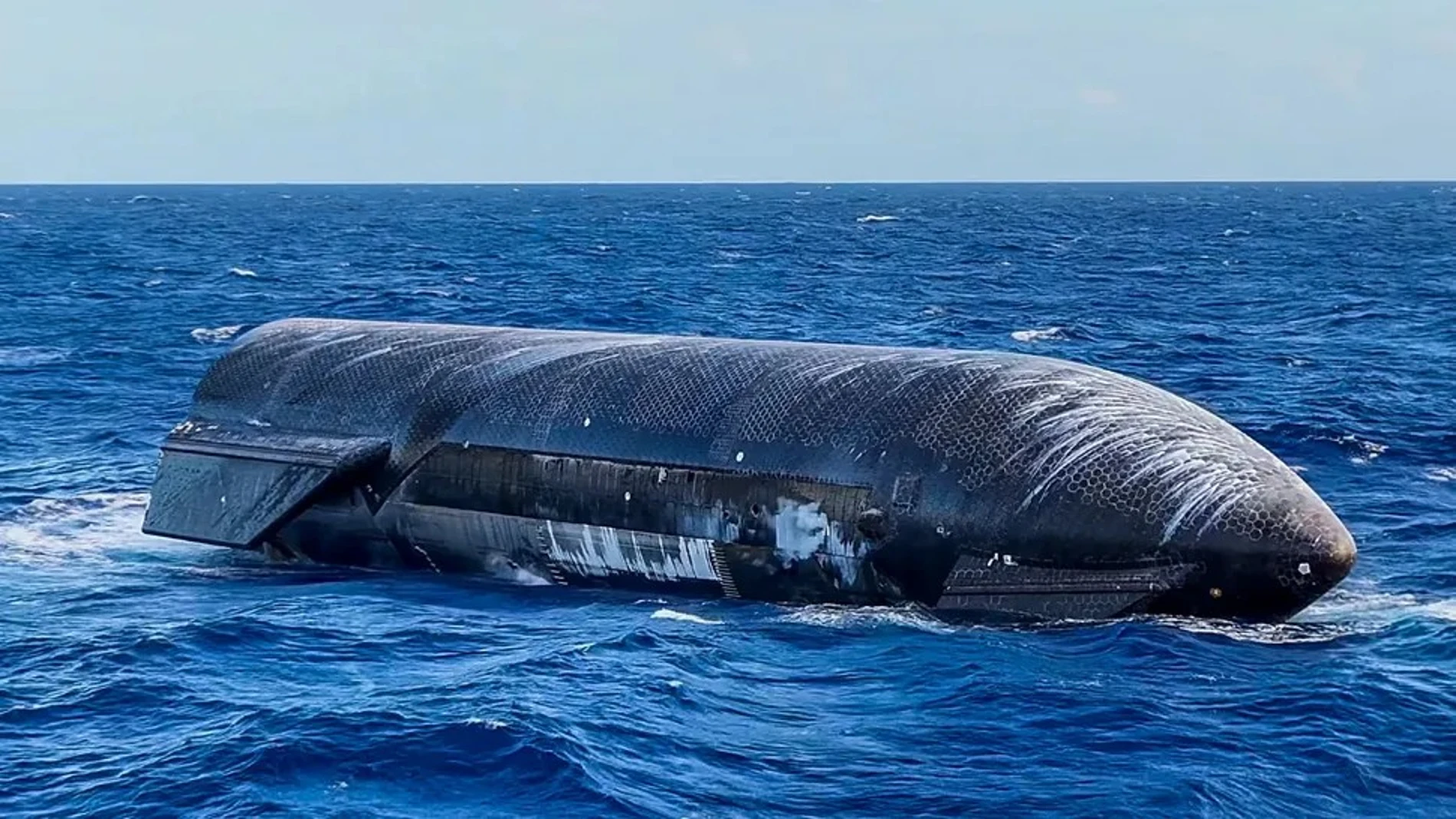
The last Starship of SpaceX continues to give surprises almost a week after completing flight 13. The upper stage Starship 40 landed last Saturday in the indian oceanoff the western coast of Australiaafter surviving reentry and executing the turning maneuver that placed her in a vertical position. The engines slowed until it touched the water with a smoothness never achieved by a Starship. Then it fell on its side into the sea without exploding..
The Times of India published yesterday that the ship is still afloat, six days after the launch since in the United States it was a Friday when it occurred, apparently intact. SpaceX has also released images taken several days after splashdown.
The Starship Recovery team has continued gathering imagery of the vehicle, which is still afloat in the Indian Ocean pic.twitter.com/ozCJYtxXGU
— SpaceX (@SpaceX) July 28, 2026
Why Starship is still floating almost a week later
The ship continues floating because the impact did not open its large deposits or cause serious structural damage. An empty Starship has a relatively small mass compared to the enormous volume of water displaced by its fuselage. As long as its tanks and other compartments retain sufficient air and remain reasonably airtight, They function as large flotation chambers. Previous prototypes often hit the water more violently or broke after falling on their side, allowing water to enter and ultimately sinking them.
NEW🚨: SpaceX shares insane drone footage from Starship’s first-ever intact soft splashdown last week pic.twitter.com/OvMVWVtxhY
— Latest in space (@latestinspace) July 28, 2026
Images of the splashdown showed some flames in the nose area when the ship was lying down. They weren’t an explosion nor did they mean the Starship was burning inside. SpaceX has not offered a technical explanation, but most likely A small amount of propellant or residual gases will escape through a conduit or valve when the position of the vehicle changes and catch fire.. The flames disappeared shortly after without affecting the structure.
First time a Starship upper stage survives flight
None of the Starships used in the previous 12 flights had ended like this. The first prototypes were destroyed during ascent or lost during reentry. Others managed to reach the Indian Ocean and made controlled descents, but ended up breaking, exploding, or sinking after hitting water. The seventh and eighth flights ended with the upper stage disintegrating during ascentwhile the ninth lost control before completing the mission. Later flights improved reentry and landing, although They also did not leave a recoverable ship.
Recover from the sea a ship as large as a 16-story tower
Elon Musk announced on Wednesday on X that SpaceX would send a ship to recover Starship. The company has not yet explained what the operation will be like nor has it identified the destination of the ship. The most likely procedure is to secure the fuselage with cables, check for hazardous propellants and tow it to an Australian port.
We’re sending a ship out to recover Starship https://t.co/fUqUZTITO9
— Elon Musk (@elonmusk) July 28, 2026
SpaceX had already negotiated with the governments of USA and Australia the possibility of recovering future Starships in these waters, Reuters reports. The studied plan contemplates tow them to a port on the western or northern coast of Australia. It is not confirmed which port will receive Starship 40 or if it will later be sent to Texas. In any case and after spending several days in salt water, The ship will not fly again even if it arrives more or less intact.
Recovery would allow thermal tiles, control surfaces, motors, and welds to be directly examined after complete reentry. The engineers could compare actual damage with data collected by sensors and cameras during the flight. After analysis, Starship could be dismantled, partially preserved, or moved to Starbase’s rocket park as a piece of history. SpaceX has not yet announced what it will do with it.
Starship 40 measures 52.1 meters highapproximately the same as a 16-story towerand weighs around 100 tons without propellants. That a structure of those dimensions has survived re-entry, splashed down vertically and continues floating several days later makes this flight an the best result achieved so far by the Starship upper stage.