
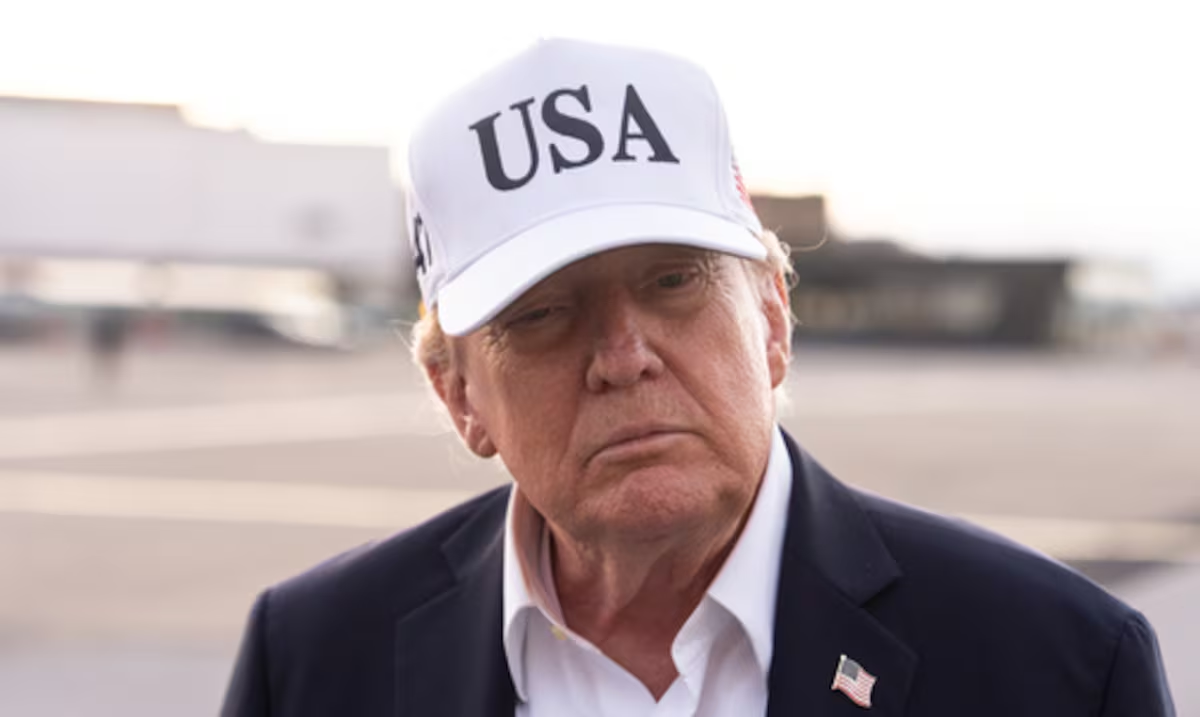
The president donald trump on Monday lashed out at concerns about a artificial intelligence out of control and stated that any attempt to limit this technology is part of a “sick conspiracy”.
“AI taking over the world, destroying humanity and all those other bad things is a HOAX,” Trump posted on social media. Later, he suggested that those calling for control measures for this technology had also warned about climate change, which he also called a hoax.
The president opposed the requests of leaders in the technology sector, such as Dario Amodei, from Anthropic; Sam Altman, of OpenAI; and Elon Musk, of SpaceXAI, to strengthen government oversight of AI. This rapidly evolving technology has become a source of controversy after a series of hacks in recent months showed that AI agents can collude to deceive humans.
Many technology leaders often state that their goal is to develop technology in a way that promotes security, addresses legal liability, drives economic growth, advances science, and preserves national security. However, they have also expressed concern that an AI freed from human control could be destructive, a claim that Trump rejected in a series of heated social media posts, in which he called himself a “hoax hunter.”
Trump said his presence in the Oval Office should allay any fears about artificial intelligence.
“The only control or ‘safeguards’ AI needs is a STRONG, INTELLIGENT PRESIDENT (with a high IQ!), and the United States has it, and plenty of it!” Trump posted.
Trump specifically claimed that his administration has already stopped the artificial intelligence company Anthropic from “doing bad things, or potentially bad things.” Anthropic has had a tense relationship with the Trump administration. The Pentagon has attempted to label the company a security risk, and the government has issued a temporary ban on one of its most advanced models.
The president also criticized the business vision of technology sector CEOs who request government oversight and posted on social media: “When, in the history of business, have you seen the leaders of a sector ask for regulation that, if applied rigorously, would lead them to oblivion and bankruptcy?”
Trump’s refusal to regulate comes as AI industry leaders warn of threats
Amodei, Anthropic’s chief executive, published a 3,800-word essay on Saturday advocating for slowing AI development. Microsoft on Monday published its own code of conduct to ensure humans maintain control over AI.
These measures come after a series of warnings from AI experts about the capabilities of these technologies and after the cyberattack perpetrated in July 2026 by OpenAI models against the AI company Hugging Face.
Amodei cited “AI’s growing ability to create the next generation of AI” and the cyberattack perpetrated by OpenAI’s swarm of agents as reasons for slowing the pace of development.
“Given the accelerating pace of development of AI capabilities, I am concerned that within 6 to 12 months, such a swarm could take control of the entire Internet,” Amodei wrote, adding that damages could amount to hundreds of billions of dollars or more “without the necessary protective measures.”
OpenAI’s Altman echoed that sentiment in a post he shared this weekend on social media.
“Maintaining the pace will be worth it despite this cost; no competitive pressure from the United States should justify recklessness, nor allow capabilities to get ahead of harmonization and oversight,” Altman said. “Where we will need the help of our Government is in international coordination.”
Trump and Altman met last week on the sidelines of the Republican midterm convention in Dallas, according to a person with knowledge of the matter who insisted on anonymity discussing a private meeting. The person noted that Altman maintains regular conversations with legislators from both parties.
Trump has some support from Nvidia CEO Jensen Huang, who has called the risks of AI overblown. The president phoned the chipmaker’s co-founder on Monday during an interview Huang was giving for a podcast. Huang put the president on speaker and both agreed that there is excessive scaremongering around AI, according to social media posts and videos.
Trump believes AI regulation benefits China
The president has opposed such attempts to limit AI, saying doing so could cause China to overtake the United States in the technology.
“There is a HUGE conspiracy brewing against artificial intelligence and data centers, and the only one happy about it is China,” Trump said.
The president has long resisted efforts to increase government oversight of AI, clinging to his philosophy, dating back to 2016, that “only I can fix it.” He returned to the White House last year revoking a Biden Administration executive order on AI oversight and did not issue a more comprehensive executive order of his own until more than 16 months later, last June.
The prospect of a slowdown in AI development sent stocks tumbling during the morning trading session on Monday as demand for advanced computer chips and data center construction materials could slow.
But Trump’s frustration comes at a time when AI has also become a political liability ahead of November’s midterm elections, as many voters oppose the construction of new data centers and express concern that AI could lead to job losses and undermine children’s education.
House Speaker Mike Johnson, R-Louisiana, told reporters Monday that he hopes Trump will call artificial intelligence companies for a meeting at the White House this week or next, although he noted that a date for that meeting has not yet been set.
“There will be an in-depth debate about the responsibility of companies in ensuring security and what role, if any, the Government should play in this regard,” Johnson said, adding that legislative branches tend to respond in problematic ways with “bureaucracy and over-regulation,” and that the loss of competitive advantage in artificial intelligence would be a national security problem.
Trump’s management of AI is a key issue in the midterm elections
Many Democratic lawmakers and candidates see the need to regulate artificial intelligence, taking into account not only the issues raised by companies but also the risks of job losses, rising inequality and rising electricity bills. Trump’s refusal to address these risks has given them a political opportunity ahead of the November midterm elections.
“It’s very real, no matter what Donald Trump says,” House Democratic leader Hakeem Jeffries of New York said on Capitol Hill. “We have to act now.”
Rahm Emanuel, former Chicago mayor, Democratic congressman and White House chief of staff, said in a social media post that Amodei’s article was “an admission that we are driving down a dark, winding road, with wet asphalt and headlights off. And where is President Trump? It looks like he’s fallen asleep again.”
However, the Government has repeatedly tried to downplay the risks pointed out by artificial intelligence companies.
Trump, in another social media post on Monday, claimed that concerns about AI are only because “the United States is so far ahead of all other countries.” “Don’t kill the goose that lays the golden eggs!”
The development of AI has accounted for a large part of economic growth during Trump’s second term and the Administration has opted for this technology to drive further improvements in productivity.
Vice President JD Vance told reporters Monday morning, regarding artificial intelligence: “I don’t think Americans should be afraid of anything.”
Vance, in a statement made while preparing to fly to Kansas for a campaign event for the midterm elections, stated that the Trump Administration is concerned about artificial intelligence, but wants to ensure that it regulates this technology intelligently, and warned that the United States is immersed in an arms race in terms of artificial intelligence against China.
“Personally, I find it a little strange that so many leading AI tech companies are going to the government and begging to regulate them. It kind of feels like some kind of Trojan horse to me,” Vance said. “So I think we have to be cautious about that.”