
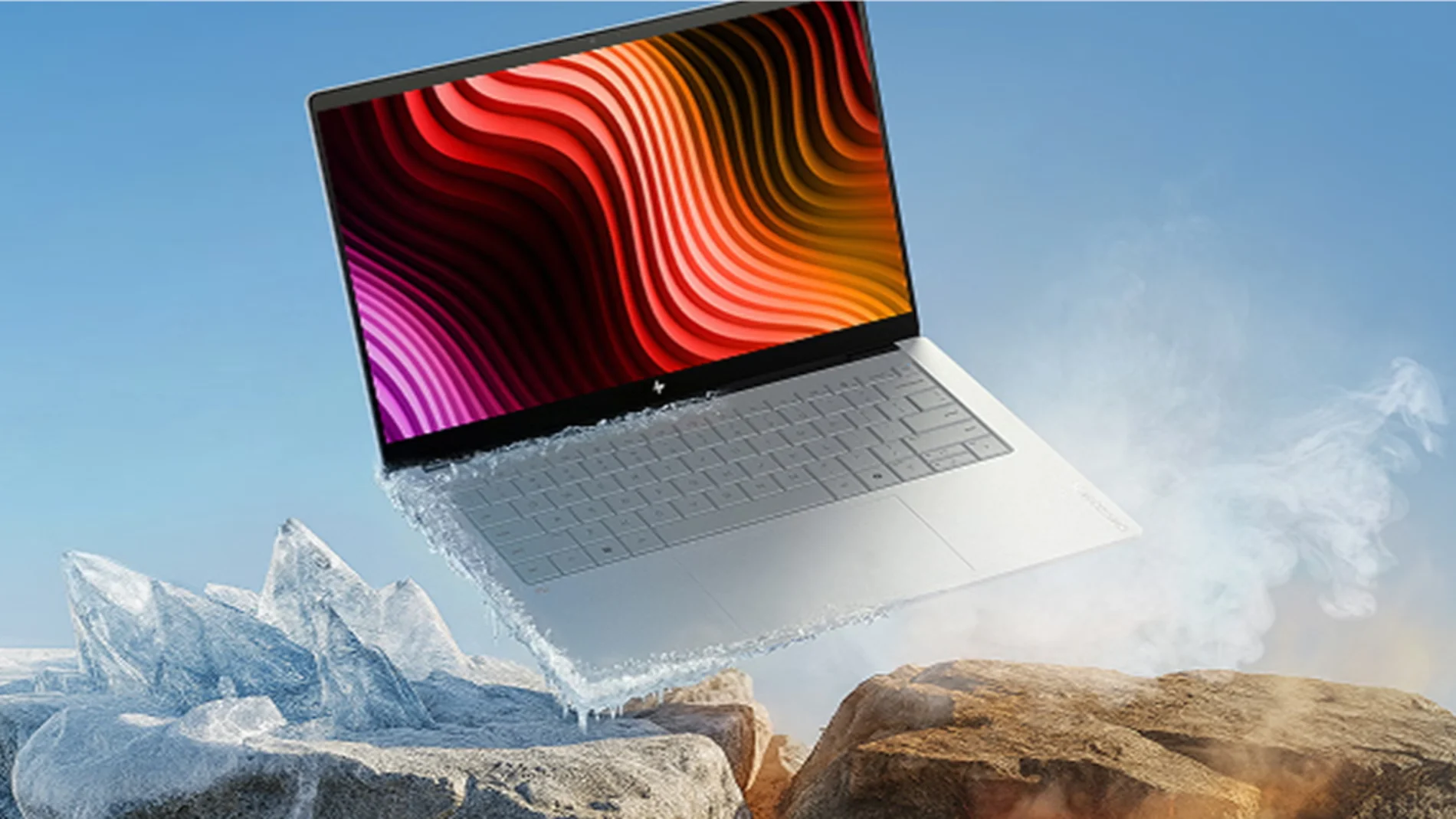
There are laptops that try to stand out for having the most powerful processor, others for becoming substitutes for the desktop processor, and some that compete directly for being the lightest. The HP OmniBook X plays in another league: tries to bring together a 14-inch high-quality screen, power, artificial intelligence and autonomywithout turning any of them into an excuse to sacrifice the others.
And in this new version there is an important change compared to the 2024 model: this OmniBook X 14 abandons the Snapdragon The result is a laptop designed especially for those who want to work for many hours, move with it and, at the same time, not having to settle for a conventional screen: 1.3 kilos to take it practically anywhere and perform almost any task.
The first contact with the OmniBook X makes it clear that HP has understood well what to expect from a 14-inch laptop. The equipment is light for its power and dimensions: 31.36 × 22.52 × 1.26 centimeters. It is made of aluminum, with an anodized and sandblasted finish, and maintains that feeling of a solid product that is expected from a device intended to last at least five years.
It is not the lightest laptop on the market, but it clearly falls into the category of equipment that can travel daily in a backpack without becoming a burden. And there is another important detail: HP has managed to maintain this compact format without giving up a 70 Wh battery, a considerable capacity for a device of this size. The company talks about up to 20 hours of autonomy in certain test conditionsalthough, as always, actual usage will be less and will depend a lot on brightness, applications and workload. In our case, it exceeded 18 hours without a problem.
And then there is the screen, one of the great attractions of this configuration. The OmniBook 3K resolution of 2880 × 1800 pixels, 16:10 format and up to 120 Hz, in addition to being tactile which adds an extra dimension, in every sense. The display reaches 500 nits in SDR and up to 1,100 nits in HDR, covers 100% of the DCI-P3 color space, and features Gorilla Glass 3. What does this mean? An especially interesting combination for those who work long hours with text, images or video, a rested view and lots of comfort.
In terms of specifications, the 3K resolution provides a high pixel density, while the OLED allows for truly deep blacks and contrast far superior to that of a conventional IPS panel. And 120 Hz provides something that doesn’t always appear in the technical sheets: a much greater sense of fluidity when scrolling through documents, web pages or applications. On paper they sound good, but after using it in different environments (living room, outdoors, airports…) it makes it difficult to go back to a laptop with a conventional screen.
As for the brain, the processor is an Intel Core Ultra 7 356H, with 16 cores, 16 threads, up to 4.7 GHz and 18 MB of L3 cache. But there is one figure that HP especially highlights: its Intel AI Boost NPU reaches 50 TOPS (capable of performing 50 trillion operations per second)dedicated to accelerating certain artificial intelligence tasks directly on the computer.
This is important because the label “AI PC” is starting to stop simply meaning that a computer can connect to a chatbot. The NPU allows certain AI functions to be executed more efficiently and without necessarily relying on sending all processing to the cloud. Video calls, camera effects, productivity tools, and certain compatible apps can benefit from it. It does not mean that this laptop will replace a dedicated GPU for training artificial intelligence models. That is not its purpose. The idea is different: make AI part of everyday tasks without each of them having to go through a remote server.
But it’s not just about the brain, we must also talk about the memory: 32 GB of RAM and 1 TB. It is a configuration that should be more than enough for practically any common professional use: browsing with dozens of tabs, office automation, photo editing, video calls, programming and intense multitasking. In addition, those 32 GB are especially interesting considering the longevity of the equipment. The memory is integrated, so it is not a machine designed to upgrade the RAM later and that may be one of the few disadvantages.
And now: ports. Here HP has learned from some of the criticism the previous generation received. The device has two Thunderbolt 4 USB-C 40 Gbps, two USB-A 10 Gbps, HDMI 2.1 and a combined headphone and microphone connection. It also incorporates Wi-Fi 7 and Bluetooth 6.0. It is a much more complete connectivity than the previous version and it is appreciated.
The webcam is also up to par: 5 megapixels, infrared, automatic HDR and temporal noise reductionplus integrated digital microphones. It is compatible with Windows Hello and has a physical privacy shutter, well thought out, taking into account that due to design and features, remote work is the best option.
Verdict:
It is a portable that plays in the major leagues and asks for that, that we squeeze it out. It’s for those who write, browse, edit photos, use AI tools, keep lots of apps open, and want a great screen without lugging around a big laptop. And without needing to recharge it every few hours