
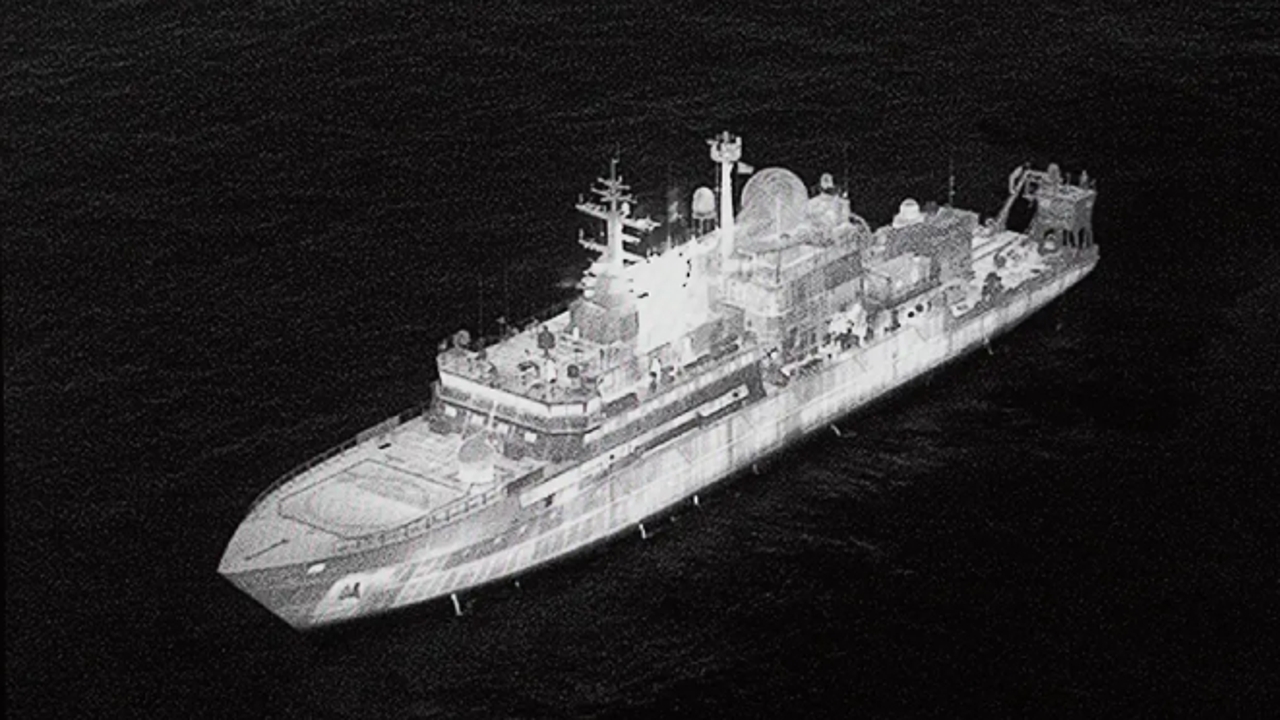
He Ministry of Defense This Wednesday, the British accused a Russian intelligence ship of aiming laser at a British Air Force patrol plane (RAF) while operating in waters near Scotland. London warns that this is just another episode in a ‘new era of threat’ by hostile states.
The ship, identified as the Yantarwas detected on the edge of the territorial waters of the United Kingdom, north of scotlandwithin the British exclusive economic zone but just outside the 12 nautical mile limit that marks the territorial sea. According to the Minister of Defense, John Healeyhis mission would have been spy on and map critical underwater infrastructure such as power and communications cables that link the country with its NATO allies.
Healey explained in London that the Yantar is designed to ‘gather intelligence and map British undersea cables’ and confirmed that the RAF sent a maritime patrol plane Poseidon P-8 to closely follow the Russian ship, along with a frigate Type 23 and presumably hunts Typhoon supported by refueling tanker aircraft Airbus A330 MRTT Voyageraccording to defense media The War Zone based on public flight tracking data. The crew of the P-8 reported that they were targeted with lasers coming from the ship, an incident that the minister described as especially serious.
BREAKING: Defense secretary John Healey says British forces were hit by lasers while tracking a Russian spy ship on the edge of UK waters north of Scotland.https://t.co/P3KxMSLHAM
📺 Sky 501, Virgin 602, Freeview 233 and YouTube pic.twitter.com/1CKIXFFhgd
— Sky News (@SkyNews) November 19, 2025
The effects of directing a laser at an airplane
Although the British authorities have not detailed the type of laser that the Yantar used, in this type of incident the range goes from simple dazzlers to higher power systems capable of interfering with sensors.
In practice, A low or medium energy laser is enough to temporarily blind the patrol plane’s optics -cameras, electro-optical or infrared systems- and significantly reduce their surveillance capacity.
For pilots, direct exposure can cause intense glare, temporary loss of vision, flashes and spots in the visual field and in cases of higher power or prolonged exposure, even permanent eye damage. Although it is highly unlikely that this is a laser weapon designed to physically damage the airframe, the simple fact that disorienting the crew or partially blinding the sensors makes these types of actions a real risk.
‘This Russian action is deeply dangerous. My message to Russia and to President Vladimir Putin is this: We see you, we know what you’re doing, and if Yantar heads south this week, we’re ready.‘Healey said.
Britain releases images of the Russian spy ship on the edge of UK waters that aimed lasers at RAF pilots
“We see you, we know what you’re doing and if the Yantar travels south like this week we are ready,” @JohnHealey_MP says pic.twitter.com/tKUBHCDN4U
— Deborah Haynes (@haynesdeborah) November 19, 2025
The Russian embassy in London flatly rejected the accusations, which it described as ‘the latest provocative statements’ by the British government. Moscow maintains that Yantar is a ‘oceanographic research vessel’ which operates only in international waters, denies that it collects intelligence on submarine cables and rules out that it poses a threat to the security of the United Kingdom.
According to the embassy, ’London’s Russophobic course and the fomenting of militarist hysteria are contributing to the further degradation of European security‘. The embassy also accused the United Kingdom of inventing threats and creating ‘the conditions for new dangerous situations’.
This is the Russian spy ship Yantar
Despite the Russian denial, British authorities have for years identified the Yantar as part of Russia’s deep-sea research structure, known as GUGIresponsible for locating and mapping the underwater infrastructure of NATO countries.
Thus, the Yantar would not be a simple surface ship but, according to different open sources, it is conceived as a support platform for manned submersibles and deep underwater robots. From that platform, these vehicles can inspect and document cables, pipes and sensors on the seabed, as well as manipulate underwater infrastructure.
He Yantar It is the top seed ship of the Project 22010 ‘Kruys’according to Russia an ocean research vessel built by the Yantar shipyard in Kaliningrad and delivered to the Russian Navy in 2015. It moves around 5,200-5,700 tons fully loadedmeasures about 108 meters in length and 17 meters beam and uses a system of diesel-electric propulsion with two azimuthal thrusters and bow thrusters for precision maneuvering. Reaches approximately 15 knots (28 km/h) maximum speed, offers a range of about 8,000 nautical miles (14,800 km) and can stay in the sea around 60 dayswith a provision of about 60 crew.
What worries allies is not just surveillance capabilities, but the potential for In a crisis scenario, these same means can be used to interfere with or damage communications and energy cables.something that governments and analysts increasingly point out as a possible sabotage strategy, although there is no public evidence that Yantar has carried out actions of this type.
First time Russian forces direct lasers at British aircraft
The episode marks the second time this year that the UK has drawn public attention to Yantar’s activities and, according to Healey, is the first time London documents that Russian forces have directed lasers at a British military aircraft. The minister assured that the Government has ‘military options ready’ in the event that the ship changes its course or approaches infrastructure considered sensitive.
‘We take it extremely seriously. I have changed the Navy’s rules of engagement so we can follow more closely, and monitor more closelythe activities of the Yantar when it is in our waters,’ said Healey.
Healey stressed that this type of maneuver will not alter British support for Ukraine and framed the incident in a broader pattern of hostile Russian activity around NATO territory. In recent months, Several allied armies have denounced the incursion of Russian drones into their airspace and possible sabotage attempts in different parts of Europe..
‘This is a new era of threat’Healey concluded, arguing that the United Kingdom must remain on alert against Russian actions, ‘just as we have been with incursions into NATO airspace.’