
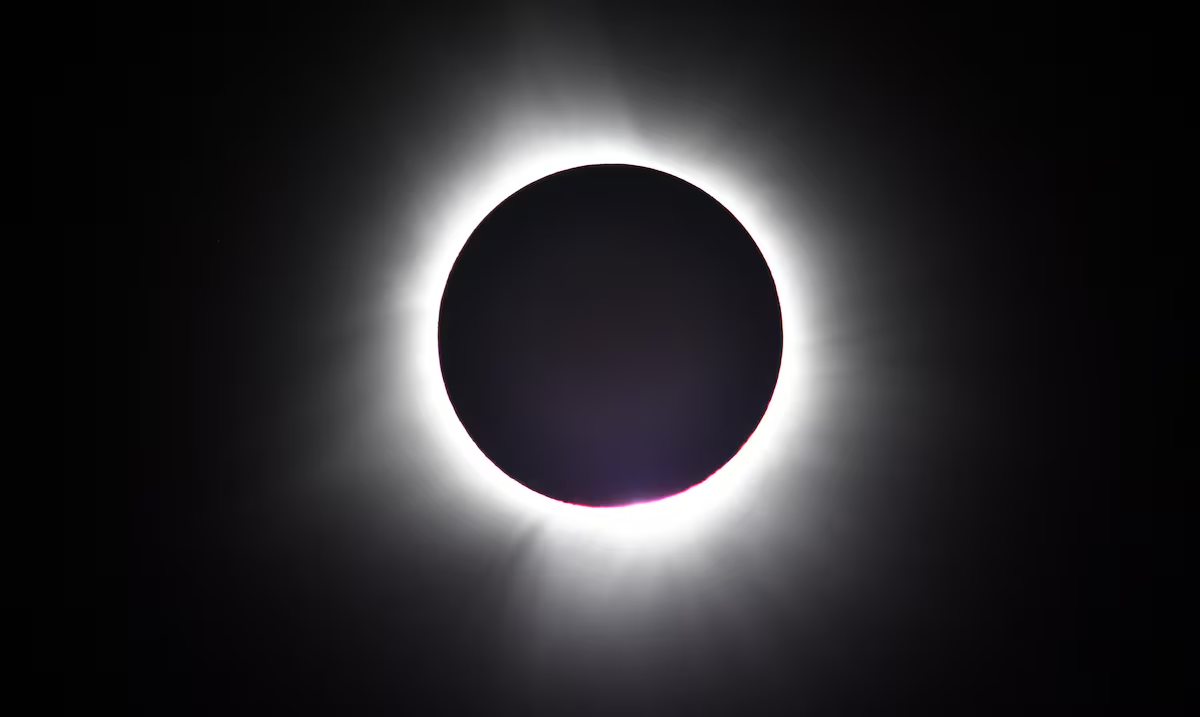
For a few minutes this Wednesday, the Moon will come between Sun and the Landbringing the darkness of day to a narrow strip of the northern hemisphere during one of the most striking astronomical spectacles: a solar eclipse total.
Puerto Rico, however, will be outside the area from which the phenomenon can be observed. But that doesn’t mean those on the island will have to miss out.
The National Aeronautics and Space Administration (POT) will broadcast the August 12 eclipse live starting at 1:15 pm, Puerto Rico timethrough their digital platforms.
According to NASA, the path of totality will pass through Greenland, Icelandthe north of Russiathe Atlantic Ocean and Spainin addition to a small sector of Portugal.
In these areas, the Moon will completely cover the surface of the Sun and will allow its corona to be observed for a few moments, while the surroundings acquire a darkness similar to that of twilight.
For those within the path of totality, that phase will last less than two minutes. In sectors close to the center of the trajectory, such as Greenland, Russia and the North Atlantic, it could last a little longer, although it will remain below two and a half minutes.
1/16 | This is how the total solar eclipse was seen in different cities in the United States. The solar eclipse was seen in the states of Texas, Oklahoma, Arkansas, Missouri, Illinois, Kentucky, Indiana, Ohio, Pennsylvania, New York, Vermont, New Hampshire and Maine. – NASA/Joel Kowsky
Outside that narrow band, millions of people will observe a partial eclipse.
According to NASA, the phenomenon can be partially seen from northern sectors of USA and Canadamuch of Europe and northwest Africa. In places in continental Europe and Africa, in addition, the Sun will begin to set while it is still partially eclipsed.
This Wednesday’s eclipse will be the first total solar eclipse visible from anywhere on the planet from the April 8, 2024when the trajectory of totality crossed sectors of Mexico, the United States and Canada.
When will there be another great eclipse for Puerto Rico?
Although this Wednesday’s spectacle will not reach the skies over Puerto Rico, the island will have other significant solar events during the coming decades.
According to the Caribbean Astronomy Society (SAC), The next significant annular solar eclipse for Puerto Rico will occur in 2038when the Moon is expected to cover near the 88% of the solar disk.
An even more impressive phenomenon will come on August 12, 2045. That day a total solar eclipse will occur whose path of totality will pass over other places, but from Puerto Rico it will be observed as an extremely deep partial eclipse, with approximately 98.5% of the Sun covered by the Moon.
The line of totality will pass very close to Puerto Rico, including the Dominican Republic, which is why the eclipse will be seen with such intensity from the island.
To experience totality properly from Puerto Rico, the wait would be considerably longer. According to models cited by the SAC, The next total solar eclipse that could be observed from the island would occur on October 17, 2153. If materialized according to these projections, The Puerto Rican sky would darken completely for several minutes.
Meteors will cross the sky
Puerto Rico will not be within the path of this Wednesday’s eclipse, but during these same nights another astronomical event can be observed from the island.
The Perseid meteor shower is approaching its period of greatest activity and this year conditions will be particularly favorable due to little interference from the Moon’s light.
The SAC indicated that different forecasts place the maximum activity between the night of Wednesday the 12th and the early morning of Thursday the 13th of Augustalthough he warned that some of the brightest meteors may appear before or after the predicted peak.
For this reason, the organization recommended observing the sky for three nights: from August 11 to 12, from August 12 to 13 and from August 13 to 14, particularly from approximately 10:30 or 11:00 pm until dawn.
Although they get their name because they appear to emerge from the constellation Perseus, meteors can appear in different places. The recommendation is to find a dark place, away from artificial lighting, observe comfortably and be patient.
The Perseids occur every year when, on its way around the Sun, the Earth passes through a region of space with tiny debris left by the sun. Comet 109P/Swift-Tuttle.
Upon entering the Earth’s atmosphere at high speed, these fragments heat up and produce the flashes that we commonly know as “shooting stars”.