
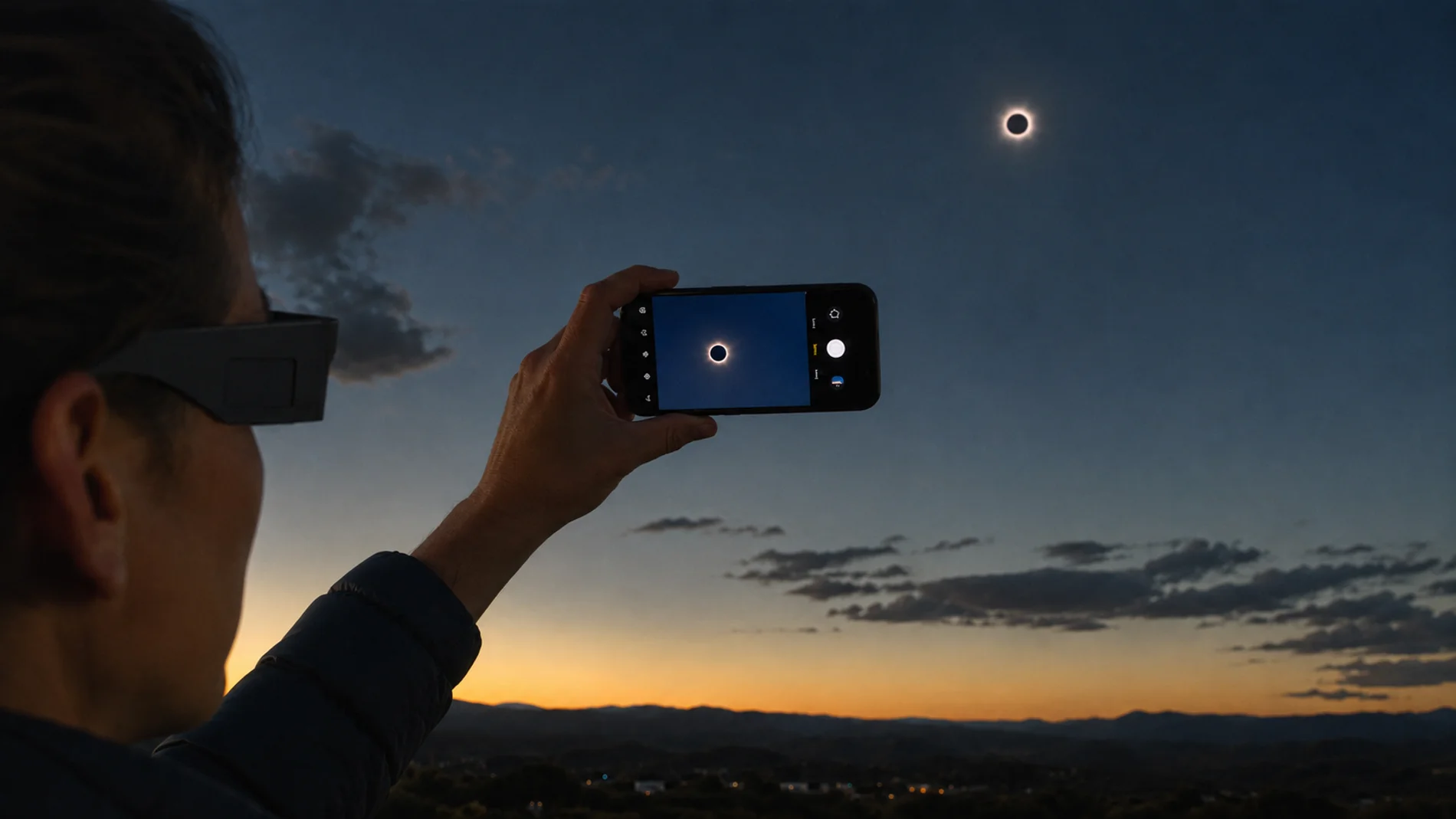
He total solar eclipse Tomorrow will be an exceptional opportunity to take photographs with your mobile, but you can also put your camera at risk. Pointing directly at the Sun without protection can damage the image sensor and other optical system componentsso precautions against the eclipse should not be limited only to protecting our eyes but also also to the camera in case it is to be used.
The problem is not caused by the eclipse itself, but by the enormous amount of energy from the Sun that passes through the camera lenses. Are They concentrate the light on a very small surface, the sensor that captures the image. Sufficiently intense or prolonged exposure can raise its temperature and cause permanent damage such as burns to the pixels of said CMOS sensor or deformation of internal components. due to the ‘magnifying glass effect’ caused by the lens.
The risk exists for both conventional and mobile cameras. The manufacturer Nikon has expressly warned that photographing the Sun without an appropriate filter can affect the sensor of a camera, while Samsung has pointed out that doing so with a galaxy can damage both the sensor and the lens. The American Astronomical Society recommends place a sunscreen in front of the camera to photograph the partial phases of an eclipse.
The situation changes only when the eclipse reaches totality and Moon It completely covers the photosphere, which is the bright surface of the Sun that we usually see. During these brief moments you can remove the camera filter to photograph the solar corona. Both the POT as the American Astronomical Society indicate that filters can be removed during totality and They must be replaced as soon as the first bright fragment of the Sun reappears.
This recommendation is especially important because a 99.9% eclipse is still a partial eclipse. Although a tiny fraction of the solar disk remains visible, It is still necessary to use protection for both the camera and the eyes. The only exception occurs between the moment in which the solar surface completely disappears and the moment in which it reappears.
To photograph the eclipse you must use a filter designed specifically for photography or solar observation, placed in front of the lens to reduce radiation before it passes through the lenses. The norm ISO 12312-2:2015which applies to glasses and visors intended to directly observe the Sun, does not apply to camera filtersalthough the American Astronomical Society considers suitable those whose materials meet its requirements for transmission, uniformity and quality. A conventional neutral density filter should not be used, as it does not necessarily offer the necessary protection against solar radiation. The safest thing is purchase a specific filter for cameras from a specialized manufacturer and use it according to its instructions.