
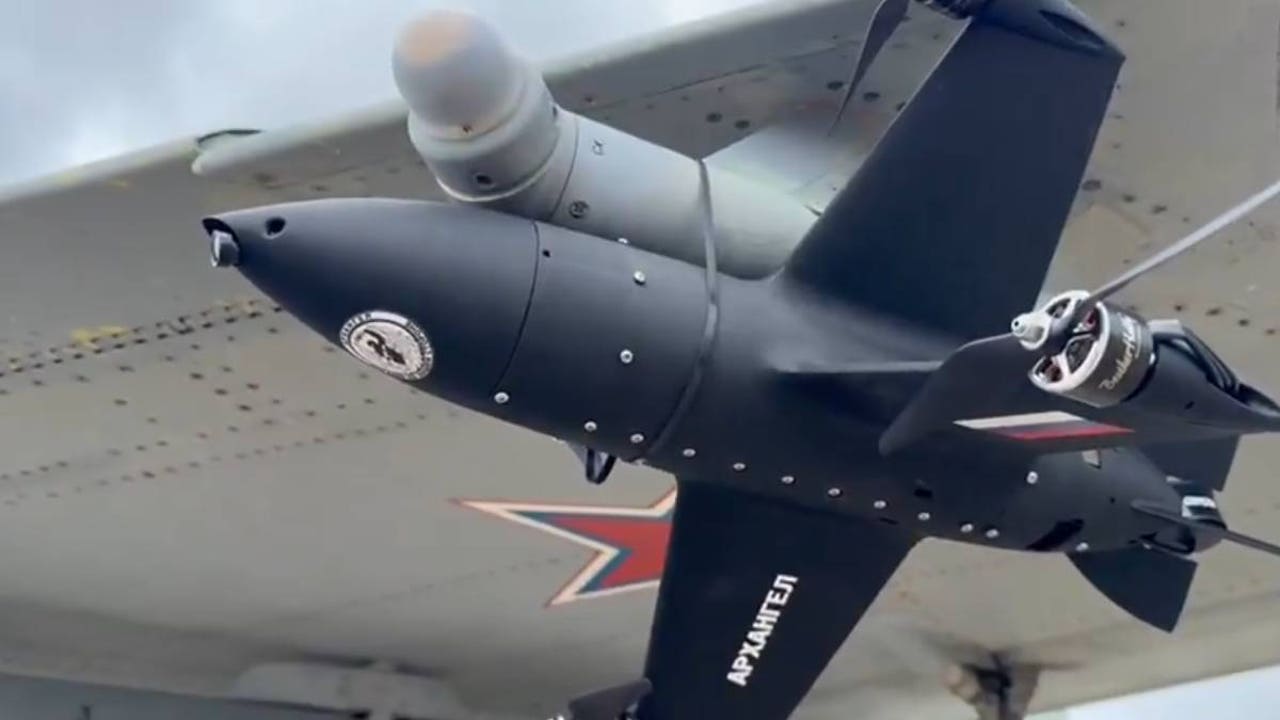
In the long war of Ukraine Numerous examples of how the need exacerbates ingenuity have been seen. In the invaded country, many private and public initiatives have emerged to develop weapons and, above all, drones, in the last three and a half years, being Brave1 One of the best known. In Russia They have, for example, Project Archangela group of Russian volunteers dedicated to the ‘creation of UAV’, but that offers somewhat less stellar results, as demonstrates a surprising video that has appeared in Russian social networks and that, apparently, is part of an attempt to Integrate an interceptor drone against unmanned aerial systems (quas) in a Fulcrum mig-29 hunt.
But here the term ‘integrate’ must be interpreted in a slightly elastic way. As you can see in the video, it consists of hold the quadcopter to hunt using plastic flanges. And, according to the specialized environment The War Zone, even if it was another way, The idea of fixing the wing of the hunting is more than questionable.
In the video you can see the interceptor drone fixed under the mi-29 wing, tied by running flanges to a capsule under the wing that contains sensors of the plane’s radar alert system. Obviously, There is no way to launch the drone with this assemblynot to mention that, even if he used another system, he would require multiple previous tests.
Release for combat or just pr? Russia’s Project Archangel is Showing The “Integration” of ESIR INTERPECTOR DRONE WITH A Fighter Jet “… So That The Interceptor Can Be” Pilote “by a Jet Fighter Crew.” But the drone is zip tied to the planet, so … https://t.co/1cdypcimgepic.twitter.com/oi3tiivs35
– Samuel Bendett (@sambendett) August 10, 2025
According to the medium, there is no evidence that drone can support the demands of a high speed flight -A mig-29 reaches a maximum speed of Mach 2,25, 2,400 kilometers per hour-, more with its exposed propellers, or that the hunting can take off With the drone set that way. The recording concludes with the take -off of a series hunting Flankerdifferent from the MIG-29, but without being seen if it is equipped with the interceptor drone.
The linking of Project Archangel with the Russian armed forces is not clear either, although the group is One of several arising since the beginning of large -scale invasion to quickly produce large amounts of FPV dronestaking advantage of the experience and industrial capacity of the private sector. The analyst Samuel BendettAt the end of 2023, he indicated that Project Archangel could be receiving financing from the Ministry of Defense Russian.
Project Archangel has affirmed that his grid type interceptor drone can reach a speed of 350 km/h and has an autonomy of 50 kilometers. In its telegram channel, the group claims to be working to ‘Integrate interceptor drones directly into fighters’ and that ‘after a long search for the ideal place for our guided interceptors (which, incidentally, still continues), We decided to place them in the MIG‘.
The publication adds that ‘of course, the plane moves somewhat faster than the cruise speed of our drone, but It can take it directly to kyiv or Lepolis‘, an affirmation that does not seem to take into account the anti -aircraft defenses of Ukraine in those cities and the fact that Russian fighters don’t even operate near them.
Beyond the drone, as fastened to hunting, it cannot be launched, Nor is it clear how it could be operated once the MIG-29. But Project Archangel states that ‘the communication problem we have solved it radically. Not to break our heads with the technical part, We simply train our crew to pilot a hunt. Thus, they will control the archangel directly from the cabin of the plane‘.
The idea of converting a drone pilot in fighter pilot, without thousands of training hours in between, It is ridiculous. The same as thinking that a drone can be manually controlled while piloting a mig-29.
The usual thing is that FPV drones directed against mobile objectives use control ‘Man-in-the-Loop’that is, with an operator who directs them in real time through a viewfinder that receives the video image broadcast by the drone. Those who do not use this system are assigned against fixed targets, which would not serve to intercept other drones.