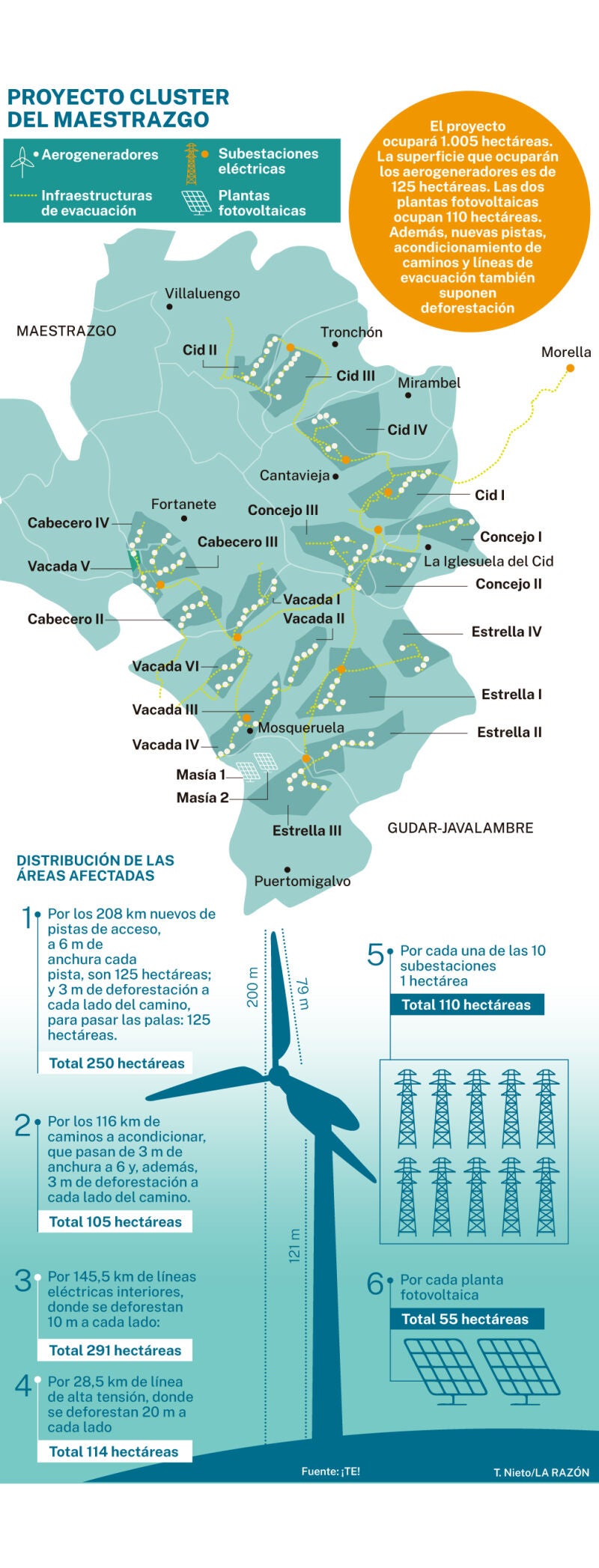
Elvira Lindo wrote a few days ago in her column that “the green movement has become substantive due to the business possibilities it offers.” The writer mentioned the Maestrazgo wind farm, whose construction was approved this summer and which has become the most powerful renewable macroproject in Spain. There are two ways to describe what it will be like depending on who you ask. The promoters say that 1,986 GWh of electricity will be produced per year and the consumption of 570,000 homes will be covered. The detractors, which involves the construction of 125 wind turbines of about 200 meters high which, in some cases will be close to or will directly affect protected areas of the Natura 2000 Network or Special Protection Areas for Birdfauna (threatened species such as the imperial eagle or the bearded vulture reside here). «There are a total of 25 parks. They say that they take up little space because they only count the base of the land, but you also have to make paths because this is a closed forest. Evacuation routes must also have 20 meters free on each side for safety. All in a region of great biodiversity,” says Mariano Tomás, spokesperson for Energy and Environment of the Teruel Exist Movement.
The vision is so disparate that there is even a discrepancy in the number of trees that are going to be cut. While the Danish investment fund Copenhagen Infrastructure Partners (CIP) states that the number of trees it has to cut is 98,000from “Teruel Exists we insist that our figure of two million trees It is not invented. We have obtained it from the information sent to us by several logging companies in the area that have received budget requests from the fund to cut down two million trees. The striking thing is that since the Environmental Impact Statement does not specify a number, everyone can say what they want,” continues Tomás. The technician also emphasizes the wiring, in some cases more than 200 km, that is needed to take the energy produced “to Catalonia, the Basque Country, Valencia or Madrid.” A quarter of the population lives in that quadrant and Aragón is in a central position. Another thing that is being reported is that there is no continuity. The same company divides the projects it presents so that each one passes its own DIA. Fraud is being done by fragmenting wind farms.
The truth is that the project passed the processing of its environmental impact declaration in 2022, something that draws the attention of this organization that doubts how it is possible. «Despite the support of several mayors for the construction, we thought that the Ministry of Ecological Transition was going to be stricter and, however, it has approved the project. We need national and regional regulation to plan on which land parks are approved. Miteco itself has maps of areas of maximum environmental sensitivity, however, in this project there are many wind turbines that are next to it,” concludes the spokesperson for Teruel Exist, who also compares the speed with which these facilities are approved versus to smaller ones such as energy communities: “There are a hundred pending approval in Aragon alone and some have taken up to eight years to obtain approval.”
Maps that are not used
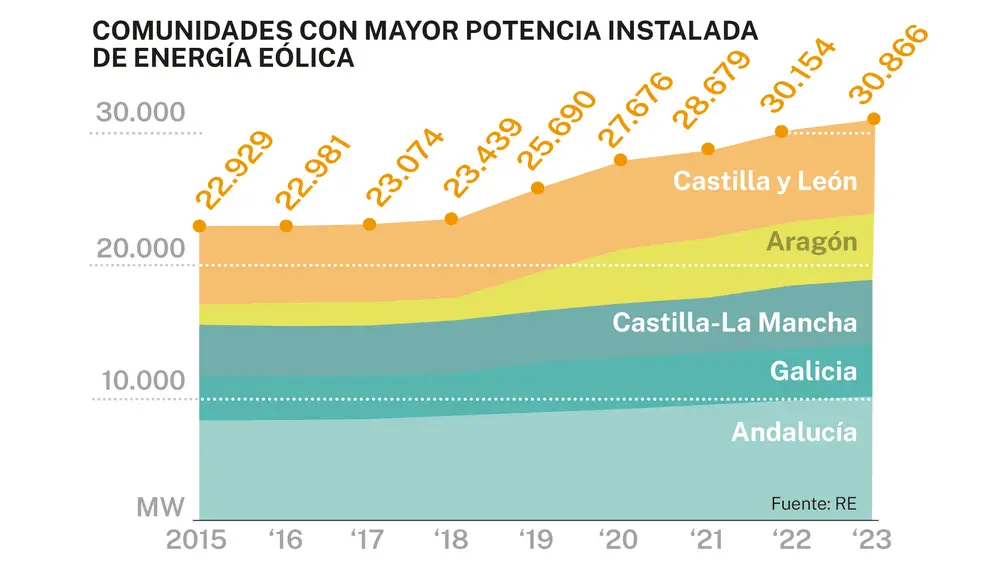
Maestrazgo is now the largest cluster in Spain and an example of a debate that has been on the table for a few years: the integration of renewables in the territory, even more so now that the Spanish government has just sent its new Integrated National Plan to Brussels. of Energy and Climate that promises another 28 GW of wind power in six years (until reaching 59,000 total MW in Spain). More mills? Where? In Aragon alone, they say from Teruel Exist, 170% of the energy they consume is already produced (“they have plenty of energy,” says Tomás); They meet the EU’s objectives and yet there are twice as many projects in the pipeline as those that already exist. «Aragón is the region that has the most accumulated projects. “We are around 33,000 MW with what is projected, with this we could supply Spain’s consumption for an entire day.”
From the Wind Business Association, Juan Virgilio, general director of the entity, clarifies: «12,000 MW have been authorized, but at the same time another 12,000 MW have been stopped, many of them in Aragon. Half of the projects presented have been discarded. The processing processes are very demanding, also at an environmental level, and if their construction is authorized it is because they have complied with the regulations. A park in a certain area may be of concern, generally in territories where until now there has been no wind power, but the experience of the 1,200 municipalities that do have these facilities in Spain is that none are against it and they see it as beneficial. It is normal that renewables open the debate now where until now there has been no wind energy. The Pniec is ambitious but it is necessary to meet Europe’s decarbonization objectives. Renewables are going to continue growing and for that responsibility and dialogue are needed.
There is a word that has appeared frequently during the interviews conducted for this report: planning. «Planning is being decided by companies, in an uncoordinated manner between them and with private and economic interest. This worries us because even though the EIS are necessary and authorized, we see that we continue to lose biodiversity,” says Juan Carlos Atienza, head of Environmental Governance at SEO/BirdLife. The organization has been working on what they call “responsible renewables” since the installation of the first wind farms in Tarifa in the 90s and since then they have carried out studies and advised so that the impact on birds and fauna is as little as possible. They have developed their own map where the areas of environmental sensitivity of the territory are marked and they confirm that Miteco has its own. “The Climate Change Law considers that projects have to take them into account as well as exclusion zones, but they have not made it binding.” Besides there has to be good public participation that goes beyond the written allegations that can be presented after the publication in the BOE of the authorization that no one reads or that no one has to pay attention to. Good prior communication on these issues is essential; “No company has a deliberate interest in extinct species.”
From the Ecodes Foundation Mariano Rodríguez (associate director of Just Transition and Global Alliances) alludes to another point: the need to create wealth for the territories whether renewables are installed or conserved with environmental protection figures: «If it is decided that a area must be protected, we would have to pay for it, that’s why we talk about return when it is installed and when it is protected. In Teruel, many mayors are in favor of the wind project and many installations are made in abandoned areas that do not have basic services and to which an influx of money is promised, but that is the obligation of the CCAA and the State. These areas should receive money for the ecosystem services of their protected areas. Furthermore, 20% of the territory in Spain is classified as low impact, why do we have to impact areas already classified as sensitive and protected, “he says.
Some time ago the foundation published a report where it collects cases of good practices in the integration of renewables in the territory because, says Rodríguez, they are not “against large parks, it all depends on where.” In addition, we are committed to a diverse model with facilities of different sizes. Muras (Lugo) is a paradigmatic example. This town was the protagonist of the wind developments of the 80s, at first everything was done wrong, but the City Council redirected the situation and the income has been used to lower the neighbors’ electricity bills or for purification.