
Let’s get the elephant in the room out of the way: it seems that, in recent years, the mention of a Huawei device has always been accompanied by a question related to Google. Well, with the Huawei Pura 80 Ultra, that is no longer valid. Whether thanks to the expansion of the AppGallery, the use of the “mirror store” of the Play Store (read Aurora Store) or intelligent use of its own software, all Google applications and options are available on this phone. No delays, no interruptions… No excuses.
That being said, let’s get to the phone. He Fingerprint unlock, on the side button, works quickly and efficiently. And it is a perfect place to place it: just lift the phone to deactivate it, if we do it with the correct finger.
The gestures in the air are another feature that has captivated me. Placing your open palm in front of the mobile phone and closing it into a fist allows you to take a screenshot, while lowering your fingers allows you to scroll on the screen.
And, speaking of Rome, The Pura 80 Ultra has a 6.8-inch LTPO OLED screen with a resolution of 2,848 × 1,276 pixels and an adaptive refresh rate of 1-120 Hz. This means that, when the screen does not need to be updated (like in a video game), the refresh rate is low, but if we need to raise it in an instant, it does so without problem and without a jump in energy expenditure.
In memory, we arrive Up to 1TB of storage (200,000+ photos) and 16GB of RAMwhich allows fluid and fast processes even if we leave several windows open and perform tasks in them simultaneously.
Separate mention of the battery. Huawei, it is clear, is working a lot in this section. It is no longer about the capacity (5,170 mAh) or the load (a beast with 100 W fast charging and wireless charging up to 80 W)but of engineering: the cooling, the processing of the microchip and the entire design, contribute to efficient spending, without jerks or temperature rises.
As for the processor, it has Huawei’s Kirin 9020, in a 7nm process, with 8 cores and Maleoon 920 GPU. What does this mean? That Huawei has made the best possible use of the United States restrictions when creating microchips. Although the performance of the Kirin 9020 is not on par with the latest Snapdragon, it must also be taken into account that the latter uses a 3 nanometer process, while Huawei’s is 7 nm. This number indicates the space that separates one transistor from another, thus, the smaller the distance, the more transistors possible in the same space. AND Huawei has managed to put almost the same number of transistors (digital neurons) as Qualcomm in its Snapdragon… in a much smaller space.
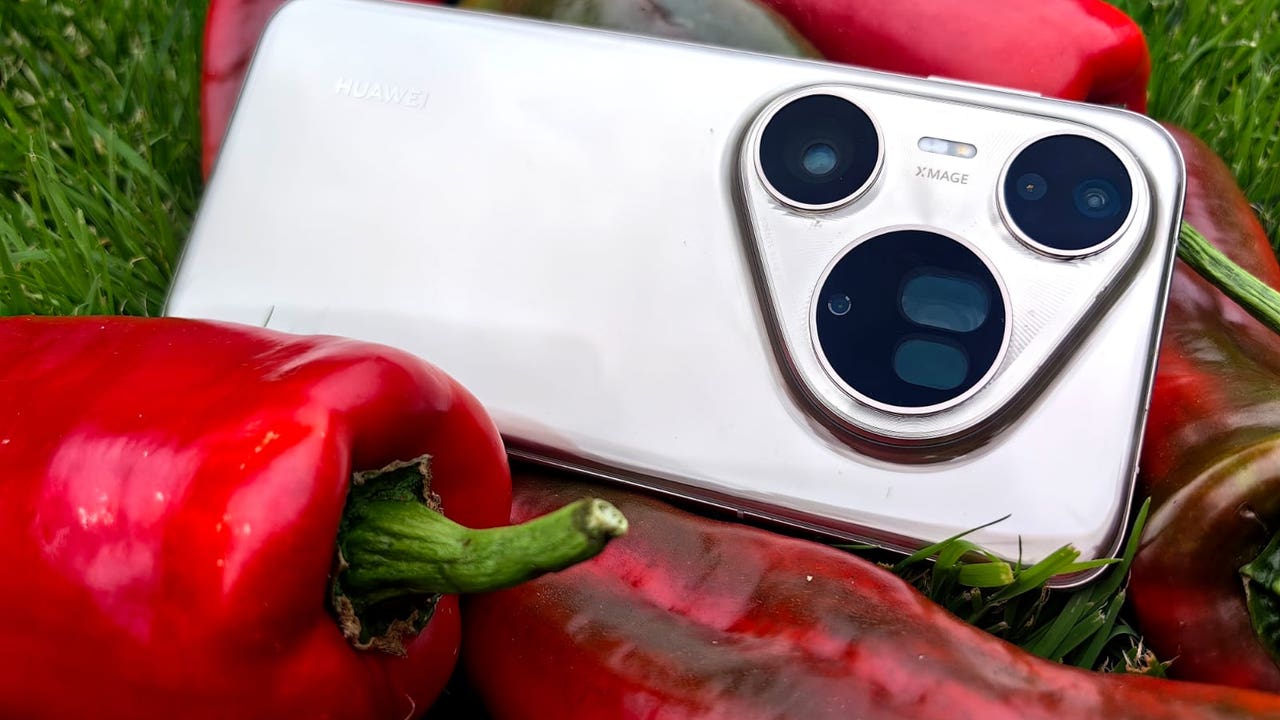
Now, let’s go with the camera. On paper, it is the best camera in a smartphone, according to DxoMark: it has almost 15 points more than its pursuer, the iPhone 17 Pro. So good is it that, in photography alone, the Pura 70 series (from last year), has a higher score than the iPhone 17 Pro. If photography is a non-negotiable, this is the mobile. And if it comes to macro photography, THIS is the mobile. The main sensor is 50 MP with a size of 1 inch. The telephoto system is particularly innovative: it incorporates two telephoto lenses coupled to the same sensor (one for 3.7× and the other for 9.4× optical zoom) using a moving prism. It also has a 40 MP ultra-wide angle and a 13 MP selfie camera. It is one of those phones that make us want to take photos more than publishing them or seeing those of others.
Verdict: For €1499, it is a smartphone that will last for years and whose camera will outlast it. It is not afraid of Google, it loads at F1 speed and if photography is the priority, this is the mobile phone. And yes, for those in doubt: the peppers in the image are from my garden. And they are very good.