
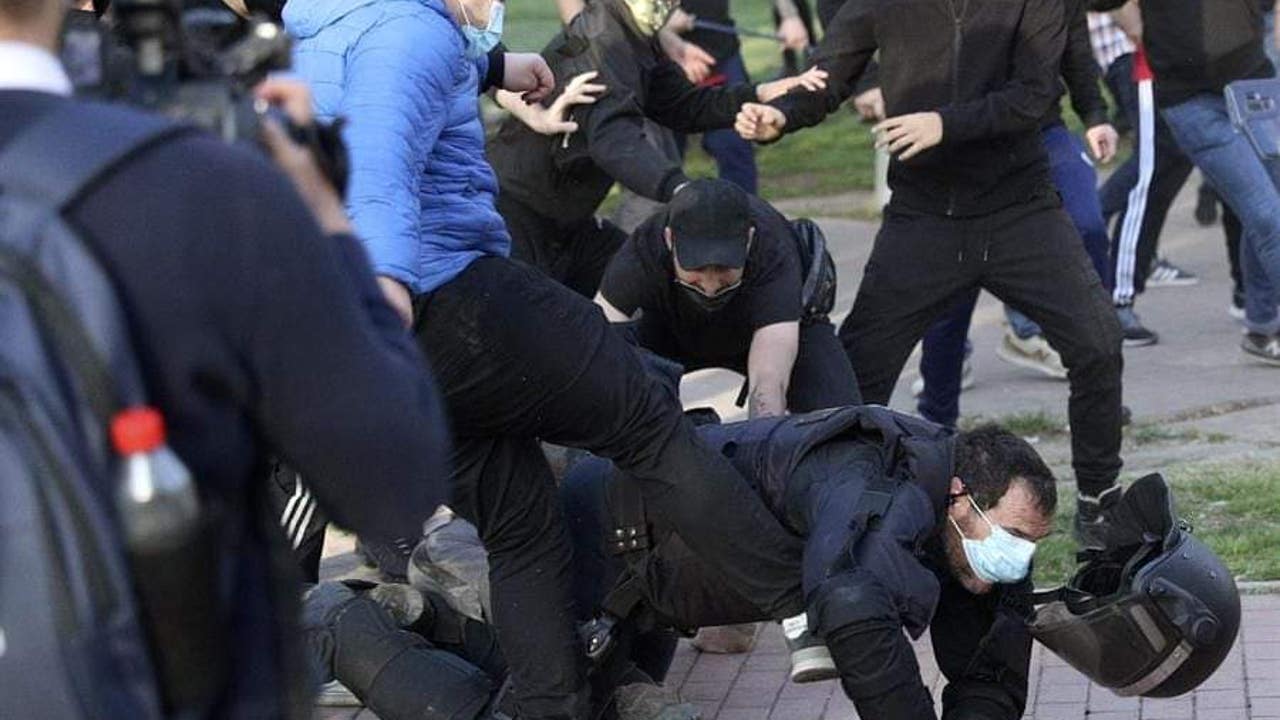
It was just yesterday when Iván, a decorated agent, recriminated the Minister of the Interior, Fernando Grande-Marlaska: “They take away our authority to give it to the criminal.” And he demanded a strong law, a law that protects the agents. These words seem to make more sense today than ever. And the pact between the Executive of Pedro Sánchez and EH Bildu to reform the so-called “gag law” has once again dealt a hard blow to the national police and civil guardswho have not been slow to show their indignation.
A malaise that is repeated in each and every one of the unions and professional associations consulted by this newspaper. “The progressive withdrawal of rubber balls from the Spanish public order model is new proof that there are no red lines for this Government and that anyone who fills his mouth with the results of our work is incapable of not subjecting issues to political negotiation. that directly affect our personal safety, our lives and that of our families,” denounces the Spanish Police Confederation (CEP). Because, in his opinion, Marlaska “cannot continue one more minute as head of the Interior.”
Sánchez’s pact with the so-called “heirs of ETA” has filled the camel’s back with the agents’ indignation. It is not that the minister ignores the repeated calls for attention to take measures to prevent the police and civil guards from being attacked more and more (46 a day in 2023), but that he has not known or been able to prevent those who are obsessed with overturning the Citizen Security Protection Law achieves its end, “legally disarm those who protect life and property of all Spaniards”.
Impunity for criminals
In the opinion of the CEP, the minister has crossed “all the red lines” in what amounts to “the greatest attack on the operability that professionals have suffered of public security throughout democracy.” At this point, they point out that we are facing a point of no return in which “violent behavior on the street can make its way in the middle of the most scandalous impunity”.
Because no one is aware that this pact comes in the midst of Budget negotiations, where “short-term calculation” manipulates and dirtyes State policies. In conclusion, this union points out, This pact will allow violence and incivility to go free; so that we police officers stop protecting the rights of everyone and become mere spectators, powerless against those who seek to impose a model of coexistence based on the impunity of a few and the lack of protection of a few, the social majority, who only want live and work in peaceful coexistence.
Lack of government support
A few words shared by another of the police unions, JUPOL, who insists that Marlaska has crossed all the red lines by allowing the rubber balls to be eliminated, “a fundamental tool for the work of police officers in situations of serious disturbances.” Its elimination, they point out, represents a serious risk to the safety and physical integrity of the agents.
On the other hand, this union points out that the modification of current legislation, relating to lack of respect for agents of authority and disobedience, represents “a direct attack on the already diminished principle of authority of the agents“In addition, they criticize Marlaska for, as always, this reform is carried out with his back to the professionals, who are not consulted. “This reform only benefits violent protesters and criminals and binds the agents of the Security Forces and Corps hand and foot.” And in the end, everything always boils down to the same thing: “a total lack of support from the Government of Spain.”
And precisely about this lack of support they also speak from the Unified Police Union (SUP), who point out that “this reform of the Citizen Security Law seems to be written against the police more than to favor the proper performance of their function.” Thus, they add that This standard does not contemplate or offer legal guarantees for the development of the police function: “Disobedience and attacks on agents of authority cannot be encouraged from a legal text. when what we seek is to reinforce the punishment of these criminal behaviors.
As for the border returns refers, they consider that we are already subject to different legal frameworks, both national and international, that contemplate these assumptions and adapt them to the standard implemented for the entire Schenghen area and the signatories of the latest regulatory text on immigration of the European Union.
Toughen penalties for assault
The Unified Association of the Civil Guard (AUGC) has also been blunt and has criticized the Executive for continuing to use the civil guards as bargaining chips, “leaving them tied hand and foot in their work.” After announcing that they will eliminate rubber balls, they make it clear that “the agents need tools to be able to do their job safely”, at a time when attacks on civil guards continue to increase year after year.
For AUGC it is “urgent to reinforce the principle of authority”, not undermine it as this reform does, and to make the necessary modifications to the Penal Code to “toughen the penalties for aggression against agents”, in order to reinforce the principle of authority.
For its part, the Professional Association of the Civil Guard (JUCIL) expresses its concern and resounding rejection of the recent transfer of the Government to EH Bildu, since it endangers the lives of the agents of the Civil Guard and the National Police by weakening their ability to act in critical situations.
Law of Hate to the Police and the Civil Guard
Agustín Leal, communication secretary of the association, believes that the new law that is approved should be called “Law of Hate to the Police and the Civil Guard” because what the Government is doing is failing to protect those who risk their lives every day to guarantee the safety of citizens. “This reform does not respond to a social demand, but to a political interest on the part of the PSOE to obtain the support of Bildu to carry out the Budgets,” he clarifies.
In Leal’s opinion, converting infractions for disobedience and resistance to authority into minor offenses and eliminating rubber balls in situations of disturbance of public order is “disarm the civil guards and police”. And these types of measures, he adds, put the integrity of the agents at risk and also weaken public security, “leaving citizens exposed at critical moments.”
In short, unanimously and in unison, each and every one of these unions and associations make it clear that sand will oppose by all means at their disposal, which grants the legal system to any attempt to approve legislation that endangers the life and integrity of the civil guards and police.