In response to criticism and accusations of its alleged inappropriate use, the delegation of the Puerto Rican Independence Party (PIP) in the House of Representatives legislation was filed to prohibit mass surveillance systems on the island, such as the automatic license plate recognition (ALPR) cameras that have already been installed in at least 15 municipalities.
“There is no such thing as mass surveillance with protections. The creation of an interconnected digital network of security cameras installed throughout a country, with technology capable of making a real-time and continuous record of the movement history of all people, whether they have committed a crime or not, It is incompatible with a free society. Allowing this would turn Puerto Rico into a state of surveillance and social control.“, he expressed Denis Marquez Lebronspokesperson for the PIP in the Chamber.
He House Bill (PC) 1421also authored by Adriana Gutiérrez Colón and Nelie Lebron Roblesseeks to prohibit the use and contracting of surveillance technologies that violate fundamental freedoms and rights.
Likewise, the legislators filed the House Resolution (RC) 787to investigate the government’s acquisition, installation, administration and utilization of this equipment using artificial intelligence.
Márquez Lebron pointed out that “the use of new surveillance technologies allows the State to access and identify movement patterns that show the most intimate aspects of people’s lives, such as going to church or health clinic, their political activities, who they interact with, among others.”
“The indiscriminate capture and access to a person’s movement history, without individualized suspicion and without a specific judicial order, constitutes an unreasonable and abusive search and search. Also, a clear violation of the constitutional right to privacy; not only by the State, but also by the private companies that provide the technologies with this mass surveillance capacity,” he denounced.
According to PC 1421, no independent state authority, entity or agency, including any public educational institution, could “implement, operate, access or contract any continuous and massive automated surveillance system that captures images or personal data for the purpose of identification, monitoring or registration of people” using any of the technologies such as ALPR cameras, facial recognition and other biometric identification systems.
Recently, El Nuevo Día reviewed that 39 municipalities have surveillance systems, of which 15 have already acquired ALPR cameras. In Humacao and Santa Isabel, brand cameras were purchased Flock Safetya company that has been accused, in multiple jurisdictions, of alleged misuse of systems by police officers atoning for their partners.
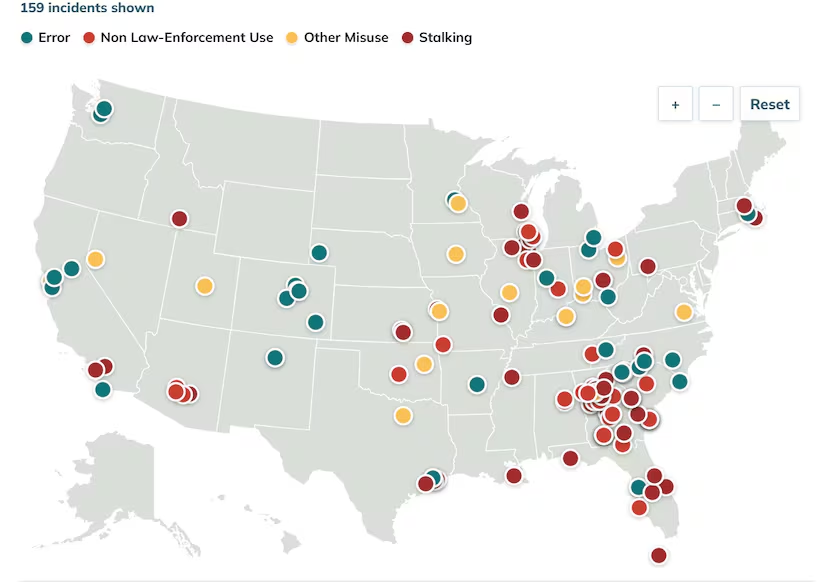
In the United States, at least 80 cities and counties have decided to cancel or not renew contracts for security cameras that use these mass surveillance systems, the PIP estimated.
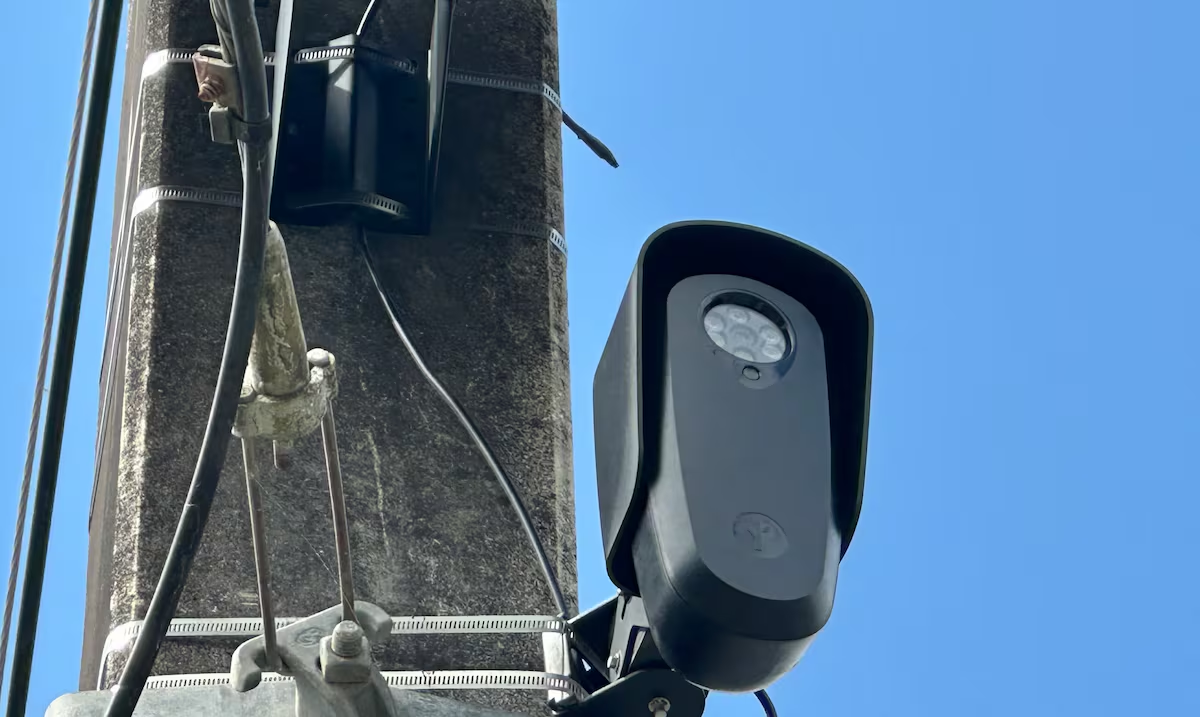
1/17 | This is how the Flock cameras installed to read tablets in Puerto Rico look and operate. The Flock Safety brand cameras in Puerto Rico are automatic license plate readers (ALPR), which use high technology for optical character recognition to capture, analyze and store vehicle data. – Adriana Díaz Tirado/GFR Media
At the local level, municipal authorities have defended the use of these devices to clarify cases of car thefts, murders and missing persons, and allege that they do not use surveillance systems to create profiles of citizens who are not under criminal investigation.
The PIP project also proposes that any data, image or information obtained by such systems be “inadmissible in any judicial or administrative procedure.”.
Meanwhile, Gutiérrez Colón maintained that RC 787 would investigate “the real scope of the technological surveillance capabilities possessed by the government of Puerto Rico and its municipalities, as well as the regulations that govern their use.” This measure orders the House Legal Committee to investigate mass surveillance systems.
“This research is especially relevant and urgent in the context of our history of political persecution and discrimination. (…) It is questioned whether the Department of Public Safety has the ability to ensure the reliability of the stored information or prevent it from being accessed by other people when it is under the control of a private company. Worse yet, all of this is done without the consent or knowledge of the people who own your sensitive personal information and data.”, emphasized Gutiérrez Colón.