
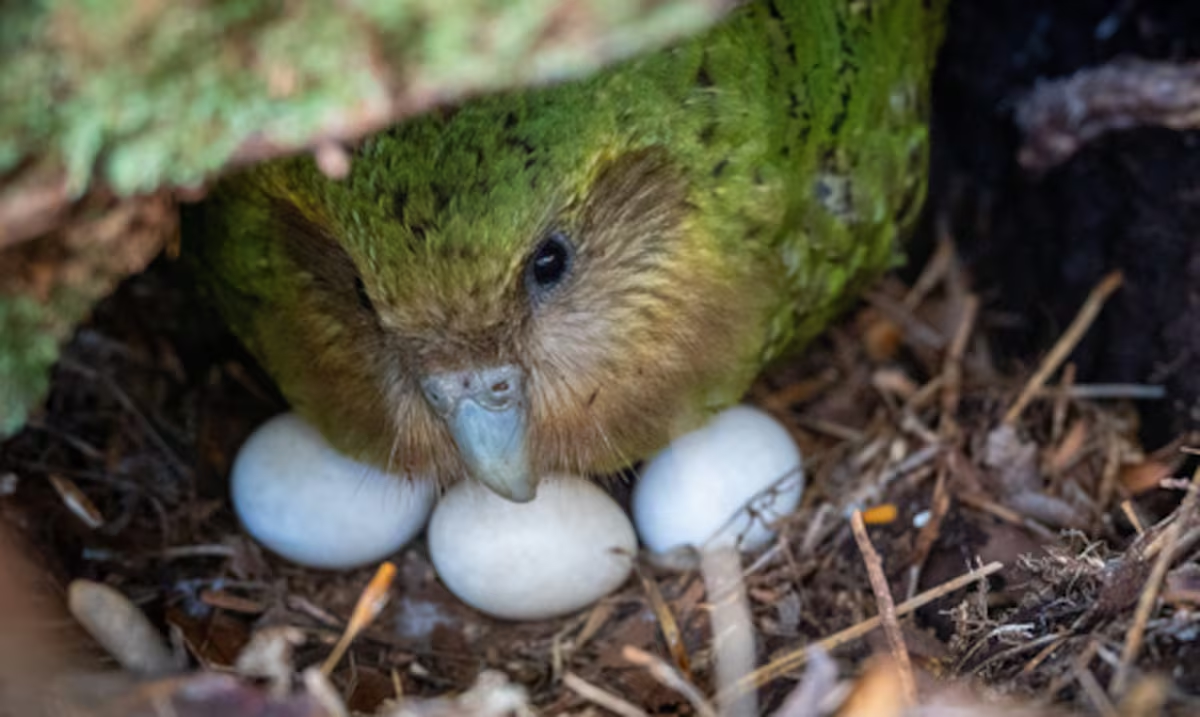
The world’s only flightless parrot species was believed to be destined to disappear. The kakapo is too heavy, slow, and, frankly, too appetizing to survive surrounded by predators. And, furthermore, it adopts a shamelessly relaxed attitude towards its reproduction.
But the fate of this nocturnal and solitary bird, endemic to New Zealandis beginning to lean towards survival after an improbable conservation effort that has increased the population from 50 to more than 200 specimens in three decades. This year, thanks to a bountiful harvest of the bird’s favorite berries – which has sparked unusual enthusiasm among the rare parrots to appear – those working to save these birds expect a record number of chicks in February, which would bring the kakapo closer to challenging what until recently was believed to be certain extinction.
Kakapos live on three small remote islands off the south coast of New Zealand, and the chances of seeing them in their habitat are slim. But this breeding season has propelled a kakapo to internet fame thanks to a video streamed live from its underground nest, where its chick hatched Tuesday.
Smelly parrots the size of small cats
The kakapo is a majestic creature that lives 60 to 80 years. But it certainly has an unusual appearance.
Each can weigh more than 3 kilograms (6.6 lb). Its face resembles that of an owl, it has whiskers and mottled plumage in green, yellow and black that imitates the play of light and shadow on the forest floor.
This flightless parrot lives there, which has complicated its survival.
“Kakapos also emit a very strong smell”said Deidre Vercoe, operations manager for the Department of Conservation’s kakapo program. “They smell like musk and fruits… a magnificent aroma.”
However, their pungent odor became bad news for these parrots when humans arrived in New Zealand hundreds of years ago. The introduction of rats, dogs, cats and stoats, as well as hunting by people and the destruction of native forest habitats, drove the country’s thriving flightless bird species – including the kakapo – to near or complete extinction.
By 1974 no kakapo was known to exist. However, conservationists continued their search and, in the late 1970s, discovered a new population of these birds.
Reversing his luck has not been easy.
Birds wait years or decades to reproduce
One reason why the kakapo population has grown slowly is that their reproduction is – like everything in these birds – peculiar. Years or even decades may pass between successful clutches.
The breeding season only occurs every two to four years, in response to abundant fruit production from the native rimu trees that the parrots prefer, which last occurred in 2022. A huge food source is needed for the chicks to survive, but it is not known exactly how the adult birds realize that there is a bountiful harvest.
“They are probably up there, high in the trees, evaluating the fruiting,” Vercoe noted. “When there is a bumper crop developing, they somehow tune into it.”
And that’s when things get really strange. Male kakapos nest in bowl-shaped nests that they dig into the ground and make rumbling sounds, followed by noises known as “ching,” similar to the squeaking of rusty springs in a mattress.
Those deep noises, which on clear nights can be heard through the forest, attract the female kakapo to the bowls. A female can lay up to four eggs and raises her chicks alone.
Since January, bird admirers have had a rare glimpse of the process through a livestream showing the underground nest of Rakiura, a 23-year-old kakapo, on the island of Whenua Hou, where she has laid three eggs, two of them fertile. The survival of the species is so precarious that the eggs have been exchanged for fake substitutes, while the real ones are incubated indoors.
On Tuesday, a technician replaced the fake eggs with the first egg, about to hatch. The kakapo stayed at a distance while the change was made, but quickly returned to the nest, seemingly unfazed. The chick hatched just over an hour later. The second royal egg is expected to be added within days.
Native birds are much loved in New Zealand
Perhaps the only thing stranger than the kakapo is everything New Zealanders have done to save it. Quadrupling their population over the past three decades has required moving them to three remote, predator-free islands and micromanaging every parrot love affair.
“We do everything we can to make sure we don’t lose any more genetic diversity”Vercoe explained. “We manage that carefully and look for the best possible compatibilities on each island.”
Each bird has its own name and is monitored using a small backpack tracker, because if one goes missing, it is almost impossible to find it. Since the kakapo remains critically endangered, there is little chance that conservation efforts will end soon, although those who work with these birds reduce their direct intervention in each reproductive cycle.
The painstaking work to preserve the species may seem overkill to non-locals, but this parrot is just one of many lively and rare birds in a country where feathered animals reign supreme. The only native land mammals are two types of bats, so New Zealand’s birds, which evolved eccentrically before the arrival of humans and predators, have become beloved national symbols.