
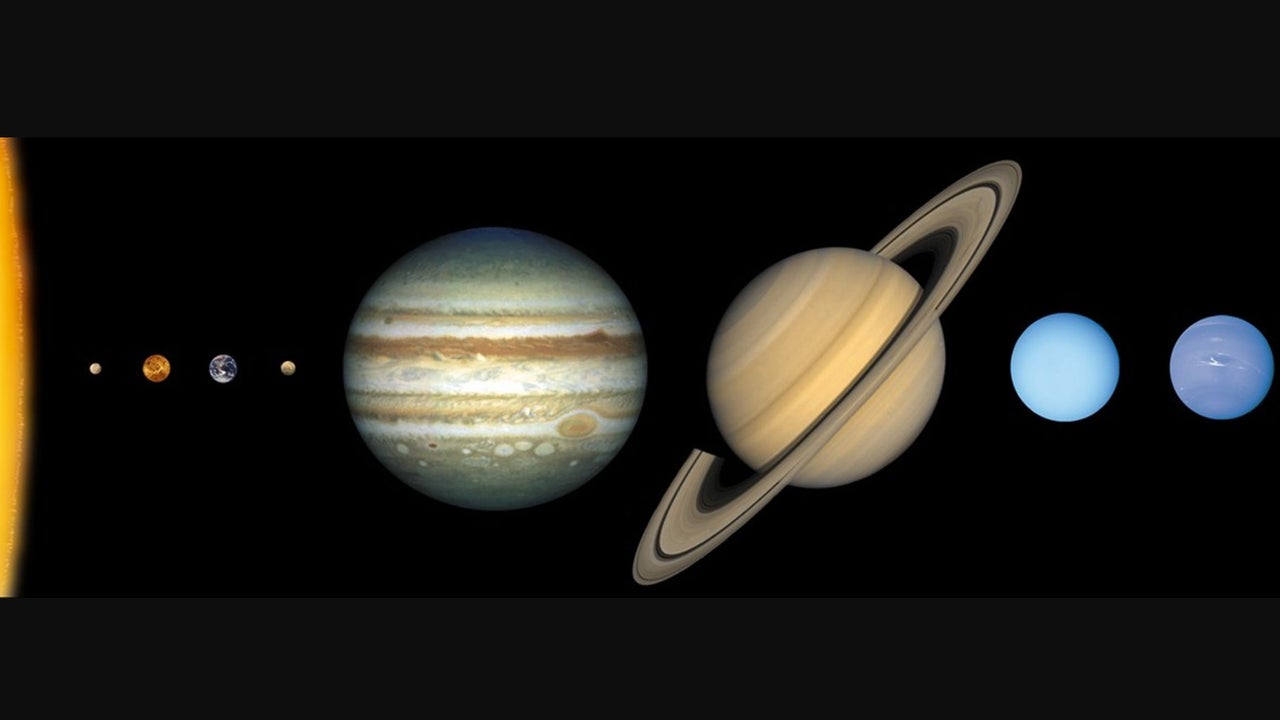
The Earth is about 12,742 kilometers in diameter. If we placed it next to Jupiter, the largest planet in the solar system, it would look like a marble in front of a beach ball. Jupiter could swallow more than 1,300 Earths in volume. And yet even he is modest when we begin to look beyond our cosmic horizons.
In our galactic neighborhood, the gas giants (Jupiter, Saturn, Uranus, and Neptune) dominate by size and mass. They have no solid surface to land on: they are huge spheres composed mainly of hydrogen and helium, with dense nuclei inside. For decades, they seemed to represent the natural ceiling of what a planet could be, at least in terms of size. But the exoplanet catalog has challenged that intuition.
In the galaxy there are gas giants that multiply several times the mass of Jupiter. Some are so massive that they border on brown dwarfs, those intermediate objects between a planet and a star that fail to initiate sustained hydrogen fusion. The question is no longer just how big they can be, but how they come to form.
The star system HR 8799, located about 133 light-years away in the constellation Pegasus, is one of the most fascinating natural laboratories for answering that question. Four gas giants orbit there with masses between five and ten times that of Jupiter, located at enormous distances from their star: between 15 and 70 times the distance between the Earth and the Sun. This system is, in a way, an amplified version of our own outer solar system.
But those distances and masses posed a problem. Classical models of planetary formation, the so-called core accretion model, hold that a solid core first forms from rocks and ice, which then grows to be massive enough to attract surrounding gas. This is how Jupiter and Saturn would have been formed. But in regions so far from the star, where material is scarce and time is limited, It seemed unlikely that this process could produce such enormous planets before the gas disk disappeared.
The alternative was another faster and more violent path: gravitational instability, in which parts of the gas disk collapse directly to form massive objects, almost like small failed stars. If that were the case, the line between planet and brown dwarf would become even more blurred.
A new study, published in Nature Astronomy and led by scientists at the University of California, San Diego, has provided a key piece to the puzzle thanks to the James Webb Space Telescope. Using spectroscopy (the detailed analysis of light to unravel the chemical composition of atmospheres), The team examined the three inner planets of HR 8799 with unprecedented precision.
Until recently, astronomers focused primarily on “volatile” molecules like water or carbon monoxide. But these substances do not always allow us to clearly reconstruct the origin of a planet. On this occasion, the authors, led by Jean-Baptiste Ruffio, looked for refractory elements, such as sulfur, which are only incorporated into planets through solid material. Detecting sulfur in the atmosphere is a clue that the planet formed from a solid core that later accumulated gas.
And that’s exactly what they found. The JWST made it possible to identify hydrogen sulfide and other rare molecules in these distant giants. The presence of sulfur suggests that, despite their enormous size, up to ten times the mass of Jupiter, these worlds would have formed through core accretion, like the giants of our solar system. An unexpected result that forces us to review classical models and expands the range of conditions in which planets can be born. “in the manner of Jupiter.”
HR 8799 is, furthermore, a young system, barely 30 million years old compared to ours’ 4.6 billion years. Their planets still glow with the residual heat of their formation, making it easier to study them thanks to this visibility. Even so, the task was extreme: They are about 10,000 times fainter than their star, and JWST’s spectroscope was not originally designed for such demanding observations. It was necessary to develop new analysis techniques to extract its signal.
The discovery reopens the big question: how far can a planet grow and remain a planet? Fifteen times the mass of Jupiter? Thirty? Where does planetary formation end and brown dwarf formation begin? Deep down, The question is not only one of size, but of origin. Two objects can have similar masses and yet be born by different processes. In astronomy, biography matters as much as the scale.
And as the James Webb Space Telescope continues to look at other systems, the scale of the possible continues to expand as does the list of unknowns. If the Earth were one centimeter in diameter, Jupiter would be about eleven centimeters. The largest known gas giants would barely double that size: perhaps eight inches. They are not huge on the outside, but on the inside. Some concentrate ten, fifteen or even twenty times the mass of Jupiter in a similar volume. Rather than swelling, they compress. And that’s where the question stops being how much they grow and becomes what really differentiates them from a failed star.