
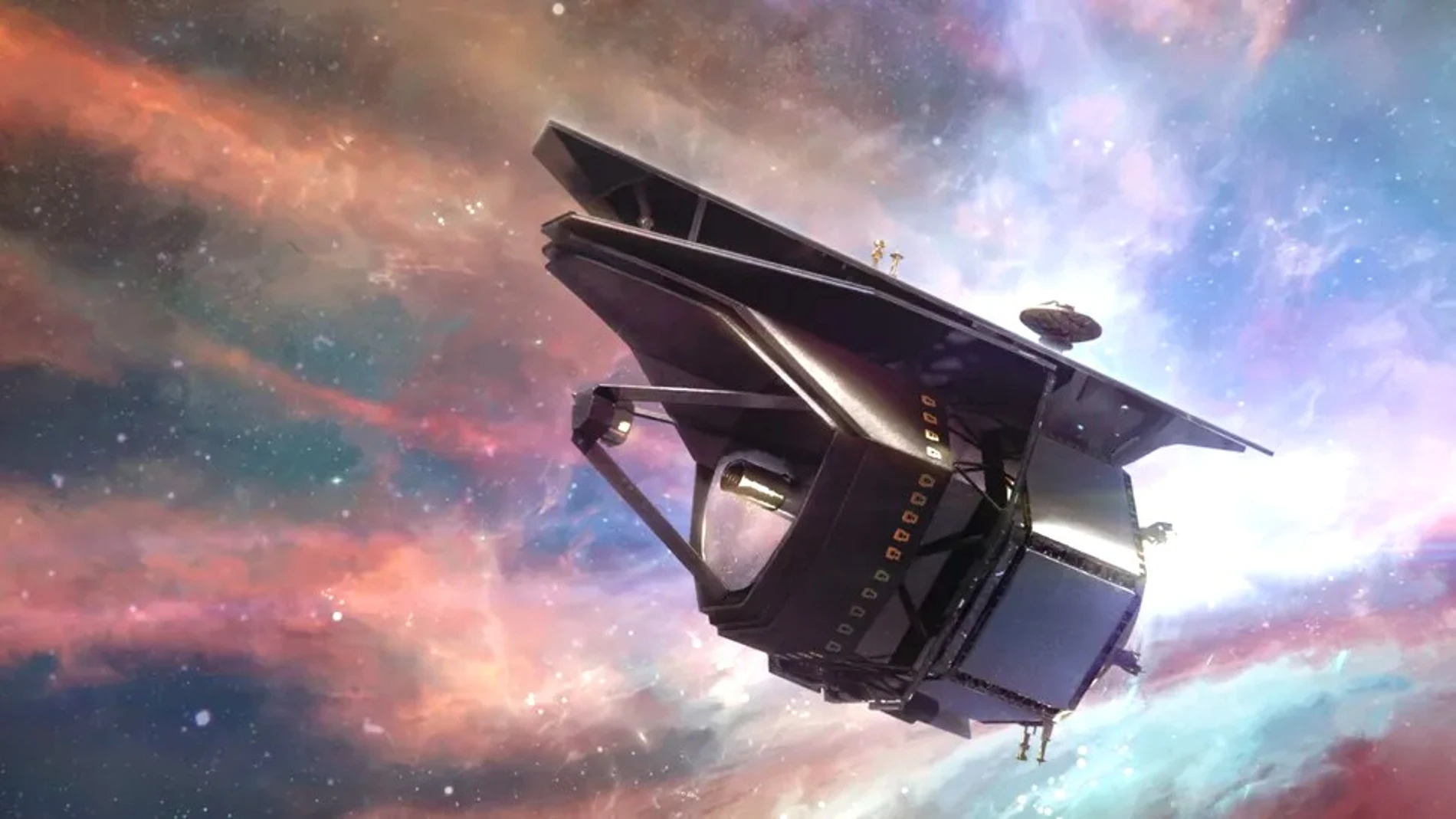
The POT has selected PREMIUM to become the first space telescope of a new category of missions and advance to the next phase of its development. The observatory is designed to study the universe using far infrareda region of the electromagnetic spectrum that will allow research from the formation of planets to the evolution of galaxies and their black holes.
The project, whose full name is PRobe far-Infrared Mission for Astrophysics and develops it Jet Propulsion Laboratory (JPL) of NASA, has just entered phase B after winning the lightning observatory X AXIS of the Goddard Centeralso from NASA. But its construction is not definitively approved, before the JPL You must complete the preliminary design, finish developing the necessary technologies and verify that the expected costs and deadlines are acceptable.
‘The PRIMA mission is humanity’s next window to the deep universe. “It will allow us to reveal what remains hidden throughout cosmic history to better understand the formation of planets, stars and black holes, and even how water came to exist on Earth,” he explained. Nicky Foxassociate administrator of the Scientific Missions Directorate from NASA, in a statement.
What PRIMA can see
One of the keys to understanding what PRIMA will provide is in the part of the electromagnetic spectrum that can be observed. The visible light that our eyes perceive occupies only a small part of that spectrum, while Infrared corresponds to longer wavelengths that are also emitted by stars, planets, dust and other objects in the universe. Telescopes capable of detecting this radiation can study bodies and regions that are difficult to observe with visible light, especially cold materials and areas hidden by large amounts of dust.
Within the infrared there are different regions depending on the wavelength of that radiation. The near infrared is the closest to visible light, the middle uses longer wavelengths and the far infrared is even further away from it, where it is especially useful for detecting the radiation emitted by cold dust and studying the gas and materials from which stars and planets are born.
He James Webb can observe from the 0.6 until the 28.5 micrometers and mainly covers the infrared close and medium. PRIMA, equipped with a telescope 1.8 meterswill work approximately between 25 and the 260 micrometers, so there will be a small overlap between the two, but it will reach much further in the infrared and will allow the study of phenomena that are outside the capabilities of the Webb.
NASA’s new space telescope will be especially useful for investigate regions hidden behind large amounts of dust and follow the evolution of materials that end up forming new planetary systems. Its instruments will also allow us to study how galaxies evolved and what relationship exists between their growth and that of the supermassive black holes that host many of them, how heavy elements accumulated and what the role of water has been during the formation of planets.
At the moment There is no operational astronomical observatory dedicated to covering this far infrared region. with capacities comparable to those planned for PRIMA. The space telescope Herschel of the European Space Agency studied these wavelengths until it ended operations in 2013, while the airborne observatory SOFIA from NASA and Germany stopped working in September 2022.
Probe Explorers, a new category of NASA missions
The mission will also be the first representative of the new category Probe Explorers created by NASA within its veteran program Explorers. This class was recommended in the space agency’s 2020 decadal study of astronomy and astrophysics for fill the gap between the agency’s large strategic missions and smaller projects of the veteran Explorers program.
Before starting its construction, PRIMA will have to complete phase B and pass a review in which its technical situation, its budget and the planned schedule will be analyzed. If NASA then confirms the mission, it will enter in phase C, dedicated to final design and manufacturing, followed by testing and launch preparation.
If all of those steps are completed as planned, NASA intends to launch PRIMA in 2033 for an initial mission five years managed by JPL. The project has a maximum budget of 1.2 billion dollarsnot including launch and other external costs.