
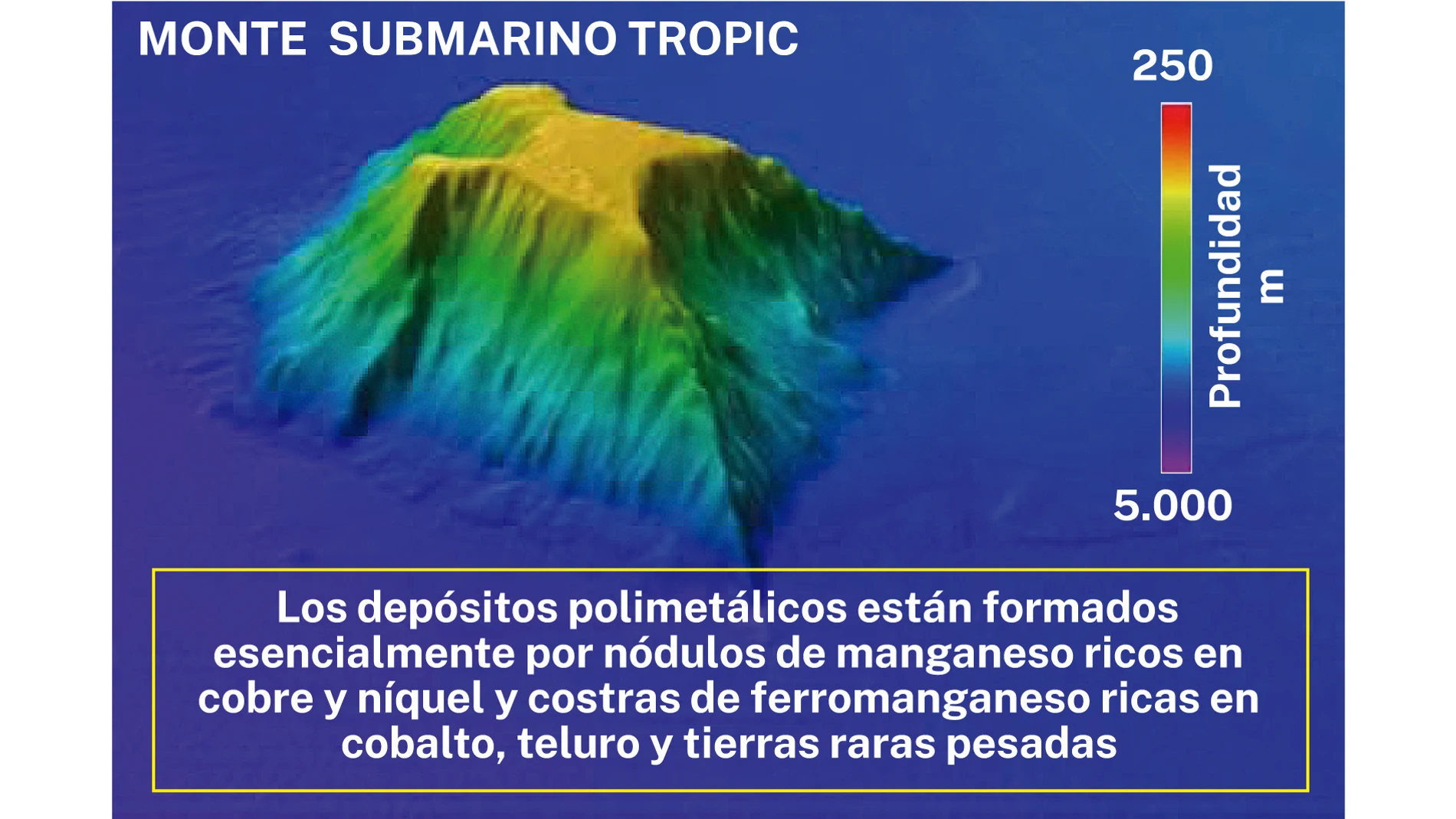
Tellurium in large quantities, rare earths, ferromanganese crusts, cobalt. All these essential minerals for the digital economy, the manufacturing of photovoltaic panels or the production of electric cars are found in large quantities in Mount Tropic, a seamount located about 500 kilometers from the southernmost area of the Canary Islands and a similar distance from the Sahara.
The Tropic is one of the many elevations that exist under the sea in this territory and is known as “the grandmothers” because they are much older than the Canary Islands, about 100 million years on average. «The ferromanganese crusts have been formed by slow but constant precipitation over these hundred million years. The presence of cobalt, a strategic element because it is used in many batteries. There are rare earths, which are used for the manufacture of cell phone crystals, high-power magnets, wind turbines). Pelicar, Bimbache and Drago, Echo, are some of those large mountains. There are some that are almost similar in size to islands. others are medium-sized and then there are an infinite number of small and very deep mountains, which have their summit more than 5,000 meters deep,” details Egidio Marino, researcher at the Geological and Mining Institute of Spain (IGME).
The mountain of discord
All of these mountains and their resources have been studied in different campaigns, more intensely since 2008, although the Tropic is the one that receives the most attention because it is the subject of dispute between Morocco and Spain. The reason? It is located in international waters, outside the 200 miles of the Exclusive Economic Zones from Spain and Morocco.
The dispute dates back to 2014. Spain presented to the UN a “Proposal for the expansion of the Spanish Continental Shelf to the West of the Canary Islands beyond 200 nautical miles. The objective was to include this seamount within the borders, expanding its platform up to the maximum allowed: 350 miles.
However, for the UN to validate the extension, both countries would first have to agree on their marine delimitations. And that hasn’t happened. During this time, Morocco has approved several legislative initiatives with which has extended its territorial waters towards the coasts of Western Sahara (territory pending decolonization), towards waters near Mount Tropic.
The professor of Private International Law at the University of Las Palmas de Gran Canaria, Lucas Andrés Pérez, details it: «The conflict over Mount Trópic is due to the fact that it is beyond the 200 miles of the Exclusive Economic Zone, in what we could define the continental shelf of each of the countries, which is set between 200 and 350 miles. This platform is regulated by the Sea Convention and does not have a fixed consideration. The UN has a Commission on the Limits of the Continental Shelf so that countries that do not have any other territory in front of their sea, so to speak, establish that platform. Because? Because it also allows you to economically exploit the resources in those waters. What’s wrong with Mount Tropic? Which is just southwest of the Canary Islands, between 200 and 350 miles. Spain, which has known for decades what is there, presented a request to the Commission in 2014 to extend the platform, arguing that this mountain is in the geological continuity of the underwater volcanic province associated with the islands. The problem is that when an area comes into conflict with a similar one in another country, the Commission cannot freely recognize the extension up to 350 miles. The Sea Convention establishes that in situations in which there is conflict between countries’ seas, the line between one sea and another is set by consensus. So until there is consensus, the dispute will not be resolved. And this is how Spain and Morocco are,” he comments.
Sahara
The professor recalls another important factor: that the mountain faces the waters of the Sahara and Morocco decided to declare the 200 miles of the Sahara continental shelf as its own in 2020, but neither for the EU nor for the UN does this territory belong to Morocco. «The European Court of Justice in 2024 ratified a previous ruling stating that a final decision cannot be made on the exploitation of a certain site that is not peacefully accepted as its own territory, if it is proven that the population of that place will benefit. Morocco consulted with the population living in Western Sahara, but according to the Court of Justice In the year 24 he did not consult with a plural population, that is, he consulted with those who considered themselves Moroccans. Furthermore, the territorial ownership or situation of the Sahara is under debate,” says Lucas Andrés Pérez. In this sense, in 2024 it was established that fishing or agricultural products leaving Sahrawi territory should have a label that specifies it. Something that has changed in 2026 and is now allowed to use certain regional names to identify the origin of products, administrative regions established by Morocco in the territory.
Islands or archipelago?
The Platform for the Canary Sea has been demanding for 25 years that the Canary Islands be recognized before the UN as a full-fledged archipelago. Something that for its director, Domingo Martín, could guarantee Spain access to 30% of Mount Tropic and would shield the internal waters between islands. «If it were a full-fledged archipelago, it could enjoy its internal waters, its territorial sea and its Exclusive Economic Zone. These are three points of utmost importance. As an island we only have two nautical miles of ZZE around each of the islands. Any ship of any origin, with nuclear weapons, monohull, drug trafficking, if there is no order from an international court, no one can stop it, not even the Spanish State, endangering the ecosystem and the citizens. If we were an archipelago, we would close the perimeter of the entire archipelago, not island by island. From that straight baseline that has closed the archipelagic perimeter, 12 miles of the territorial sea are delimited, another 12 of the adjacent security sea, which is now 24, and 188 more miles of Exclusive Economic Zone. That is where the Spanish State has to intervene and negotiate what is the median with Morocco, with the Sahara and with Portugal,” he considers.
In this sense, last year the Parliament of the Canary Islands approved a non-legal proposal to ask the UN for legal recognition as an archipelago.
For Martín, the dispute in the Atlantic not only has to do with Mount Tropic, but with Morocco’s desire to control all the waters of the Atlantic, beyond controlling the resources of Western Sahara. «Between Lanzarote, Fuerteventura and Morocco, we have 14 delimited grids, for many years now, in which oil and gas were found. We believe that if the Canary Islands Sea were delimited as a full-fledged archipelago, Spain would have all those riches and security within the sea and within its airspace,” he says.
Resources that are not currently exploitable
►Although it would be very interesting to be the owner of that territory due to the economic advantages it offers, as stated by Professor Lucas Andrés Pérez (“it is also interesting to know about it because of the geopolitical situation, the interest in certain resources. About five years ago oil was discovered in the north of Morocco…”), as of today These underwater resources cannot be exploited and it is not even known if it would be profitable. «In the sea there is still no environmental, mining or exploitation legislation. Currently only research is being done. In the future it will depend on how the legislation evolves and furthermore the means for exploitation are still in preliminary development,” considers Egidio Marina, from the IGME. Furthermore, he adds that Any of the other mountains that are not under dispute could be exploited.