
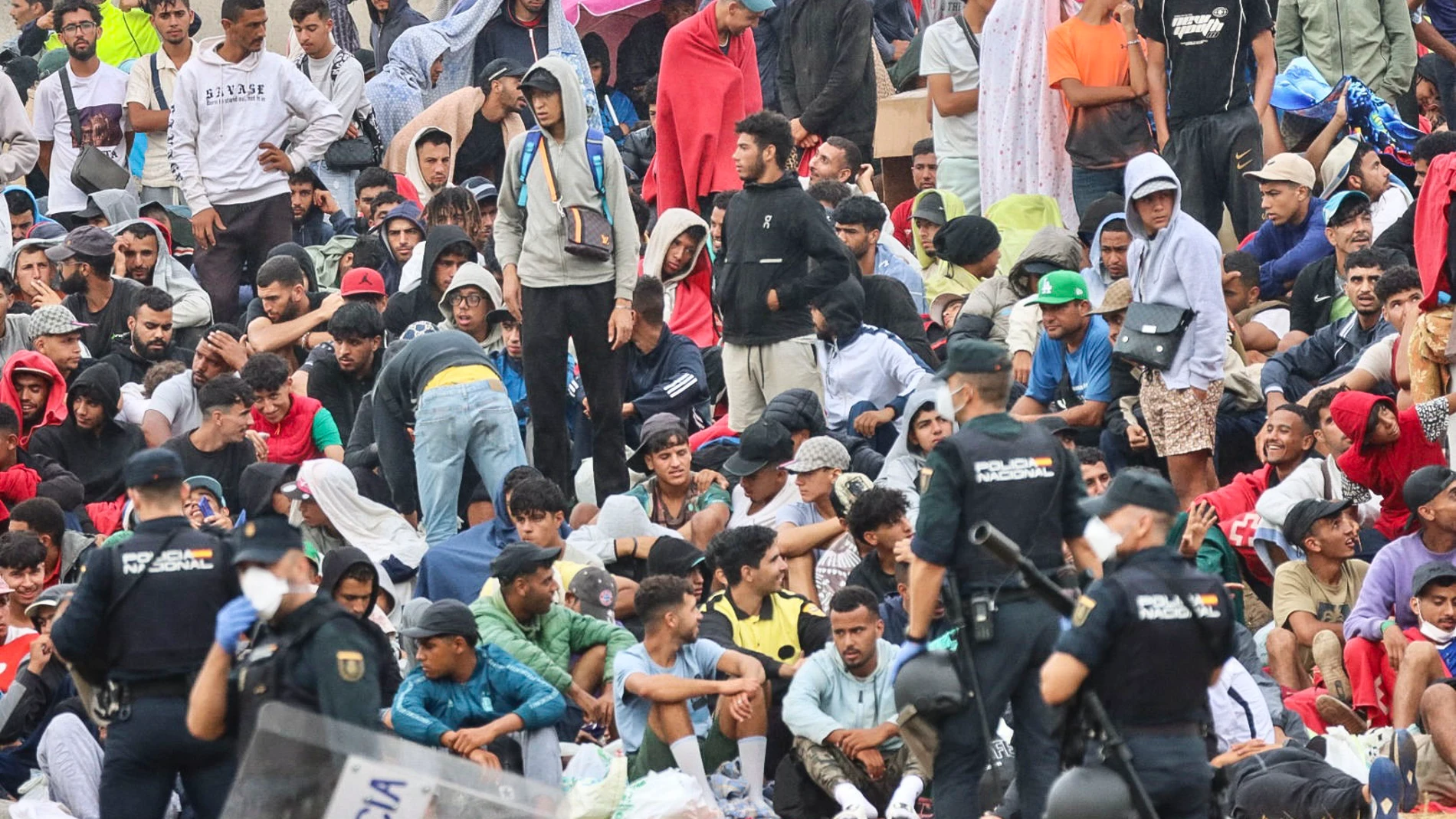
No one on either side of the Strait questions at this time the wound suffered in Spanish-Moroccan relations after the Ceuta crisis, the avalanche of July 30 and 31, and its current consequences. Beyond the deep and immediate causes of the decision of the Moroccan security forces to inhibit themselves for several hours in the ominous days at the end of last month, the Moroccan intellectual elite, often present in their media, as well as certain political figures individually – in the absence of a detailed and transparent assessment and explanation of what happened by the royal cabinet during the last three weeks -, these days denounce a list of grievances, offenses, misunderstandings and inaccuracies historical events often unknown in Spain.
If no one agrees to point out the cause of the unrest that ended up precipitating the “political message” sent to Spain during July 30 and 31, there is much more consensus among the Moroccan elites – as on other occasions the majority of the society of the neighboring country remains oblivious to what happened – about what they consider an exaggerated and unfair reaction of the media, opinion leaders and Spanish political class about Morocco, its interests, institutions and history.
“What has been experienced much worse in Morocco, especially since the outbreak of the Ceuta crisis, has been the treatment of a part of the Spanish public debate,” former Moroccan Tourism Minister Lahcen Haddad tells LA RAZÓN from Rabat. «It is not about criticism of Morocco. Criticism is normal, legitimate and even useful, even when it is severe. The problem is another: we have witnessed a quite exceptional accumulation of stereotypes, amalgamations, conspiracy theories and, in some cases, openly hostile speeches towards Moroccans,” warns the vice president of the Moroccan Chamber of Councilors.
«In certain media and among some public figures, any explanation seems to have to start from the hypothesis of Moroccan manipulation, blackmail, a secret operation or malicious intent. Probably what has surprised me most is the absence of sufficiently loud voices saying enough is enough. When a discourse goes from political criticism to Moroccanphobia, stigmatization or even dehumanization, there should be democratic reflexes capable of marking a limit,” says Haddad, one of the Moroccan politicians with the greatest knowledge of the Spanish language and bilateral relations.
“In Spain there continues to be a bellicose and condescending attitude towards Morocco and its institutions and a lack of knowledge of our shared history that we have been able to see in the last three weeks in its media,” laments, for his part, doctor in history and specialist in Spanish-Moroccan relations Samir Bennis. “Never, in any case, is Spain and its political leaders talked about in the same way in the Moroccan media,” recalls the writer and diplomatic advisor, a native of Fez, who has long been advocating in his country to explain more and better – and in the Spanish language – the Moroccan positions in order to fill a void that, in his opinion, ends up being filled by “misinformation and shouting.”
Along similar lines, political scientist and professor at the International University of Rabat (UIR) Beatriz Mesa denounces to LA RAZÓN how “Spanish intellectuals are daily referring to what happened in Ceuta as an episode of hybrid war and calling for retaliation against Morocco and the expulsion of migrants: hostile, aggressive and dangerous language for coexistence between the two countries.” “This can end in something very serious,” he warns.
In Mesa’s opinion, the crisis responds to the “political message” sent by Rabat to the Government for “not having complied with the red lines agreed upon in the last bilateral summits.” «From Morocco, the nationality law of the Sahrawis has been perceived as an affront, which is perceived as political instrumentalization, and the lack of progress of the socialist Government in supporting Moroccan sovereignty over the Sahara and the autonomy project. From Spain it is still not understood that Morocco is an increasingly independent and autonomous regional power, supported by the US and other international powers,” he says.
Furthermore, the professor of Political Science at the UIR explains that “Morocco is very hurt by the avalanche of instrumentalized information that is being released to Spanish public opinion, mixing everything and attributing all responsibilities for what happens to the head of state, demonstrating a great lack of knowledge about the different institutions and instances of power,” although she admits “the very bad management” that its authorities are doing regarding the sovereign claim over the cities of Ceuta and Melilla.
Not wanting to be “the gendarme”
As in the precedent of the recent Ceuta crisis, the land invasion of May 17 and 18, 2021, although this time without hearing it from representatives of the Moroccan administration, one of Rabat’s recurring complaints is that of being forced to assume the role of “Europe’s gendarme”, that is, being condemned in perpetuity to do the dirty and thankless work of guaranteeing the security of the Spanish borders. In the absence of figures broken down by year, data for the last decade as a whole shows that between 2014 and 2020, the EU allocated some €1.5 billion to bilateral cooperation with Morocco, including the Emergency Trust Fund for Africa.
Morocco insists that European funding covers only a fraction of the actual expense of maintaining border surveillance and calls for a shared responsibility approach rather than relying on border control alone. Furthermore, it denounces the cynical attitude of Spanish public opinion in demanding tight control of the borders and an expeditious attitude from its security forces when, at the same time, violations of the human rights of migrants are denounced.
Without a doubt the most thorny and irreconcilable issue on both sides of the Strait is Ceuta and Melilla. Although neither the Head of State nor the current Government have made any explicit public statement about the future of the two Spanish cities, the truth is that sovereignty over Ceuta and Melilla is an inalienable sovereign demand of the Moroccan State that also has the majority support of its population.
This has not prevented individual political figures, as has happened with the former Prime Minister Saadeddine Othmani (PJD) and the current Minister of Justice Abdellatif Ouahbi – the most important case due to his current position – from referring in recent weeks to the issue of Ceuta and Melilla. Almost two weeks after his interview with a Saudi network, the head of Justice of the Moroccan cabinet went further last Friday than he did then. In statements that can be framed at the beginning of the pre-campaign for the next general elections, the politician from the Authenticity and Modernity Party (PAM) – the second force in Parliament – once again heated up the atmosphere by demanding from Pedro Sánchez’s Government a “space for dialogue” in order to “find a definitive solution” to the issue of the sovereignty of the two cities.
In this regard, the historian – and author of several essays on Spanish-Moroccan relations and the question of the Sahara – Samir Bennis, explains that “in Spain it should be known that Morocco does not plan to make any formal proposal about Ceuta and Melilla before international institutions, which are in no way priorities for its authorities.” “But it must also be understood that it does not follow that my country renounces a historical claim,” he reminds LA RAZÓN.
Furthermore, the historian denounces, as he has been doing insistently on the networks and the media in the last three weeks, that “beyond Spain’s historical arguments regarding its sovereignty over Ceuta and Melilla, what is an absolute example of historical ignorance is to say, as is constantly done in Spain over and over again, that Morocco did not exist when the cities came under Spanish control.” «It’s a lie. Morocco signed treaties, agreements and conventions with Spain in 1767, 1780, 1799, 1845, 1859 and 1860. The fact that Morocco did not regain its independence until 1956 does not mean that the Moroccan State did not exist,” he ditches.
“What has hurt me the most,” concludes former Minister Haddad, “is not that Spain has its own interests, its own relations with Algeria or its own legislative decisions, but to discover, as a result of this crisis, to what extent certain prejudices and a form of Moroccanphobia can still be expressed publicly without a real response. Our long-term bilateral relationship depends on disagreements not turning into reciprocal caricatures and hostility between both societies,” he concludes.
“No matter how much evil tongues say, there will not be a political crisis between Spain and Morocco and both countries are interested in getting along and are called to understand each other,” concludes Bennis. The uncomfortable neighbor to the South will continue to be a great unknown for a good part of the Spaniards who these days witness an incessant flow of messages in the media and networks of all kinds.