
The elections that were held last Sunday in Andalusia put a very sensitive issue on the table for the PSOE. The Government of Pedro Sanchez and his membership in it is not something that is working for the party at the electoral level. It was tried, but the facts show that it does not work.
Maria Jesus Montero She was banished to the regional elections, something she rejected at first, with the aim of mobilizing socialist voters. Not only did he not succeed, but he achieved the opposite effect and led the game to its worst result in history. Before her, Pilar Alegría He suffered the same fate in Aragon and, although the polls still have to speak, the road does not look easy for Óscar López in Madrid, nor for Diana Morant in the Valencian Community. It seems that the PSOE is not capable of winning elections, not only in complicated places like Madrid, but also in others where it has been able to govern for decades.
At LA RAZÓN we have analyzed the latest elections in each autonomous community, the latest municipal, European and general elections to see what the electoral pull of the PSOE is with Sánchez at the helm and the result is clear. Of the last 20 elections that have been held, the PSOE has lost 17 of them, 85%. In addition, 1,559 deputies, regional deputies and councilors have been left behind and 1.2 million votes have been lost adding up the results of all those elections.
As soon as the shock of the accusation of José Luis Rodríguez Zapaterothe PSOE will have to address how it will face the next electoral cycle and what it can do to maximize its results. Regional and municipal elections should be held next May and general elections around June.
There are voices within the party, mainly those of the mayors, who ask Sánchez to go to the polls first, to bring forward the general elections, for fear of paying the price for their wear and tear. This deferred punishment for Sánchez already happened in 2023 and it is feared that in 2027 it could be even worse. However, Moncloa shows no signs of being willing to do that. At most, the possibility of a “super Sunday” that makes all the elections coincide can be considered, something that the mayors do not view favorably.
In fact, within these last 20 elections analyzed, the 2023 municipal elections were one of the main losses for the PSOE. The socialists lost 1,545 mayors and councilors in them, according to data from the Ministry of the Interior, and More than 365,000 votes were left in relation to the previous municipal electionsthose of 2019.
Those municipal elections were the elections in which the most elected officials lost. However, they were not the worst in terms of vote deficit. That dubious prize goes to the European Parliament elections of June 2024 by far. There the PSOE went from having obtained more than 7.3 million votes in the previous election to 5.3 million, two million fewer ballots.
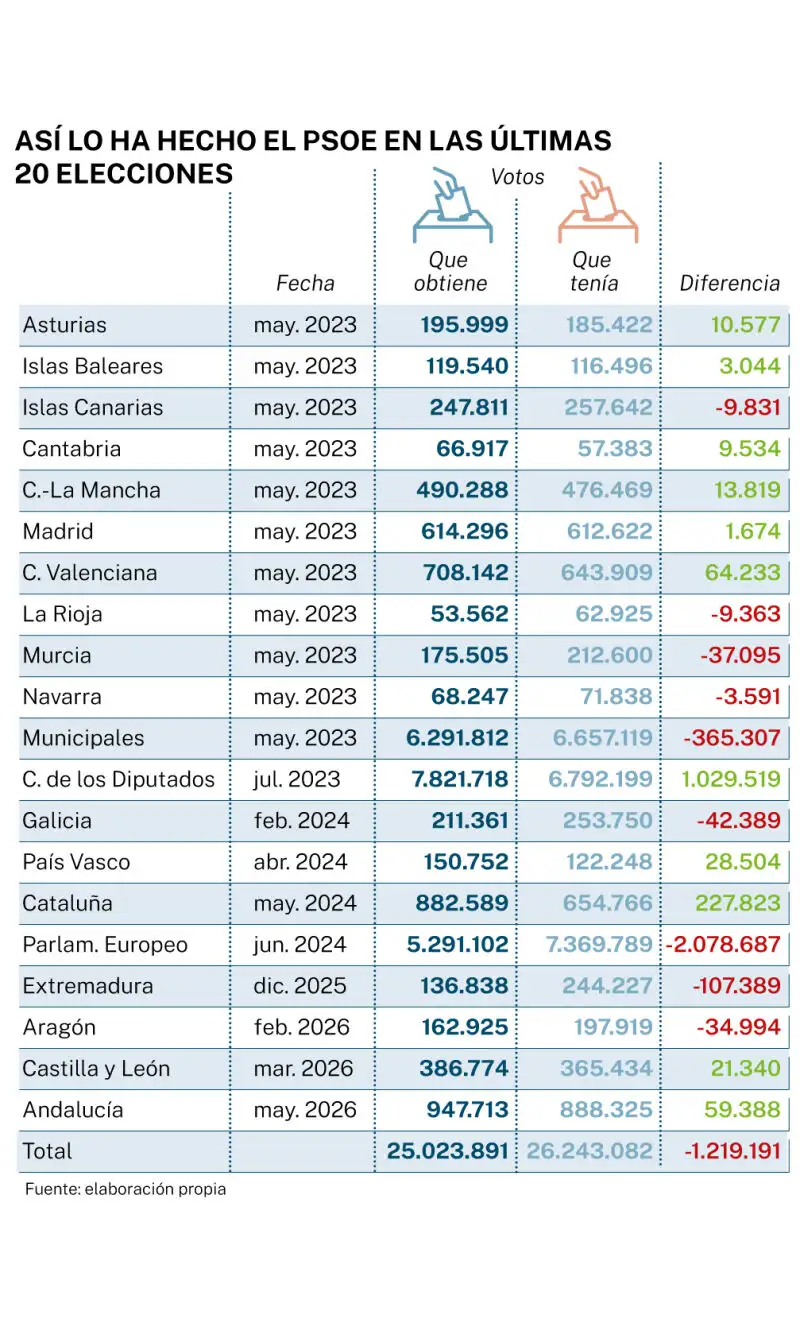
At the regional level, the worst electoral setback for the PSOE was Estremadura last December, when it lost no less than 10 seats and 107,389 votes. They are followed by the Aragon elections this February and those of Galicia February 2024. In both, it suffered the loss of five deputies and 34,994 votes and 42,389 votes respectively.
It is striking that all these electoral events, the toughest for the PSOE, occur precisely after Pedro Sánchez was reinstated in 2023. It is in this legislature in which the Government is finding itself unable to approve relevant laws in the Congress of Deputies and in which the majority of corruption cases surrounding the president’s entourage are occurring, which is having an undeniable electoral effect for the party.
Regarding the positive balance, the PSOE has only won in the regional elections of Castile-La Mancha and Asturias of 2023 and in those of Catalonia May 2024. Currently Emiliano García-Pagethe president of Castile-La Mancha, is the only socialist baron who governs with an absolute majority and, although he won the last elections, he lost two deputies in the elections. The Asturian Adrian Barbon He also lost a deputy despite winning. The only one who has won the elections and has gained deputies is Salvador Illa.
In fact, Catalonia is the autonomous community in which the PSOE has grown the most in votes, a surplus of 227,823 compared to the previous elections. However, the cake in the increase in votes goes to the 2023 general elections, in which Sánchez managed to get just over a million more people to vote for him than in November 2019.
To analyze this data, it must be taken into account that the November 2019 elections were a repeat election, so participation fell significantly. If the 2023 result is compared with those of April 2019, the PSOE grew 308,576 votes. It is a triumph, but a relative one: in that same comparison, the PP increased its electoral base by almost four million votes between April 2019 and 2023.
Even so, in Moncloa they are very satisfied with the comeback that Sánchez was able to make on June 23 and that seems to be his current strategy, that of sacrificing territorial power to once again have the possibility of remaining in the Government after the next general elections. This, however, generates a lot of discomfort in some sectors of the PSOE. own García-Page described it as a “stab in the trap” of Sánchez the possibility of celebrating a super electoral Sunday.