
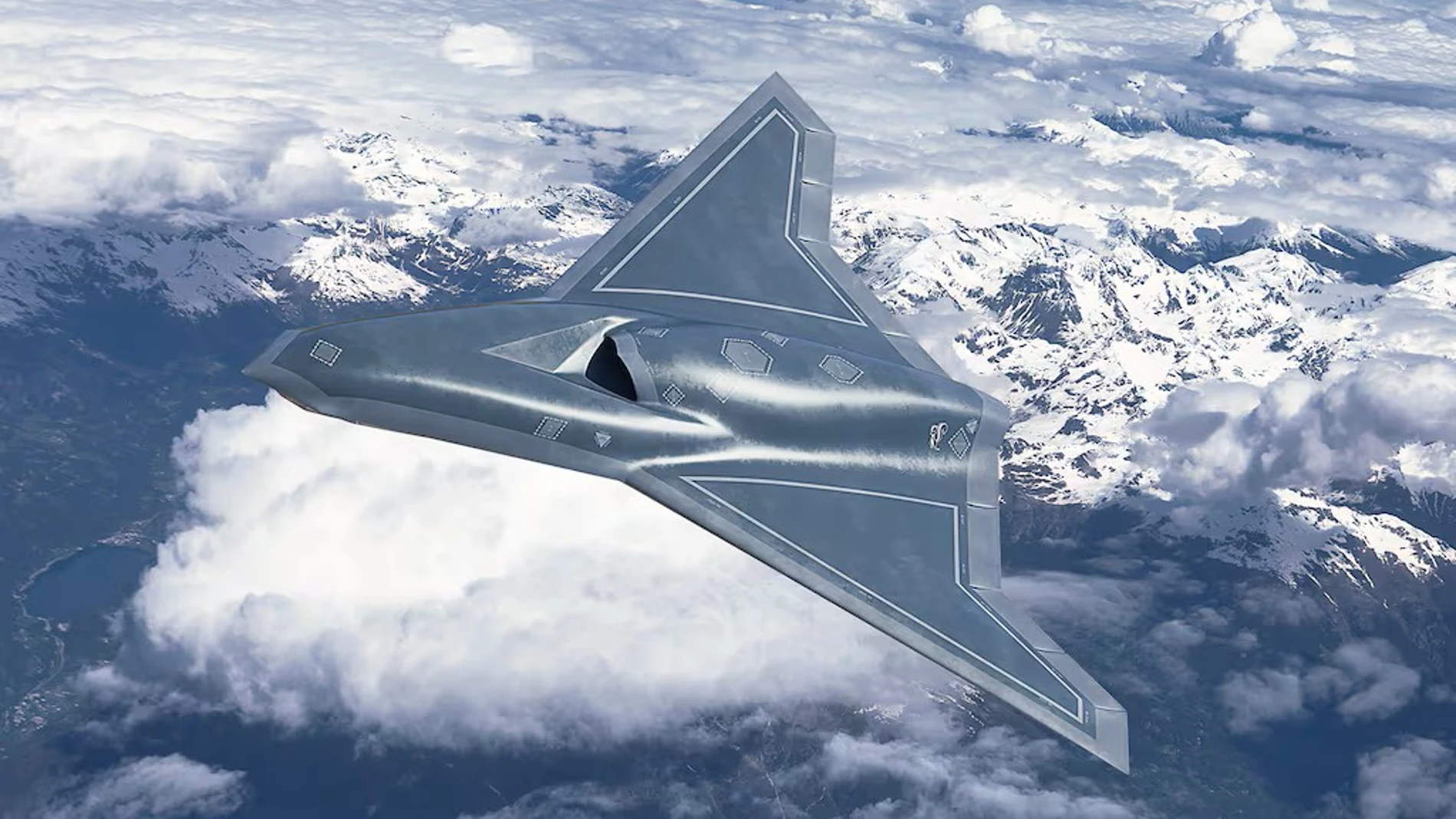
The American company Lockheed Martin has decided to accelerate the development of Vectis even before its first prototype has taken off. The division Skunk Works announced on September 14 that it will manufacture four more devices, raising to five the fleet planned to carry out tests with this unmanned combat aircraftDefenseNews reports. The first maintains the objective of making its inaugural flight before the end of 2027.
Vectis belongs to a new category known as CCAacronym for Collaborative Combat Aircraft or collaborative combat aircraft. It is about unmanned aircraft with a high degree of autonomy designed to operate alongside manned fightersbut without forcing the pilot to operate them as if they were remote-controlled drones. The idea is that they can receive a mission and take care of tasks such as fly to a given position, search for threats, attack assigned targets, or coordinate with other aircraft.
Lockheed Martin is developing the project with its own funds and has not announced any clients or contracts for now. For the first phase of the CCA program of the Air Force American were selected YFQ-42A of General Atomics and YFQ-44A of Andurilwhich already carry out flight and weapons tests and They will accompany both fifth and sixth generation fighters. Vectis could compete for subsequent contracts, although Lockheed has not officially confirmed its participation in the second phase.
The defense company has designed Vectis expressly thinking about fifth generation fighters like the F-35 that also producesalthough it ensures that it can be integrated with future platforms. The device measures approximately 10.4 meters in length and has 11.6 meters wingspan, dimensions that bring it closer to a compact combat aircraft than to the usual tactical drones.
Its design is highly conditioned by the need to make it difficult to detect by radar. Vectis lacks a vertical tail, will use an internal bay to carry weapons, and has its engine air intake recessed into the top of the fuselage. This last solution partially hides the front of the engine, an area that can produce significant radar reflections, and carrying the missiles inside the aircraft avoids additional reflections generated by external weapons and supports.
To reduce risks and accelerate the program, Lockheed has turned to an existing engine. Vectis will be powered by a turbofan manufactured by Williams International, FJ44-4of more than 16kN of thrust and will be subsonic.
With the Vectis, the company is committed to combine autonomy, low observability, the ability to transport weapons and a radius of action that allows it to be used in scenarios as extensive as the Indo-Pacificalthough it has not yet revealed a specific reach figure.
Its main use will be when several units work around an F-35. One Vectis can move forward to locate threats, another can carry additional missiles, and another can perform electronic warfare tasks while the fighter remains at a greater distance from enemy defenses.. Lockheed also contemplates precision strike, reconnaissance, target acquisition and air-to-air combat missionswhich will allow functions that currently fall on much more expensive manned platforms to be distributed among several aircraft.
That is why the construction of five units is an important step for the project. A single prototype allows you to demonstrate that the plane flies, while a small fleet opens the door to test how several Vectis coordinate with each other, share information and work together with manned fighters. Before we get to that point, however, Skunk Works still has to get the first Vectis into flight in 2027.