
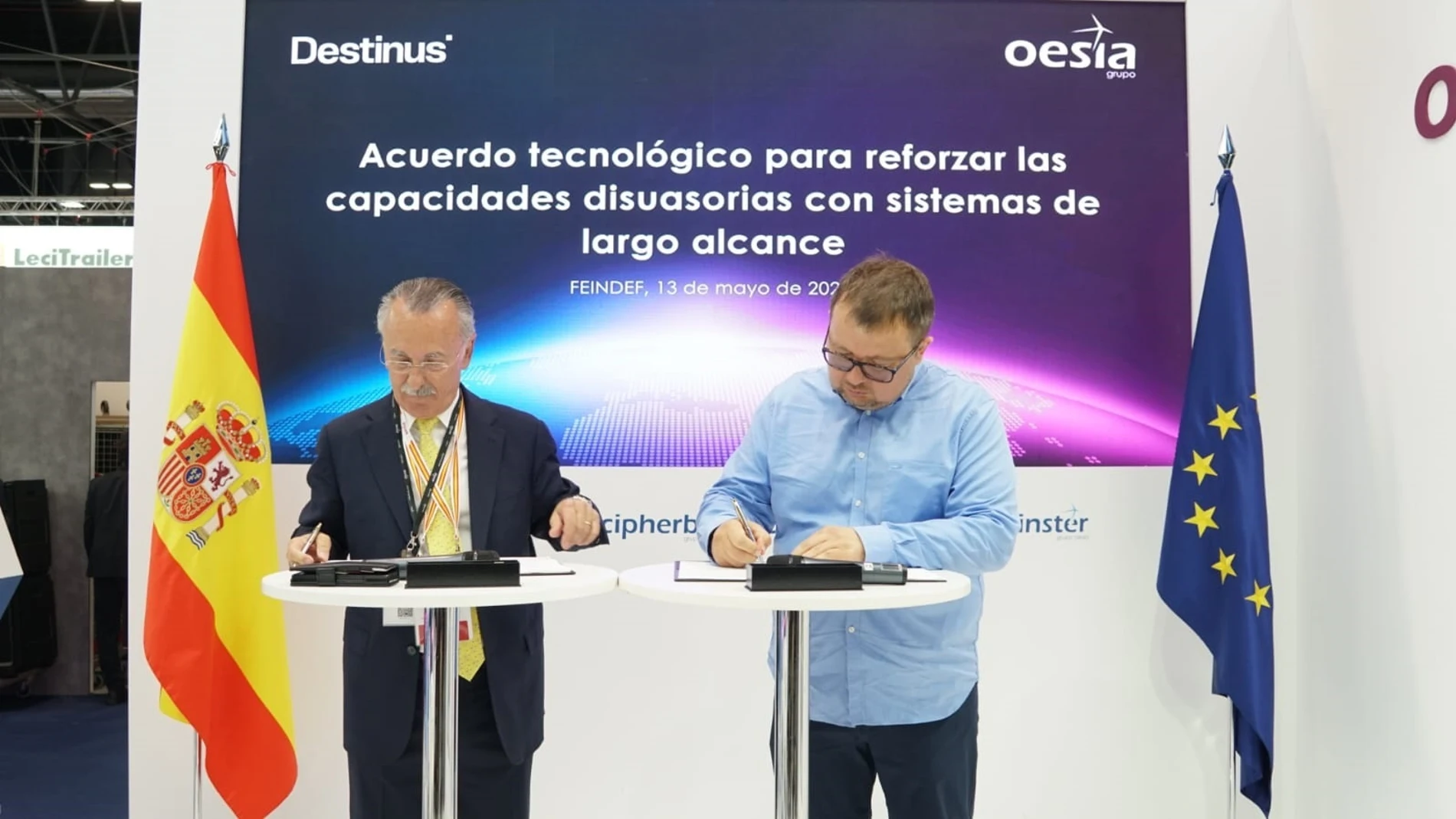
In mid-April, news shook and put the defense industrial fabric on alert: Russia pointed out a Spanish company, UAV Navigation, from the Oesía group, as a “potential target.”
The official announcement was made by Dimitri Medvedev, vice president of the country’s Security Council, which raised the seriousness of the matter one or two notches.
Although the Kremlin’s real target is an engineer who is opposed to Vladimir Putin’s regime and who has important ties to the Spanish company: Mikhail Kokorich, owner of Destinus.
At a time when the US and Israeli invasion of Iran dominates the news and analysis, bombs continue to fall in Eastern Europe, people die and drones fly over. It is the latter that led Russia to threaten one of the most serious companies in the Spanish military fabric. But the germ of the warning – the threat could be transferred to the cyber plane but not to the physical plane – is within the borders of Vladimir Putin.
One of Oesía’s main partners is Destinus, an aerospace company that in recent years has turned towards the manufacture of unmanned aircraft. The Spanish company manufactures its guidance systems in one of its star products, the “Ruta” long-range missile, which in recent years has been acquired by the Ukrainian Armed Forces to repel Russian attacks in the Dombáss area.
The most representative project of this alliance is the development of long-range attack systems, including the aforementioned missile. It is a new generation drone designed to operate in modern war scenarios, characterized by the need for precision, autonomy and penetration capacity in complex defensive systems.
In this scheme, Destinus provides the aerial platform – including design, propulsion and system architecture – while Grupo Oesía is in charge of critical elements such as navigation, guidance and on-board electronic systems.
This distribution of functions is significant. Contemporary warfare relies less and less on raw hardware and more on system intelligence: sensors, encrypted communications, the ability to operate without GPS, or resistance to jamming. That’s where Oesía comes in, whose specialization in electronic technologies allows it to integrate into highly complex projects as a strategic partner, not just as a supplier. In a context marked by historical dependence on the United States, initiatives such as Destinus and Oesía seek to reinforce European strategic autonomy, especially in areas such as long-range drones or hypersonic technology.
The Destinus offices in Madrid are in Tres Cantos. But sources from the sector point out that the strong part is in the Marconi industrial estate, in Villaverde. «They have a very powerful ship, about 400 people work. Every day it makes dozens of drones that have Ukraine as a buyer, which is why Russia now points to Oesía, because they use the navigation software,” he summarizes. The company is also “growing very quickly.” In recent months it has reached agreements in Spain with Expal, the subsidiary of the German Rheinmetall.
Controversial profile
Businessman Mikhail Kokorich (1976, Siberia) embodies one of the most unique – and controversial – trajectories of the global technological ecosystem: that of an entrepreneur trained in post-Soviet Russia who has traveled through the United States and Europe between geopolitical tensions, regulatory conflicts and a progressive reconversion towards the military and defense industry.
Trained as a physicist at Novosibirsk State University, he began his business career in the 1990s, in the midst of the country’s economic transition. The jump to the aerospace industry came with Dauria Aerospace and, later, with projects in the United States such as Momentus, specialized in orbital transportation. That’s where the problems with the Russian motherland began. In 2021, in the midst of escalation between Washington and Moscow, the North American Department of Defense perceived it as a threat to national security. He was expelled from the military project – despite being one of the most brilliant specialists in the sector – and was prevented from accessing certain technology that he himself had developed.
That episode marked a turning point. Kokorich left the United States and reoriented his activity towards Europe, in parallel to a growing political rupture with Russia. After publicly condemning the invasion of Ukraine, in 2024 he announced the renunciation of his Russian nationality, a gesture with a strong symbolic meaning that places him within the technological diaspora opposed to the Kremlin. A step that “sentenced” him to be in the crosshairs of Putin’s Government.
In this context, Destinus was born, founded in 2021, becoming its main project and the seed of Russian threats to the Spanish defense industry, since our country occupies a relevant place in its business strategy.