
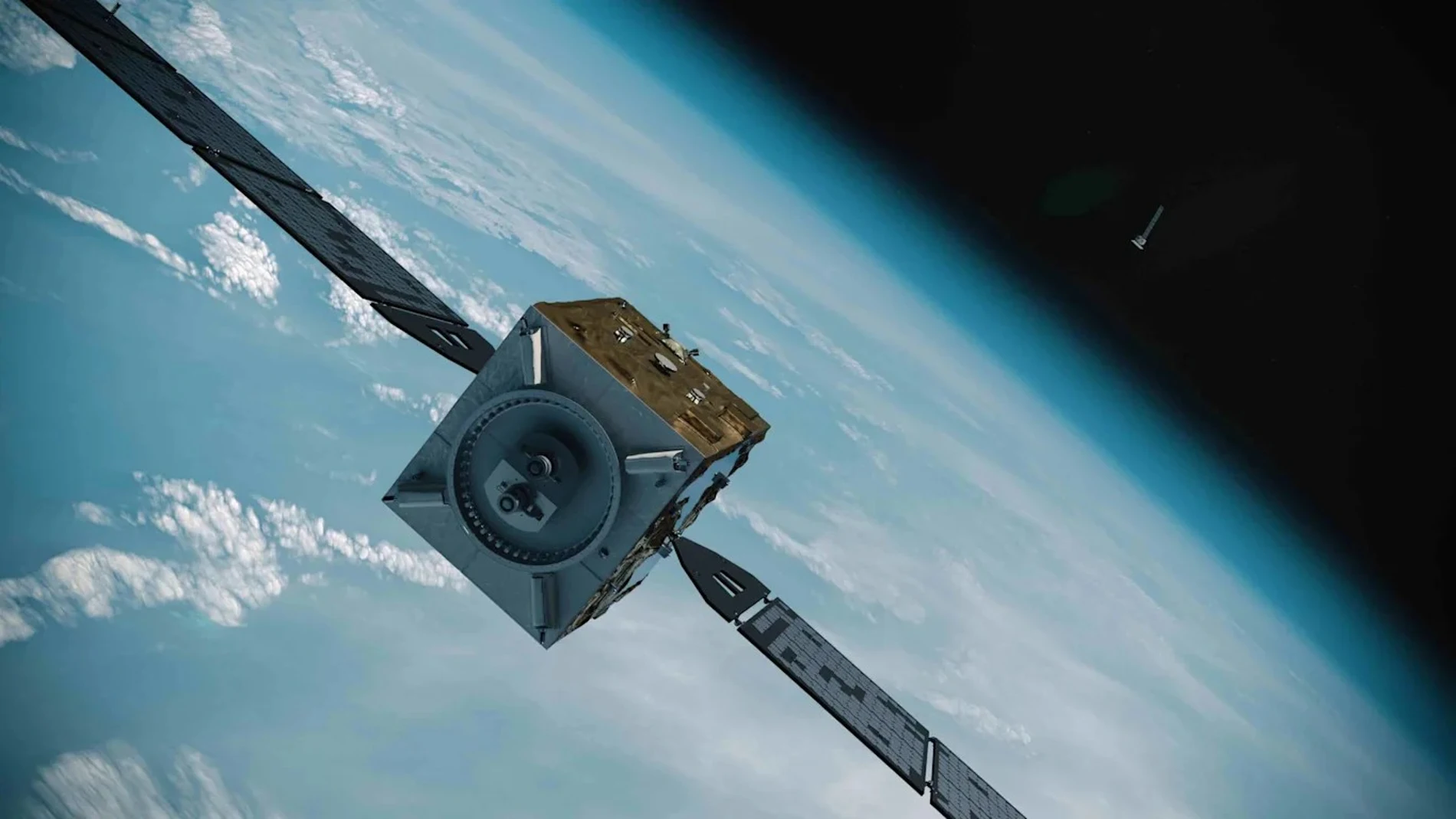
Astroscalea Japanese orbital cleaning company, has revealed which satellites will be the target of the unmanned mission ISSA-J1 and how he will carry it out. ISSA-J1, scheduled for launch in 2027aims to inspect two retired Japanese satellites in two different orbits. It will be the first time in the world that a private company does something like this, which constitutes a ‘major step forward for commercial in-orbit inspection and space situational awareness capabilities’.
As the economy in space grows, the number of satellites also increases and those that are out of service, as well as space debris, accumulate. The POT cataloged in 2025 around 30,000 objects in orbit, of which about half are satellites, both active and inactive, and the rest are rocket stages, fragments and other debris. Preventing Earth’s orbit from becoming excessively congested is crucial to the safety of future space operations.
ISSA-J1 hopes to demonstrate Astroscale’s ability to approach multiple customers in different orbits within a single mission, using a single spacecraft.
This won’t be Astroscale’s first launch. In 2024, the company successfully realized ADRAS-J, the world’s first commercial mission to approach and encounter space debris. The company aims to offer low-cost meeting and exorbitant operations.
‘In-orbit inspection provides critical information on satellite health that cannot be obtained from the ground. By inspecting multiple objects in different orbits in a single mission, ISSA-J1 will help demonstrate new capabilities that support satellite operators in understanding the health of spacecraft and preparing for future services,’ he explains in a statement. Nobu OkadaCEO of Astroscale Japan.
ISSA-J1 is being developed within the framework of the Small Business Innovation Research Program from Japan. The mission will inspect two retired Japanese satellites, ALOS and ADEOS IIto analyze its orientation, its rotation movement and its signs of degradation. Both satellites were launched into orbit in the early 2000s.
If everything goes as planned, ISSA-J1 will be launched next year. Once in space, the mission ship will be deployed to undergo initial systems and communications checks. Shortly after, it will begin operations in orbit.
Once operational, the ISSA-J1 spacecraft will adjust its orbit and approach ALOS. You will first observe the satellite from a distance, before gradually reducing the distance and taking images at close range. The spacecraft will then gradually transition to a different orbit through a series of trajectory adjustments and repeat the same maneuver with ADEOS II.
The ISSA-J1 mission will perform ‘close-range observations of multiple objects, closer than traditional monitoring methodsdemonstrating new possibilities for in-orbit inspection services. This capability promotes safer and more efficient satellite operations throughout the entire mission life cycle, from response to anomalies to preparation for future services‘, explains Astroscale in its statement.
On the other hand, the company also aims to demonstrate orbital refueling in the near future. This capability is essential for the future of space travel, as it will allow satellite missions to be extended, as well as deep space travel. As part of a mission planned for this summer, Astroscale will carry out the first-ever orbital refueling of hydrazine on US Space Force satellites in geostationary orbit.