
To build an increasingly powerful conventional computer, in principle, it is enough to manufacture processors with more transistors and connect them through an appropriate infrastructure. In the quantum world, however, the recipe is much more complicated. Qubits, the fundamental units of these computers, are extremely sensitive to their environment and superconducting processors need to operate at temperatures close to absolute zero. Therefore, for a quantum computer to grow, the enormous “refrigerator” that keeps it cold also has to grow.
IBM has just taken a step in that direction. The company has managed to connect and put into operation its first two cryogenic modules together, forming a single ultracold environment. The systems have reached temperatures below 15 millikelvin, that is, 0.015 degrees above absolute zero. It is more than 180 times colder than deep space.
The temperature is difficult to imagine. Absolute zero, 273.15 degrees Celsius below zero, is the theoretical lower limit of temperature. IBM’s systems have to come close to it because their quantum computers use superconducting qubits. At such low temperatures, certain materials can conduct electricity without resistance and circuits can maintain the quantum states necessary to perform calculations. In addition, extreme cold reduces thermal noise that could disturb these states.
Until now, quantum processors of this type have typically been installed inside large cylindrical cryostats: isolated chambers containing cooling systems and numerous connections. This architecture has allowed the development of current quantum computers, but has a problem when trying to increase its size. Putting more and more qubits on a single chip generates difficulties with space, heat, connections and interference between them.
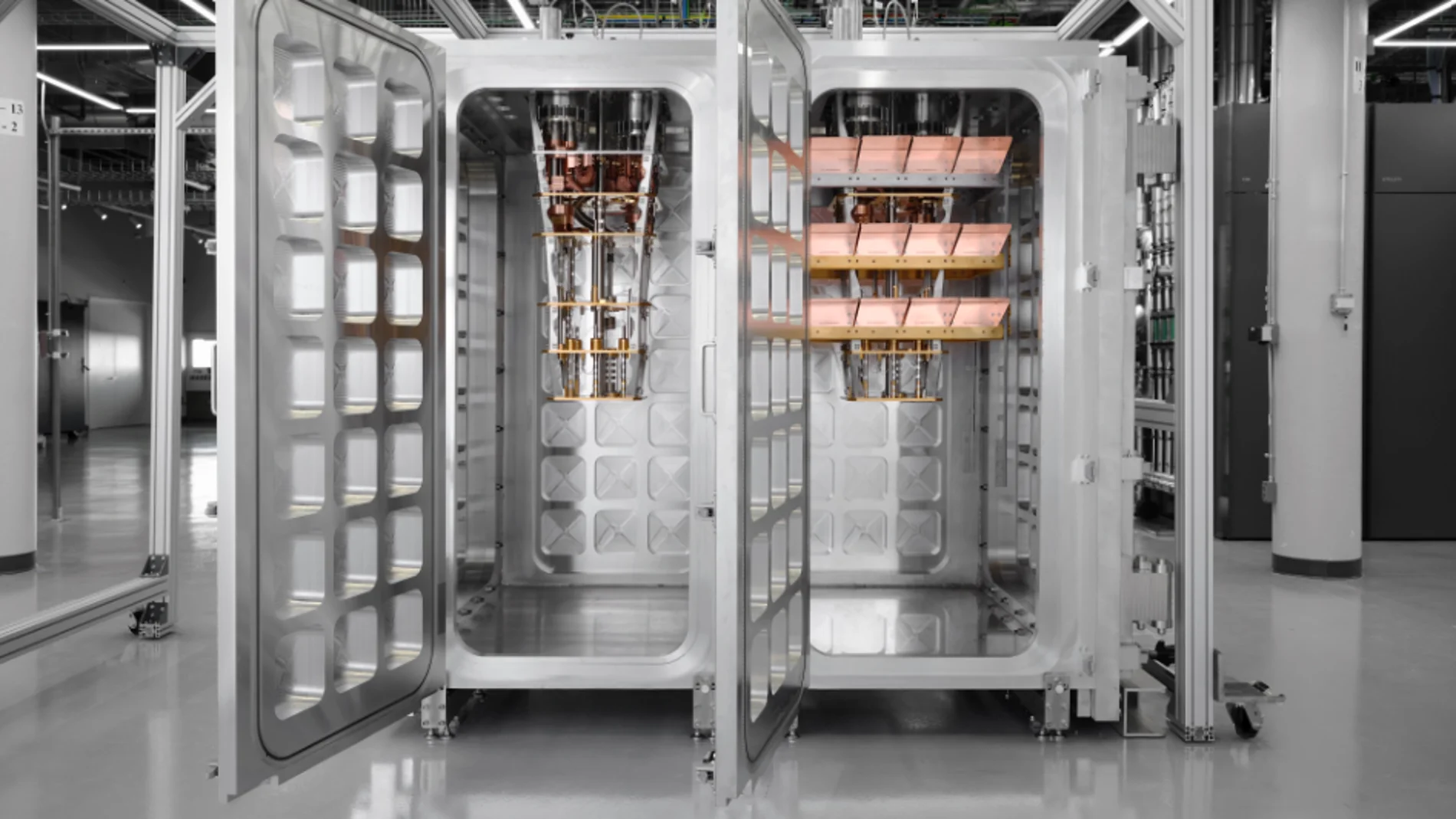
IBM’s alternative is to change the refrigerator itself. Instead of a single gigantic vessel, the company has designed free-standing, box-shaped cryogenic modules. Each constitutes a complete vacuum and cooling environment capable of housing a quantum processor. The advantage is that these boxes can be placed next to each other and connected by links that allow multiple processors to work together.
The architecture may seem simple, but keeping things cool when connecting two systems is a formidable engineering problem. Each module has its own vacuum chamber, cooling system and thermal shielding. When joined together, the connections between processors pass through a type of cryogenic tunnel protected by several layers of insulation. So, Information can pass from one processor to another without the heat from outside ruining the conditions necessary for quantum operation.
The two modules that IBM has just put to work Together they measure, combined, more than 2.4 meters high and wide. Each is about three times the size of a conventional household refrigerator, but its interior is designed for something much more delicate than preserving food: it offers space for the connections and components necessary to control a quantum processor. In fact, Each module provides up to 12 times more wiring space than some of the most widely used IBM quantum systems today.
The reason for building such an infrastructure is that the future of quantum computing probably does not involve making a single gigantic chip, but rather connecting several processors. IBM aims to use its modular cryogenic systems so that different chips can share information and function as a larger quantum machine. By 2027, its roadmap contemplates connecting several processors using so-called L-couplers to reach at least 1,000 programmable qubits. Later, each module could hold thousands of qubits.
This is especially important to achieve so-called fault-tolerant quantum computing. Qubits are extraordinarily fragile: any disturbance can introduce errors into calculations. To build a machine capable of To execute complex operations reliably it will be necessary to use error correction techniques and distribute quantum information among many physical components.
IBM intends for all this architecture to lead to Starling, the fault-tolerant quantum computer that the company plans for 2029. The new cryogenic infrastructure is, therefore, not the computer of the future, but one of the pieces necessary to build it. The company has now managed to demonstrate that Two of these “refrigerators” can work together and simultaneously maintain the necessary extreme conditions. The next step will be to install new processors in them and check how they behave when the number of connections and qubits increases.
Building a quantum computer capable of solving problems that conventional machines cannot address requires much more than inventing better qubits. There is also a need for infrastructure that keeps them isolated from the world and, at the same time, allows them to work together. In the race toward large-scale quantum computing, refrigerators are also part of the computer.