
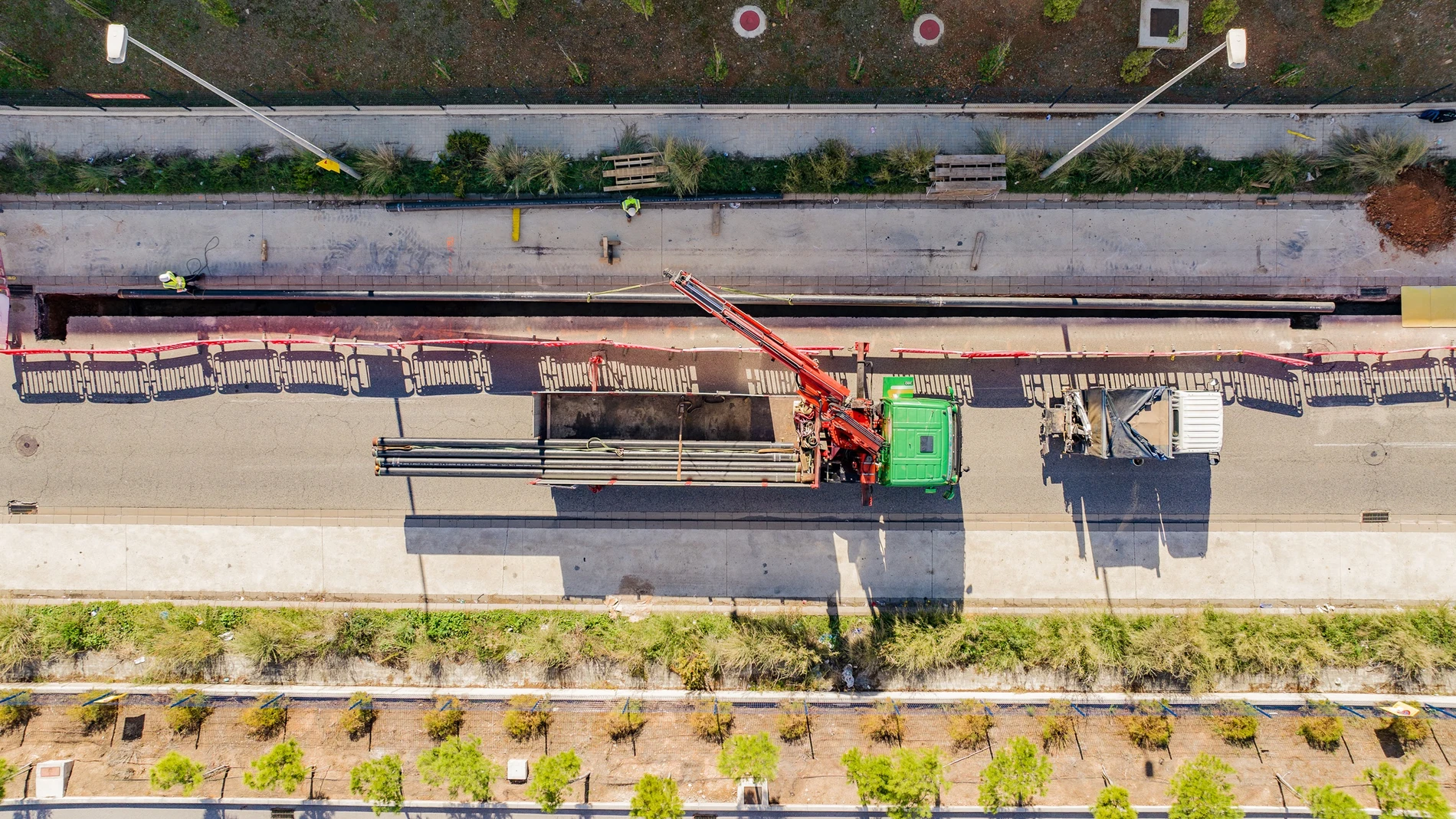
Renewable gas or “green gas” is obtained from the treatment of urban, agricultural, livestock and agri-food industry waste, as well as from wastewater treatment. They are gases from renewable sources, which is why they are characterized by not generating carbon emissions. Hence, its development is key to decarbonization. The two main renewable gases are biomethane, which is produced from organic wasteand green hydrogen, which is generated from renewable electricity and water.
The first is emerging as one of the great keys to reducing emissions, since, having qualities similar to natural gas, it can be distributed without facing costs through the existing gas infrastructure and used in homes, industries, businesses and also for transport mobility. Therefore, Green gas is the energy that best responds to the energy trilemma: it is economically and socially sustainable, contributes to security of supply and allows CO2 emissions to be reduced now and with an indigenous source.
Currently, Naturgy has four biomethane production projects in operation with an installed capacity of 6.6 MW: the Elena plant, in Cerdanyola del Vallès (Barcelona), the first to inject renewable gas from landfills into the distribution network; the plant located in the Bens WWTP, in A Coruña; the Vila-sana plant, in Lleida, installed on the Porgaporcs livestock farm; and the Utiel plant, in Valencia, which came into operation in 2026. In addition, the company has established partnerships with Hispania Silva, Bioeco Energías and ID Energy to develop new biomethane plants throughout Spain until 2030.
Nedgia, Naturgy’s gas distributor, plays a key role in the deployment of renewable gases thanks to a network of more than 60,000 kilometers that can immediately bring green gas to 5.5 million consumers. The company has signed 98 biomethane injection contracts, with a planned capacity of 5.8 TWh per year. In 2025, its networks distributed more than 170 GWh of biomethane, equivalent to the consumption of more than 33,000 homes, avoiding the emission of more than 34,000 tons of CO2.
Biomethane in Spain
The development of biomethane in our country requires integrating environmental rigor, regulatory security and adequate territorial planning to ensure sustainable deployment and an effective contribution to the energy transition. This is the conclusion of the report “The main environmental variables in biomethane plants in Spain”, prepared by INERCO and presented by the Naturgy Foundation.
The study highlights that the growth of this technology must be approached from a comprehensive vision, where the sustainable management of organic waste, environmental protection and territorial planning are fully aligned. Faced with the growing interest in biomethane, It is essential that projects are designed taking into account the characteristics of the environmentthe real availability of raw materials and compatibility with other uses of the territory.
One of the key aspects is the existence of a clear, stable and coherent regulatory frameworkwhich provides legal certainty to both promoters and administrations and allows the deployment of facilities to be accelerated.
In this sense, it is worth noting that Spain is the third European country with the greatest potential of biomethane production. According to sector estimates, the potential reaches 163 TWh per year, a figure equivalent to 40% of the national demand for natural gas. This volume would allow 100% of domestic consumption and 62% of industrial consumption to be decarbonized, in addition to avoiding the emission of 8.3 million tons of methane from the decomposition of waste.
The economic and social impact is also especially relevant. Taking advantage of all its potential would allow generating more than 20,000 direct and 40,000 indirect jobsin addition to thousands of jobs associated with its construction. Likewise, it promotes a new circular economy based on the valorization of livestock and agricultural waste, facilitating its management and generating organic fertilizers. In this way, it also contributes to solving the demographic challenge.
All against the backdrop of National Integrated Energy and Climate Plan (PNIEC)which has doubled the renewable gas production target to 20 TWh per year in 2030, and the European plan, which sets a proportional target of 35 TWh for Spain. This confirms the strategic role that green gases will play in the energy transition and reinforces the opportunity for Spain to become a European benchmark.