
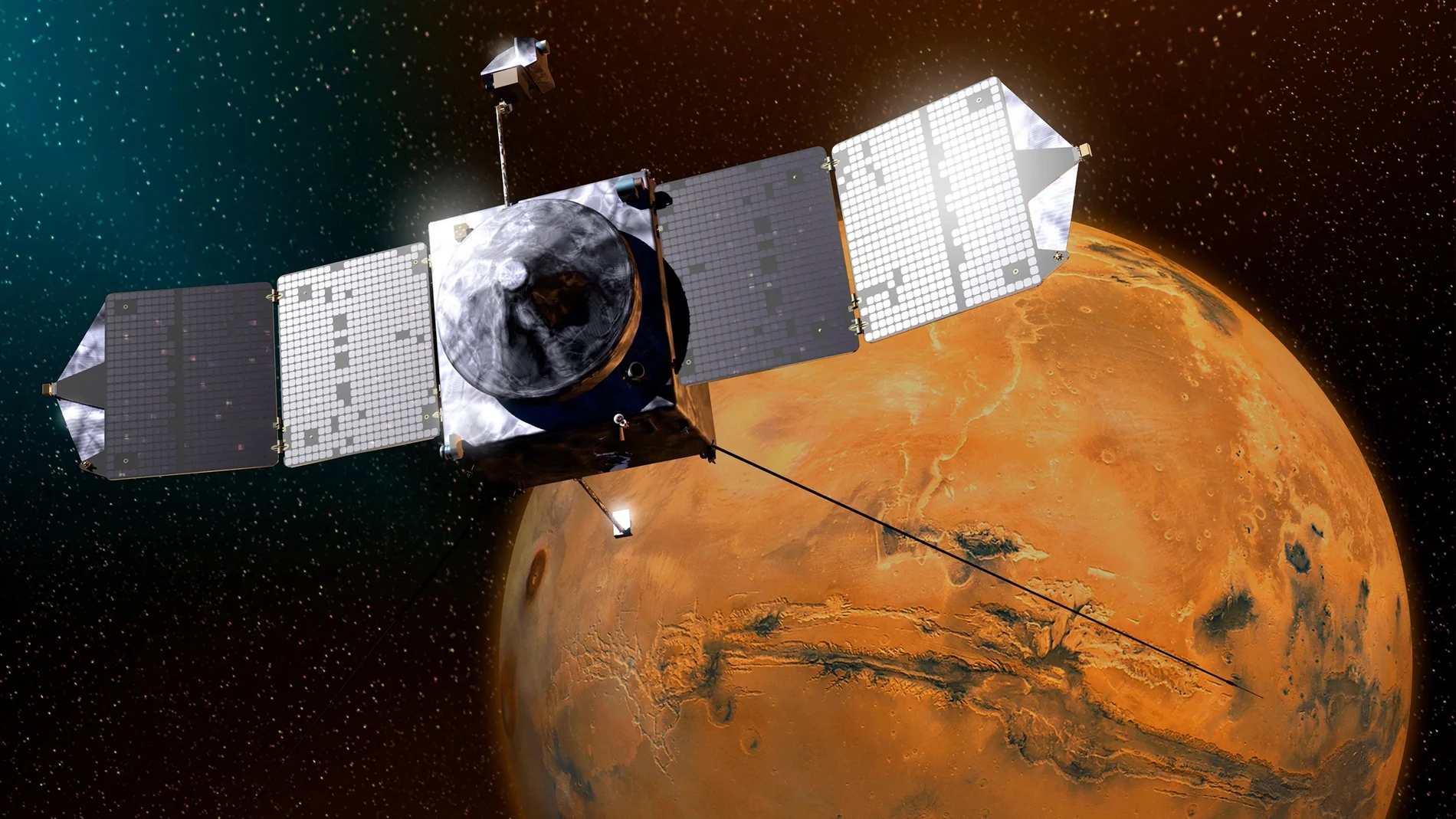
After 11 years studying Mars from its orbit, the space probe MAVEN is officially dead. NASA has spent the last few months trying to establish contact with it, but this Wednesday it announced that it is in an ‘unrecoverable state’ and has terminated its mission.
The last transmission of Mars Atmosphere and Volatile Evolutionor Evolution of the Atmosphere and Volatiles of Mars, was received on December 6 by the Deep Space NetworkDSN, NASA, before the orbit of the spacecraft, powered by solar energy, will take her behind Mars.
When it reappeared on the other side, a brief fragment of telemetry picked up by the DSN receivers indicated that MAVEN was in safe mode and spinning uncontrollablywhich pointed to an alteration of its orbital trajectory. According to NASA, that rotation caused the batteries to drainleaving the communications system without power and the ship in an unrecoverable state.
Attempts made since then to contact MAVEN have been unsuccessful, the agency explains in a statement. The cause of the incident suffered by the satellite on the far side of Mars remains under investigation.
The ‘best Martian mission in history’
The announcement of the end of MAVEN brings to a close more than a decade of science and research. MAVEN was launched in November 2013 by rocket Atlas V of United Launch Alliance and reached Mars orbit ten months later.
In a press conference this Wednesday, Shannon Curryprincipal investigator of MAVEN, described the probe as the ‘best Martian mission in history’. Mike Moreaudirector of the MAVEN project, praised the team and stated that its members ‘they really experienced the loss of a loved one with the end of the mission’.
‘The team was, of course, very affected by this, but at the same time we are incredibly proud of the science we have accomplished over the last decade,’ Curry said, calling MAVEN a ‘the best observer of atmospheric escape anywhere in the solar system’.
The MAVEN anomaly investigation panel concluded that the probe likely lost power within hours of the December incident, ‘which caused the communications system to eventually lose power and left the ship in an unrecoverable state’Moreau explained. He added that ‘the anomaly investigation commission continues working to determine the root cause of the failure.’
The orbiter’s original mission was scheduled to last only one year, but was extended for another ten in which the ship continued to operate normally. The loss of MAVEN leaves only two NASA probes operational in Mars orbit, the Mars Odysseyreleased in 2001, and the Mars Reconnaissance OrbiterMRO, which took off in 2005. Both continue to operate well beyond the originally planned duration of their missions.
MAVEN was also one of the five spacecraft that NASA used as a communications repeater for rovers located on the Martian surface. The other four, which are still active, are Odyssey, MRO and the European ships Mars Express and Trace Gas Orbiter.
MAVEN was the first probe equipped with instruments to study the evolution of the atmosphere of Mars and its interaction with the solar wind. Among its main contributions, it allowed us to directly observe how Mars has been losing part of its atmosphere to space, detected several types of Martian auroras and measured for the first time on another planet the so-called ‘sputtering’ or atmospheric spraying, a process by which particles from the solar wind hit the atmosphere and expel molecules into space. During the mission, his scientific team produced more than 800 publicationsaccording to NASA.
‘The data collected by MAVEN will continue to provide valuable information about Mars for decades‘, said Louise Prockterdirector of NASA’s Planetary Science Division, in the agency’s announcement.