
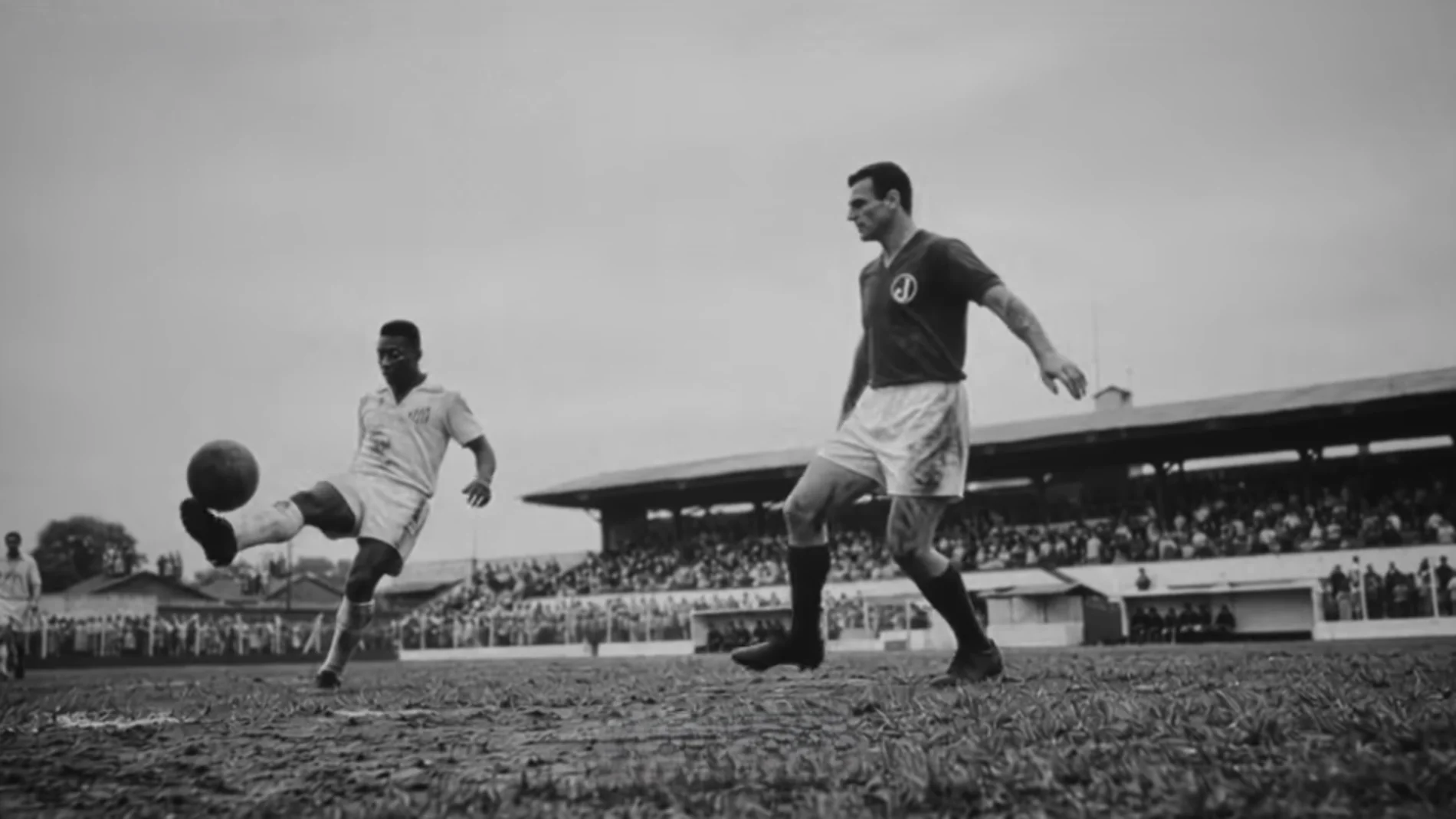
In the final stretch of the World Cup that concludes this Sunday with the confrontation between Spain and Argentina, Google Deepmind He has given joy to football fans by publishing a video with the recreation of one of the most legendary plays of this sport, starring Pelé. The AI division of Google has turned to its most advanced models to reconstruct what the Brazilian footballer considered the best goal of his career. The play took place on August 2, 1959, but was not filmed and for more than six decades It was only preserved through a photographthe chronicles of the time and the memories of those who were in the stadium.
Pelé was then 18 years old and had already won with Brazil the 1958 World Cup. He played with Saints a match of Paulista Championship in front of Juventus Sao Paulo in the stadium Javari Street. His team won by 4-0 and the forward scored three of the goals.
In the 42nd minute of the second half, Pelé He first raised the ball over a defender’s head. Without letting it touch the ground, He raised him again over a second rival. Then he saw the doorman come out to meet him, He also passed the ball over him and he finished calmly with a header into an empty goal.. Pelé thus made three hat-tricks in a row and beat three opposing players without the ball touching the grass before the goal.
The match was held at a time when television broadcasts were rare and many matches were not even recorded. Pelé regretted for years that there were no images of that action, especially because it placed it above the more than a thousand goals attributed to him during his career.
That Pelé said that is no small thing. The Brazilian was the first great world star of modern football and continues to be the only player to have won three World Cupsthose of 1958, 1962 and 1970. Many of his best performances, however, occurred before the cameras regularly accompanied the great footballers.
This is how Google recreated Pelé’s best move with AI
Google approached recreation as a historical investigation. A team gathered about 2,000 documentsincluding stadium plans, newspapers, maps and family albums, as well as more than 3,600 images. He also interviewed witnesses, journalists, historians and residents of the Mooca neighborhood. A model of the field, photographs and diagrams They served to reconstruct the position and movements of the players.
The company He later recorded soccer players reproducing the play on the grass of Rua Javari with heavy leather balls and uniforms typical of the fifties. I see 3 extracted the three-dimensional geometry and the movements of the actors using a technique called Performance Control.
Gemini Omni and Nano Banana Pro They allowed them to replace the specialist with the image of Pelé, recreate his shirt with the number 10 and transform the current stadium to return it to its 1959 appearance. The players and the stage were separated into independent layers so that they could be modified without altering the original movement.
The post-production combined traditional visual effects with AI tools to integrate the ball, balance the color and unify the texture of the images. The digital result was then transferred to film using a filmout machine to give it the look of 1950s cinema. The result is the most documented and faithful reconstruction yet of one of Pelé’s most legendary plays.