
Spain has broken the historical record of tourists. In 2024, we will receive 94 million foreign visitors. Most of it was concentrated in the summer months, when the dog days are a slow guillotine and tourists multiply along the Mediterranean coast. It’s no secret that water is the great challenge of tourism in our country; which is why it is time to roll up your sleeves in the very heart of destiny.
That was one of the lessons learned in FiturNext –the Sustainability Observatory of FITUR, the Madrid International Tourism Fair–, which this year has launched its sixth edition in collaboration with Aqualiaa reference in the comprehensive management of the water cycle. «Aqualia serves 45 million people in more than 2,300 municipalities in 18 countries. Many of these towns have a first-class tourism sector,” Lucas Díaz, director of Aqualia Spain, declared for La Razón at the inauguration of the stand on Wednesday.
«From Galicia to Andalusia, from Extremadura to Catalonia and, of course, in the Canary and Balearic archipelagos, tourism plays a fundamental role in the economy and directly affects the way we should manage water“, revealed. Furthermore, he stressed that “the water management and tourism sectors have the responsibility of working with the utmost respect for the environment where they operate. In this scenario, innovation, efficient management and digitalization will play a key role.
Precisely, a highlight of the event took place yesterday, during the round table “Opportunities for the circular economy in the management of the water cycle”, in which the main challenges of the sector were detected. «The tourist does not have a consumption like that of the average citizen, therefore, we have to multiply the citizen’s usual consumption by five to meet the demand,” said Víctor Monsalvo, head of the eco-efficiency area in Aqualia’s Innovation Department.
«Tourism has increased 10% annually. If that means increase water resources by 10%the situation requires expanding the ways in which we obtain it,” stated the expert, who sees the development of desalination and wastewater regeneration They are the “great opportunity to ensure the sustainability of the water cycle.” Both are “unconventional resources that have become a strategic source of water, especially in areas – inland and coastal – where tourism is increasing and, at the same time, scarcity.
Monsalvo stated that through the “recycling” of water they achieve “a more stable supply of purified water for agricultural and industrial use and for irrigation of parks and gardens, covering the direct and indirect consumption of tourism.” But with water regeneration other valuable resources are also obtained, such as biogas which is generated through the biological processes that occur in the treatment plants themselves or the common salt that Aqualia produces from the seawater it purifies.
«There is still work to be done so that these products are accepted by the end consumer. There we have a nice challenge ahead of us and the acceptance of solutions by public entities “It is essential.” Without them, he said, innovations would remain in a drawer and we would not see them come true.
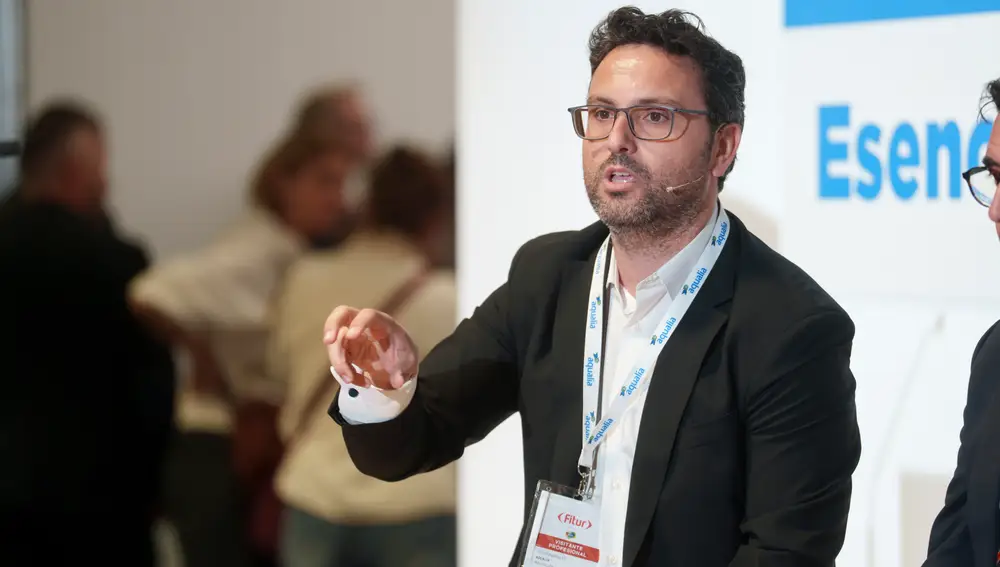
An example of efforts to combine efficient water management and an increasing influx of tourists is Écija, in Seville. Its mayor, Silvia Heredia, told the auditorium that, in alliance with Aqualia and the local irrigation community, they have taken advantage 1.5 million hectometers of regenerated water for irrigation. “Thanks to this, dryland crops have become intensive, tripling their profitability,” he celebrated.
He was accompanied on the panel by José Juan Franco, mayor of La Línea de la Concepción (Cádiz), who reported on the 8 million euro project for the implementation of the reuse of water from the treatment plant for the tertiary sector. «It is being given a second life to water for the irrigation of tourist resources very important in the area, such as golf courses, and it is expected to expand their use to other areas,” he said.
From the private sector, José Manuel Alcántara, general director of Arcgisa, the Water and Waste company from Campo de Gibraltar, intervened, “an area that has been in an exceptional drought situation since 2021.” There they have an industrial hub that consumes 35% of the water and a very demanding tourism sector. His company’s solution lies in water regeneration, which has allowed the local industry save 60% of resources in the last 10 years: “Without it, the industry would not be viable.”
Ignacio Gragera, mayor of Badajoz, also participated, who stated that «Public-private collaboration is the model to maintainsince it allows municipalities to carry out projects to make water use more efficient.
Furthermore, Monsalvo pointed out that «a favorable regulatory framework is needed to activate this type of circular economy projects”, in the face of a Waste Law that is not as favorable as we expected. It will also be necessary to “generate a value chain and logistics” and face challenges such as “reducing the carbon footprint in our activities.”