
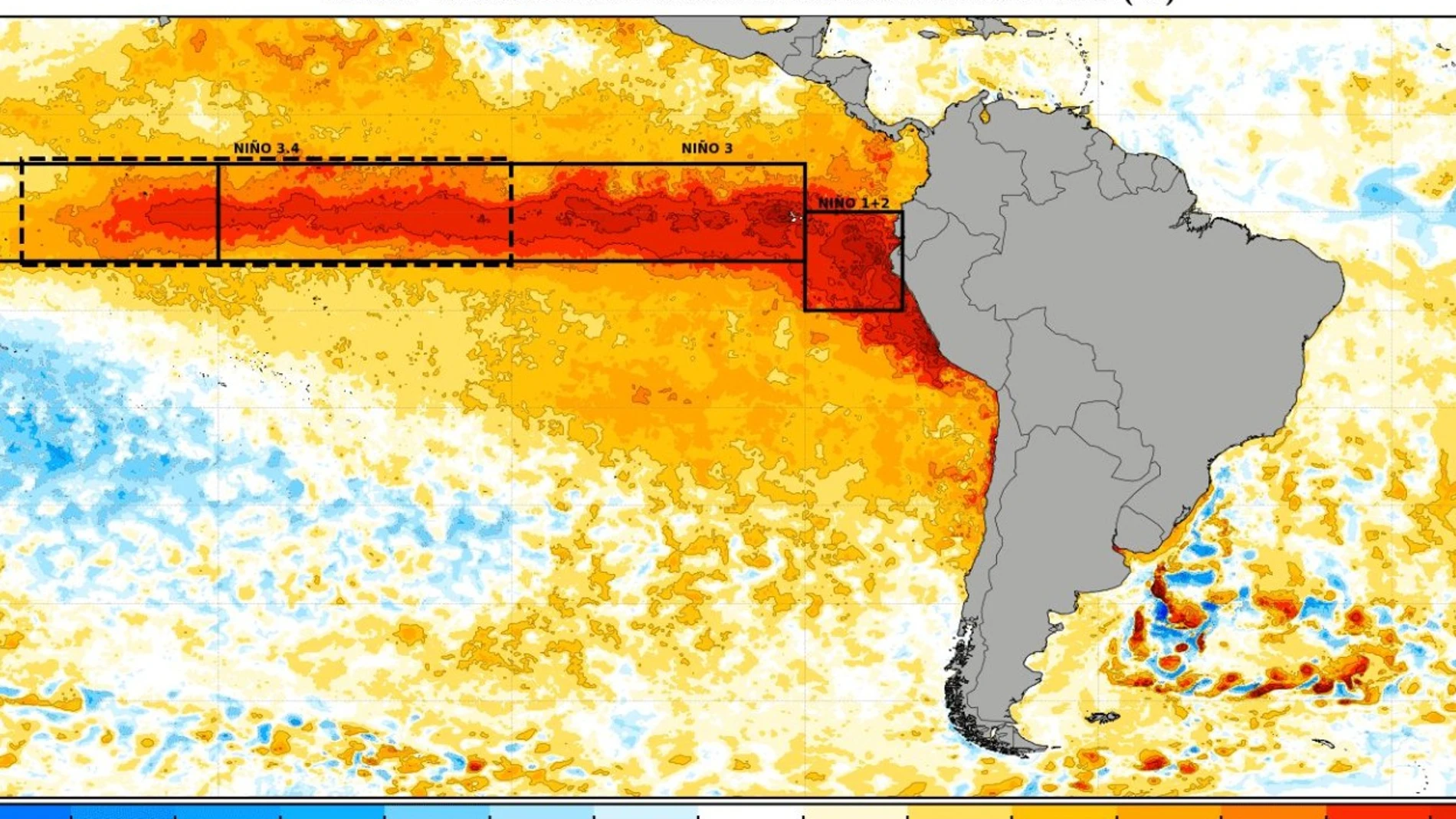
China has raised the alert regarding the evolution of El Niño, that could reach a “extreme” intensity. The phenomenon has rapidly strengthened and, according to the latest models from the National Center for Marine Environment Forecasting, It already presents a higher intensity than that recorded at this point in the extreme episodes of 1997-1998 and 2015-2016.
Forecasts suggest that the temperatures of the waters of the central and eastern equatorial Pacific, which have remained abnormally warm since spring, could reach a maximum close to 3.5 degrees above usual values. This is a higher estimate than the one made by Chinese experts last June, according to Efe.
El Niño officially entered this phase in May and has since quickly strengthened. Tan Jing, an engineer at the National Marine Environment Forecast Center, has warned of this situation, according to the Chinese state agency Xinhua.
The evolution observed by the Chinese authorities coincides with the forecasts of the US NOAAe, which estimates that there is a 69% probability that this El NIño will become the most intense since records exist.
((H2:More rain and risk of flooding)
The warning comes after a particularly difficult summer in China, marked by typhoons, torrential rains, floods and landslidesbecause they have left dozens dead and forced hundreds of thousands of people to be evacuated preventively.
China could experience major changes in its precipitation during the next few months. Tan Jing expects more rainfall in the north and northeast of the country during the summer and autumn, as well as in areas south of the country. Yangtze River Delta. On the other hand, the middle course of the river could see less rain.
The phenomenon would also have consequences on the marine ecosystems. An increase in temperatures is expected in the Bohai Sea, the Yellow Sea and certain areas of the East and South China Seas. This scenario increases the risk of marine heat waves, affecting aquaculture and aggravating coral bleaching.
Fewer, but potentially more intense typhoons
The evolution of El Niño can also modify the activity of typhoons in the northwest Pacific and the South China Sea. The models suggest that fewer cyclones could form, although those that do develop would tend to do so further east and south and could reach a greater intensity. This could translate into episodes of waves and storm surges with greater impact.
The effects of the phenomenon would not end this year. The forecasts cited by Xinhua even point to abnormally heavy rainfall possible in Yangtze basin during the summer of 2027with the consequent risk of complicating the management of floods.